

Don't Throw Out Plastic Nursery Pots — Use Them To Boost Your Houseplant's Airflow
We may receive a commission on purchases made from links.
When we think about the needs of our houseplants, like proper soil, water, and sunlight, we don't often consider airflow. Yet fresh air is as vital to indoor plants as it is to their garden-grown counterparts. Their roots use oxygen to facilitate vital functions, like extracting water and nutrients from the soil. Without sufficient oxygen, houseplant roots suffocate, and the above-ground plant parts will wilt, discolor, or die.
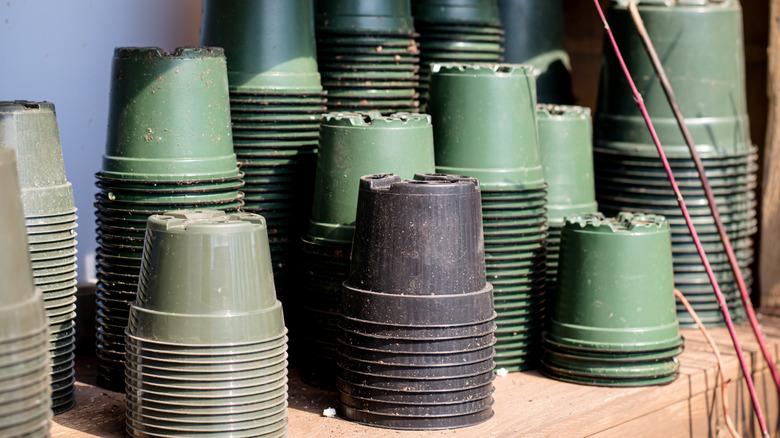
You can prevent this issue with a super-easy hack that also solves another problem — you'll reduce that enormous pile of plastic nursery pots you've amassed in your garden shed. You can make good use of these planters by cutting off their bases and inverting them in your houseplant containers. You're essentially creating a false-bottomed pot and adding an air chamber that aerates plant roots.
This is far more than just a creative way to reuse plastic nursery pots in your garden. By implementing this hack, you are practicing air pruning, a technique that encourages new roots to grow in after the original roots die from lack of moisture and humidity. Air pruning also stops plants from getting root bound, where their roots circle the base of the pot, reducing oxygen exposure. With lots of fresh roots, your houseplant has a much larger surface area from which to take up water and nutrients.
Cut the base off old plastic pots to create an air chamber in planters
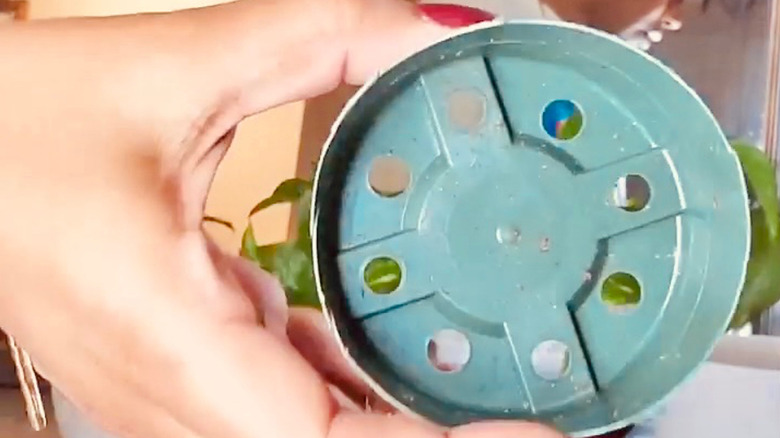
Creating a false bottom in planters could not be easier. Simply cut vertically down the side of a plastic nursery pot using shears or sharp scissors, stopping about an inch from the base. At that point, switch directions with your cutting tool, turning it horizontal. Cut around the bottom of the pot until it comes off. Flip the cut-off base of the pot over and place it at the bottom of whatever planter you want to add an air chamber to.
Check that both the nursery pot bases and the planter have lots of drainage holes. Don't believe these sand and gravel myths for pots without drainage. You don't need to add any additional materials to the bottom of your houseplant's planter beyond the false bottom. In fact, doing so may actually impede drainage.
Houseplants that will especially benefit from having well-aerated roots include pothos, monstera, philodendron, aglaonema, and alocasia — basically, any species within the Araceae family, plants that are also known as aroids. The false-bottom technique ensures the roots of these predominantly epiphytic plants get the abundant oxygen they need to thrive. Alternatively, you can use purpose-built pot inserts to fill the bottom of large planters while keeping them light and movable while achieving the same purpose. A 13-inch Bloem Ups-A-Daisy Round Resin Insert costs about $11.