

Not Grass, Not Moss: The Cheap & Easy Alternative That Makes Lawns Look Great

If your lawn is not looking all that lush, and quite frankly, you're over trying to give it extensive care with unsatisfactory results, it might be time to look for an alternative. You might not particularly want grass because it's such high maintenance, and even though you like the look of moss, it isn't the best option either because your lawn area gets quite a lot of sun. While there are countless grass alternatives you can grow, lucky for you, there's one that looks a little like moss but is actually a lush, low-growing perennial that's easy to look after and quite cheap to care for. This brilliant lawn replacement is known as Irish moss (Sagina subulata).
When planted as a lawn alternative, Irish moss creates a gorgeous ground cover that spreads to form a dense mat of dark green mossy-looking leaves. To add to the allure, in spring and summer, tiny, daisy flowers appear that are white and fragrant. If you live in USDA hardiness zones 4 through 8, you can easily replace that patchy and time-stealing lawn with a low-maintenance alternative that will delight you with a gorgeous carpet of green — and be the envy of your neighbors. Although it might look quite delicate, Irish moss is perfectly capable of handling light foot traffic and is even resistant to deer.
Replacing your lawn with Irish moss is easy
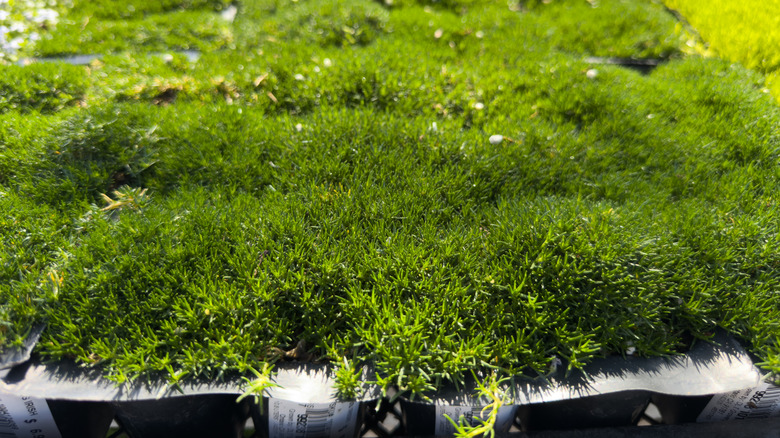
Once it's established, Irish moss is relatively low-maintenance, but it can be a little picky about its environment. Irish moss prefers a sunny position with a little shade in the afternoon. It does particularly well in sandy or rocky soils that drain well and contain a little organic matter. It's not drought-tolerant, but doesn't like wet feet either, so you'll need to get the balance right when watering. Using a soaker hose every few days can be helpful to keep the soil moist but not waterlogged. Luckily, you'll find that regular watering is about the only maintenance you'll have to perform to keep your Irish moss lawn looking fantastic. As a bonus, this species will also crowd out pesky weeds, so you don't have to worry about them, either.
Space individual plants around 6 to 12 inches apart to get good coverage, as each plant will grow into a mound that's around 12 inches wide but only 1 inch high. As long as your soil is not deficient in nutrients, Irish moss shouldn't need any extra fertilizer. However, if you notice your ground cover struggling or not looking quite as lush as it should, just one application of slow-release fertilizer in spring should do the trick. You'll find that this will be far cheaper than all the fertilizer and weed killers you need when growing a traditional lawn. If you end up with a few brown patches due to incorrect watering, you can easily dig up a clump or two and divide the plants to fill in any gaps as the need arises. This convenient method of division will also allow you to easily fill in bare patches in your yard and garden with low-maintenance Irish moss.