

Not Stone, Not Brick: The Budget-Friendly Driveway Edging Idea

We may receive a commission on purchases made from links.
Driveway edging can be decorative, but its original purpose is to help absorb weight and prevent the driveway from spreading, dipping, or cracking. For concrete driveways, edging also protects the corner edge from chipping, should your vehicle's wheels roll off one side of the drive. Coincidentally, it also gives those wandering tires a place to land that isn't on top of your fragile grass. Aesthetically, driveway edging can also make a narrow driveway appear bigger, no matter what material you use. Many people install stone, brick, or gravel driveway edging because it's an elegant landscaping idea that gives the driveway an "old money" look. But you don't have to have "old money" to make your driveway feel like a red carpet. Instead of stones or bricks, consider using wood chips or bark as a budget-friendly driveway edging material.
Wood chips are technically a type of organic mulch, but they serve a more aesthetic purpose. Unlike garden mulch, which is intended to decompose and enrich the soil, wood chips will hold up longer in the elements. Regular mulch can be spongy underfoot, but wood chips are suitable for foot traffic and are commonly used in pathways. Large wood chips can even mimic the look of stones from a distance, but they're a fraction of the cost. A bag of Timberline Pine Bark Nuggets from Lowe's is about $1.79 per cubic foot, compared to a bag of Kolor Scape Pea Gravel which is $11.16 per cubic foot or Kolor Scape Red Lava Rock which is $14.46 per cubic foot. Plus, the lightweight nature of wood chips means you can save even more money by foregoing professional delivery and installation.
Wood chips or bark nuggets make for affordable driveway edging
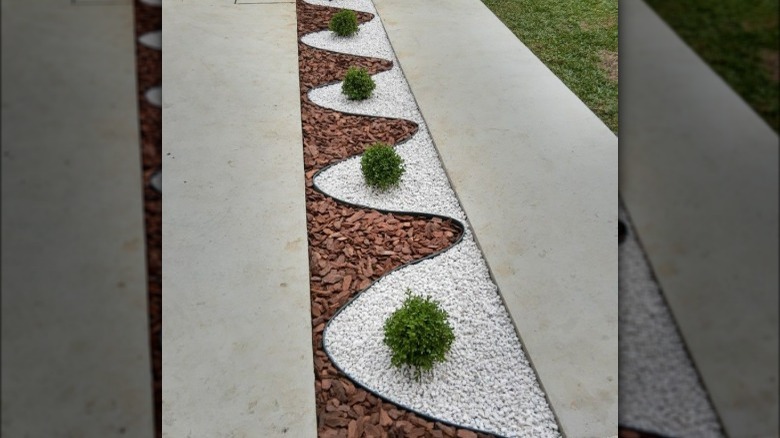
There are many colors and types of wood chips to choose from, making them a wise choice if you're particular about matching the edging to your driveway, your home's exterior, or other yard and garden elements. Pine bark nuggets are generally the most affordable. Cedar and cypress may degrade more slowly and offer pest-resistance. Hardwoods are the most expensive option, but they are strong and long-lasting, making them an especially good option for driveways where tires frequently roll over the edging. You can even make your own wood chips from local trees if you've been meaning to rent or buy a wood chipper for other yard projects.
Depending on the type of wood you choose, wood chips will maintain their beauty anywhere between 3 and 7 years, but they are still biodegradable. In addition to retaining moisture and keeping soil temperatures cool, a wood chip driveway border can benefit your lawn and nearby plants as it slowly degrades and releases essential nutrients like calcium, magnesium, and phosphorous. The chunky nature of wood chips makes them decent at suppressing weeds, especially if they're placed at a depth of at least 4 inches. However, you may still need to pull aggressive weeds around your driveway every now and then.
Using wood chips as an affordable driveway edging material comes with some tradeoffs. Chunky wood chips are usually more erosion resistant than fine mulch, but if your driveway has a lot of rain runoff, heavy rocks might be more suitable. Pieces of wood can also scatter onto the driveway, requiring you to sweep them back into place. To keep them from becoming displaced, consider spraying your wood chip driveway edging with a product like Mulch Worx Pro Mulch Glue.