

The Clever Framed Artwork Hack That Makes It Look Like A Gallery Piece

Whether wall decor looks like it came straight from a gallery or the sale bin at Bargains-R-Us often comes down to how the artwork fits in its frame. Some of the most striking art pieces feature framed canvases with visual elements that exceed their borders. The boundary-crossing can be as complex as it is in as Pere Borrell del Caso's "Escaping Criticism," or as straightforward as extending lines across the front of a piece, past the confines of the canvas, and onto the frame, as content creator @tinalemac showed on TikTok.
Artists who want to embrace this hack with DIY wall art should choose a canvas print that has a simple image. A still life with fruit or a portrait are good examples of the type of art to look for: You can repurpose old wall art for this. The technique requires you to paint around the picture's subject, so a piece with a plain background is ideal.
Something like an IKEA RÖDALM frame would work for this technique. Its construction creates an almost seamless interface between the canvas and the frame. You'll also need some architect's tape, sandpaper, and acrylic paint. A few brushes, including a small filbert brush with short bristles, are also needed to get the job done. From these simple tools arises duo-toned wall decor that mimics the look of gallery-wrapped canvas art but keeps the frame.
Steps for applying the technique to the canvas and the frame
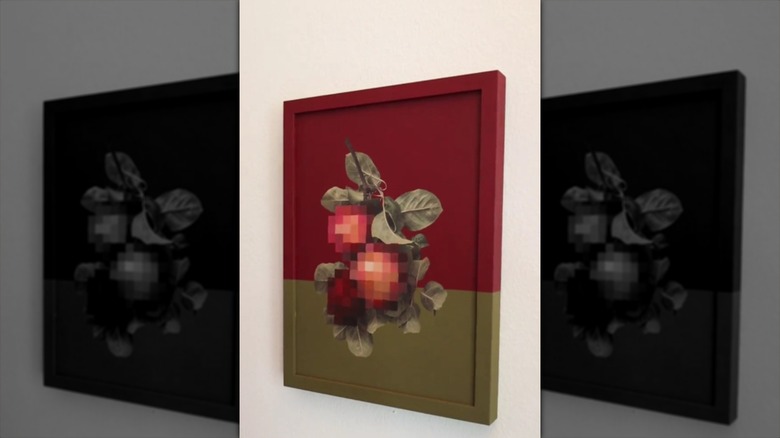
Since you're going to paint both the canvas and the frame, it makes sense to prep each piece first. Start by sanding the frame to remove any paint or stain that covers it. Next, place a straight line of tape across the front of the picture. The adhesive should cover not only the front of the canvas, but the sides, too. You'll mark both the frame and canvas at the same level (in fact, it may be helpful to place the picture inside the frame to help you line up the tape on both).
@tinalemac Did you know IKEA's picture frames fit perfectly on a canvas?! This piece finally feels complete, it just took a moment to slow down and reimagine it a bit 🖌️ DIY IKEA CANVAS FRAME HACK ✔️ IKEA RÖDALM – 12x16" frame ✔️ IKEA PJÄTTERYD canvas art ✔️ Acrylic paint ✔️ Chalk pencil ✔️ Painter's tape ✔️ Sandpaper #ikeahack #ikeadiy #diyikea #diywallart #diyideas
Start painting one of the canvas sections demarcated by the tape. Use a small filbert brush with short bristles to paint a border around the outside edges of the subject on the canvas. In principle, this is just like painting the trim around a door frame before you work on the walls around it. You're less likely to paint something you don't want covered if you make a border around it first. Then, fill in the areas outside the boundary. The short, rounded tip of a filbert brush is easier to use around small features, like the nose on a portrait, than a fine script brush. Paint the portion of the frame that aligns with this section of the canvas.
Choose another color, perhaps a complementary one, for the other side of the canvas and frame. Repeat the process until both are covered with the second color of paint. Hang up the finished piece.
Give the artwork a jewel-like look with glazing
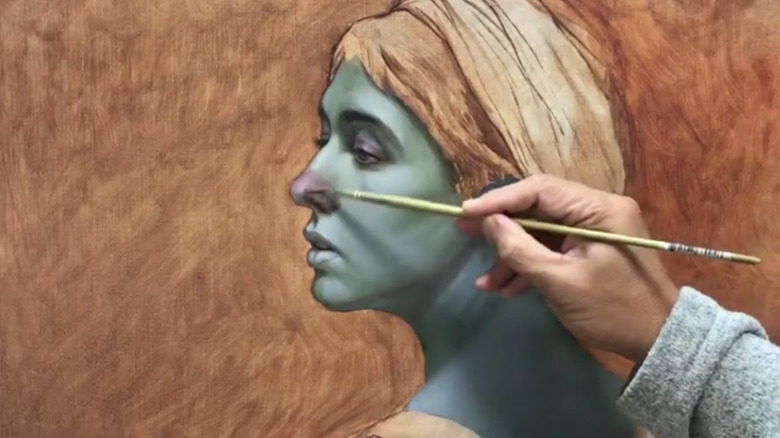
Acrylic paint works well for this project because it dries faster than oil. However, if you'd like artwork that has an almost jewel-like two-toned look, then oil's the medium you want: You'll need it to apply a technique called "glazing" to your piece. It's something that works well for grayscale art to which you'd like to add color.
Here's how you'll do it. Tape a line across the canvas and frame as described above. Next, mix a dab of oil paint with a painting medium, like linseed oil, until the mixture is thin and translucent. This is the glaze. The more paint you add to the medium, the darker the glaze will get. Keep in mind that the oil hues need to be a transparent color, like Indian yellow, rather than an opaque hue, like Bismuth Yellow, for the glaze to work.
Apply your paint to everything on one side of the tape, including the subject: Don't paint around it. Add the glaze to the frame in the same area, just as you would with the acrylic paint. The picture will show through the glaze, but it'll appear as if you've placed a piece of colored cellophane across its front. It may take several days for the glaze to dry. Once it does, choose another transparent oil paint color, such as Winsor Violet. Combine the paint and the oil in the exact same way you did before. Apply the new color to the unpainted side of the canvas and the frame. After you're done, remove the last of the adhesive and hang the art on your wall.