

How To Turn Your Backyard Patio Into A Bird Haven
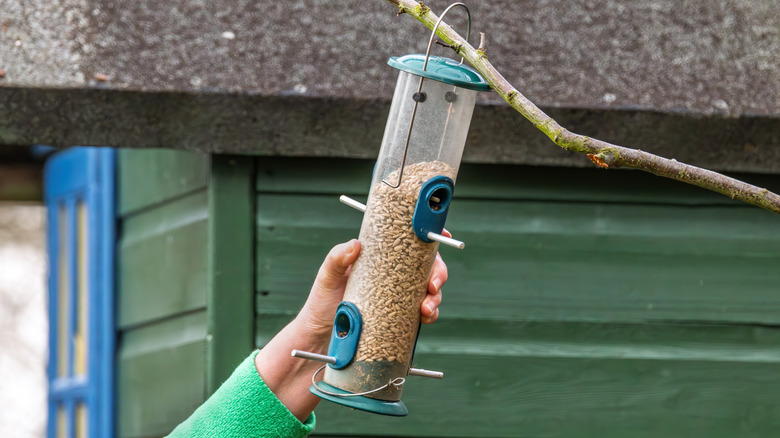
If you're interested in attracting more birds into your outdoor space, no doubt you've already come across countless birdscaping tips to turn your yard and garden into avian haven. Many of these are fairly straightforward, especially if you have plenty of space and a few decent-sized trees to work with. But what if you don't? If your garden is dominated by a patio, or you only have the confines of a small deck to work with, you could be forgiven for feeling like you're fighting an uphill battle.
If this sounds familiar, then we would urge you to persevere. True, it's easier to attract birds into your yard if you have quiet, human-free spaces to offer. But if your patio tends to lie quiet for much of the year, then there's no reason you can't coax birds into stopping by. We're here to help with a few choice changes that you can make. Some are fairly straightforward, like ensuring you match your chosen bird food to the diets of the species in your area. Others are less obvious but key to your visitors' safety, like adding decals to your windows to minimize the risk of unfortunate collisions. There are even some, like creating a windbreak with potted evergreens, that you'll be able to enjoy for yourself — even if your local birds take a while to warm up to the space.
Provide shelter with vining plants
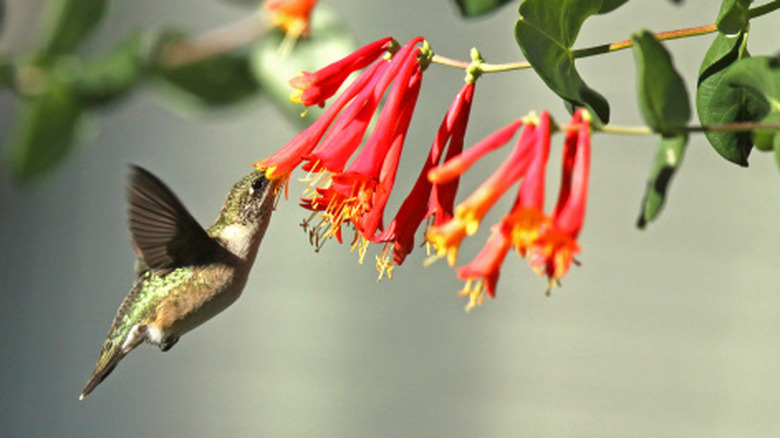
If you've already been down the proverbial rabbit hole of how to attract birds to your garden, you'll know how big a role plants play. There are certain plants that birds are naturally drawn to, often because they provide a ready source of shelter and food. On a patio, vining plants are an especially good choice. Planted on a trellis, you can provide yourself with some much needed privacy from the prying eyes of your neighbors. That same privacy can provide visiting birds with shelter from the elements and a place to hide from predators.
As for which plants you should choose, it depends on the species in your area. For example, there are various vining plants you can use to attract hummingbirds, such as trumpet honeysuckle (Lonicera sempervirens). If you're aiming for broader appeal, you could plant Virginia creeper (Parthenocissus quinquefolia), popular with a variety of birds for the berries it produces in the fall. Both will cover a trellis if allowed to do so, making an ideal nook for songbirds. Alternatively, if you have a pergola, these are excellent plant choices for giving yourself some natural shade.
Feed the specific species in your area
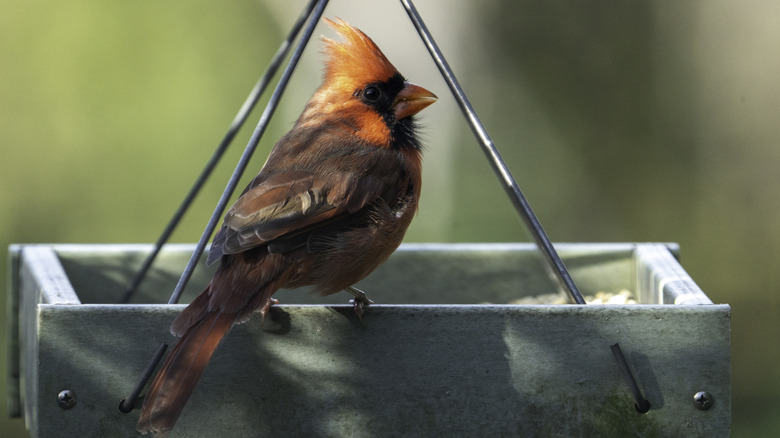
In any garden, regardless of size, hedging your bets when it comes to food is important if you want to attract more birds. In other words, it's not enough to simply put out loads of bird feeders, fill them with peanuts, and call it a job well done. Instead, you need to think carefully about which birds live in your region. Once you know whose eyes you're hoping to catch, you can then dig into how they prefer to feed and what each species prefers to eat. As an example, if you want to attract more robins into your yard, then you should know that they're predominantly ground feeders who love worms and insects. This makes a low-level platform feeder filled with mealworms a great choice. Similarly, if it's northern cardinals you're after, black oil sunflower seeds are the offering of choice — ideally placed on a tray-style feeder not far from the ground.
Back to the idea of hedging your bets, in addition to offering feeders, planting food for the birds in your area is also a good idea. This can be a little less species-specific, although you shouldn't just plant anything that bears fruit or seeds. Instead, try to use native plants to attract the birds in your area. The goal is to plant food-bearing flora that your birds will immediately recognize. If they instinctively know that they can get a decent meal from what's growing in your planters, the odds of a patio visit are likely to increase dramatically.
Grow a container garden with seed-producing plants
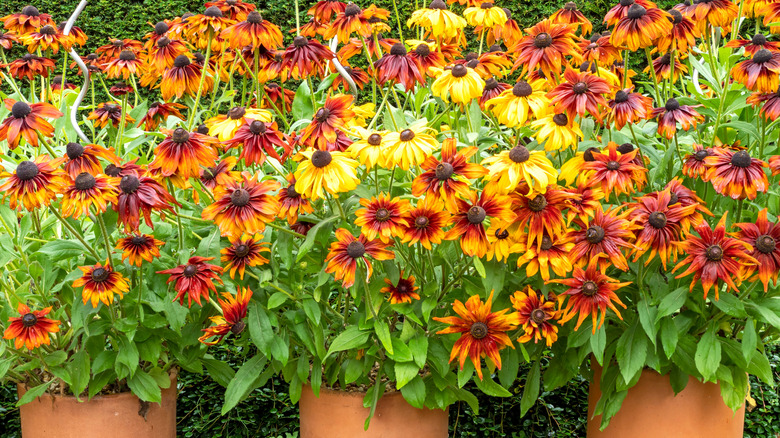
If the previous idea has you looking for perennial plants you can add to your patio to attract birds, then planting natural seed-spreaders in containers is a great option for your patio. Plants like coneflowers (Echinacea) and black-eyed Susans (Rudbeckia), for example, are both favorites for a number of seed-eating birds. Blue jays, cardinals, and goldfinches are all rather partial to their seeds; the key to success is remembering that the flowers are for more than your own enjoyment. While you may prefer to snip away the spent flower heads once they've started to turn brown, that's precisely when they're most attractive to the birds as they go to seed.
Of course, you'll need to ensure that they grow well in the first place. Different seed-bearing plants have different needs, but if you're growing coneflowers or black-eyed Susans, a sunny spot is usually best. Both do well in containers, and provided that you use a large pot for them, you can expect them to grow just as well as they would in the ground. To ensure this idea gives you the greatest chance of encouraging birds to visit, place your containers in a quieter corner of the patio, and ideally close to cover. If there are dense trees nearby that birds can dive towards should they feel threatened, they may be more inclined to take the risk.
Add a birdbath to a quiet part of your patio
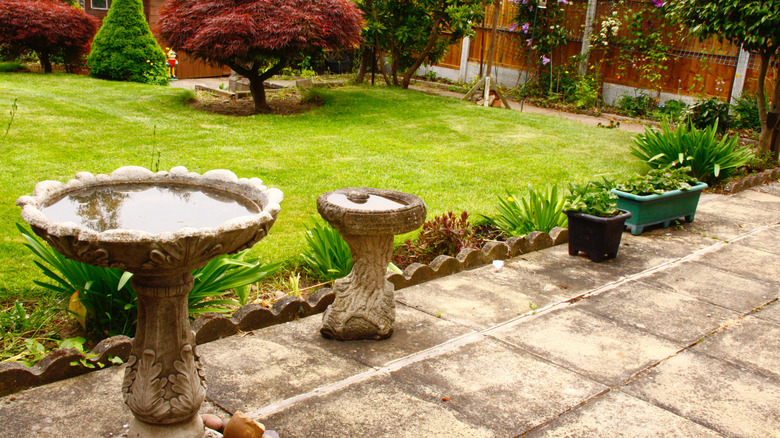
Birds, like countless other creatures, need a plentiful supply of fresh water. Not only do they drink it, but they also use it to clean their feathers and ensure they're in good condition for flying. If you can provide them with a safe and reliable bathing spot, then the birds around your neighborhood are far more likely to start stopping by. Which sounds easy enough. But on a patio, where you're likely limited on space, choosing where to put your birdbath is almost as important as having the birdbath in the first place. Similar to your seed-bearing plants, you should position it in the quietest area of your patio, and if possible, close to a reliable source of cover, like a tree.
Once your birdbath is in position, it's important that you regularly maintain it. This means keeping it topped up, especially in the summer when it could easily dry out, as well as keeping it clean. Aim to change the water daily, and give it a thorough scrub once a week to prevent algae from building up. If you're unsure what size birdbath you should buy, it's usually best to shoot for one around 1-2 inches deep. If you already have a birdbath that's deeper, consider adding some stones to the bottom to provide smaller birds with a safe and comfortable place to perch and splash. Finally, if you want your patio birdbath to be as attractive as possible, consider getting one with a recirculating water system, or add a mister or bubbler. Birds absolutely love the sight and sound of moving water. If they're on the fence about venturing into your patio area, the gurgling of a fountain may well be enough to tempt them across.
Use potted evergreens to add shelter (and privacy)
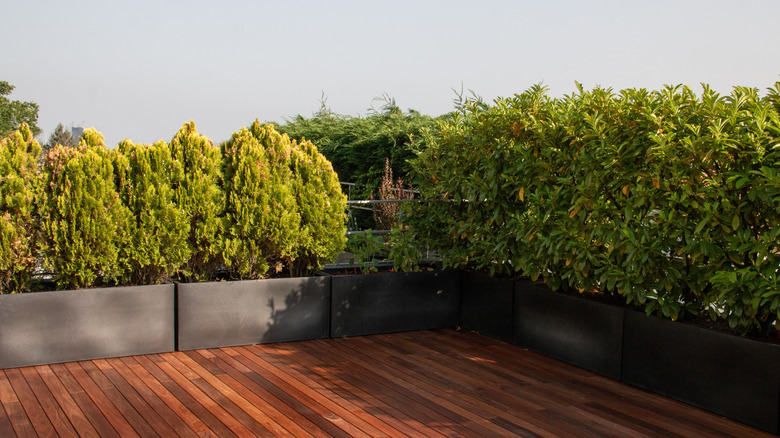
Evergreen trees and shrubs are a popular choice among gardeners hoping to "plant" their privacy screens instead of building high-maintenance fences. Potted varieties are excellent for patios, alleviating the need for in-ground growing space. Many of them are also ideal for birds, especially if you choose native varieties. Native evergreens are viewed favorably by birds as a ready source of shelter in the early spring. By positioning them around your patio, you can make birds feel that little bit safer when visiting your feeders and birdbath.
As for which types you should grow, you have options. There are various ornamental conifers, including potted false cypress (Chamaecyparis) varieties, that you can use to give your local birds cover. Alternatively, if you want to provide them with both food and board, you could add dwarf hollies (Ilex) to your planting scheme. Not only are these evergreen, but they also provide berries – just make sure you get both a male and female, to ensure berry production. They usually fruit in the cooler months, helping to make your patio an attractive source of sustenance at a time when food is scarce elsewhere. Look for evergreens that grow well in your USDA Hardiness Zone, and make sure to check your chosen variety's growing requirements.
Dedicate a corner of your patio to a brush pile
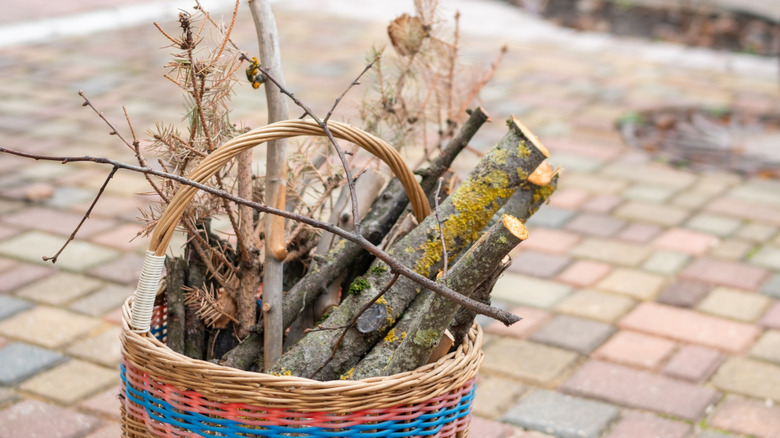
Bare, open spaces, especially those with paving slabs or concrete, are unlikely to inspire confidence among visiting birds. However, if a corner of your patio is dedicated to a small pile of twigs and branches, those birds may view it as a handy place to perch and a useful source of cover should predators come venturing near.
Harnessing the benefits of keeping a brush pile within the confines of your patio requires careful thought. In a bigger garden, you can cordon off a corner and simply toss any errant, wind-blown branches into a pile. You could even throw some fallen leaves onto it to attract protein-rich insects. But on a patio, and especially on a deck, the last thing you want is an invasion of wood-boring insects. Even if your patio is made from stone, those insects could make their way into your home. Instead, consider containing your pile to a large basket. Pile up some bare twigs inside, and place it in a quiet corner. You could also position it near your birdbath to provide them with nearby cover and thus encourage them to take the plunge.
Keep your patio and feeders clean
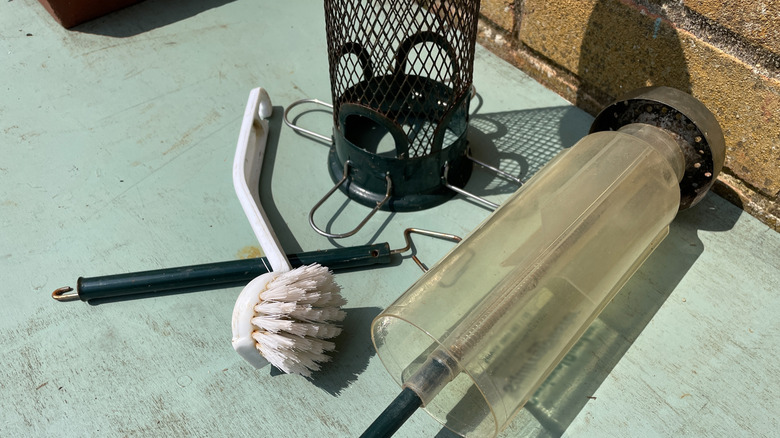
Did you ever hear the saying that cleanliness is next to birdliness? Probably not, but it's true. Birds are naturally clean creatures, and yet, they have a happy habit of, well, "going" wherever they happen to be standing. That could be on your patio railing, in your birdbath, or indeed right in the middle of your platform feeder. This isn't just unpleasant. If left in situ, those droppings can spread disease and pathogens (including salmonella and avian pox) among the birds visiting your yard.
With that in mind, it's important to thoroughly clean your bird feeders, your railings, and anywhere else they leave their droppings. To wash birdfeeders, use hot soapy water and a trusty brush, followed by a 10-minute soak in a diluted bleach solution (1 part bleach to 9 parts water). Make sure to scrub inside all of the nooks and crannies, and aim to do it often — at least once every two weeks is a good bet for feeders. At the same time, if you spot droppings after just a couple days, you shouldn't leave them unchecked until next week. Cleaning just by the calendar is one of the biggest bird feeder cleaning mistakes you can make. Instead, clean more or less often based on the weather, how busy your feeder is, and whether you spot any mold or debris.
Hang a hummingbird feeder
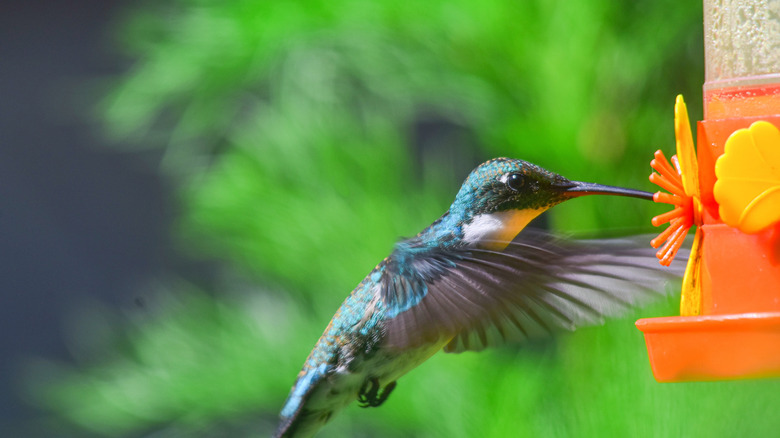
As well as planting honeysuckle to encourage hummers to visit your patio, it can pay to hang a dedicated feeder. These are usually quite reasonably priced, and they're widely available. The key, as with many of these patio-based ideas, is where you place it. Hummingbirds prefer to feed in spaces away from dense shrubbery, as it could be harboring predators. As for the perfect height for your hummingbird feeder, you'll want to strike a balance between making it comfortable for the birds, easy to refill, and safe from prowling cats; 4 to 6 feet is often optimal.
Of course, this might be tricky on some patios. But if you have a pergola, then you could easily suspend the feeder from its beams. Just be careful about how far you place the feeder from your house — especially if it's near a window. It's best to position it as close to your window as possible, ideally no more than 3 feet away. Any further, and if the birds dart away from the feeder (especially if startled), they could crash into the glass at a high enough speed to get injured. All of this sounds like a lot to think about, but it's worth doing. Hummingbirds are known for having strong memories, especially when it comes to food. Once they begin to associate your patio with delicious nectar, they might grow in confidence, and they may well return to your yard next season.
Mount window feeders
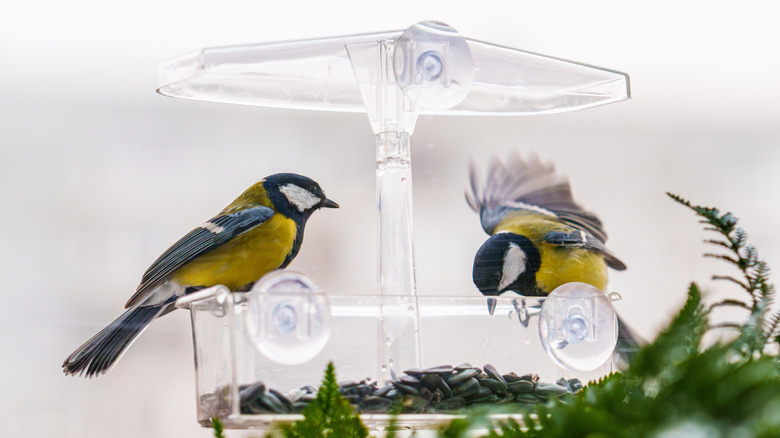
If, despite your best efforts, you're struggling to get birds to visit your patio when you're also using it, consider hanging a window feeder. Typically made from clear plastic with suction cups on the back, window feeders stick directly to the glass. Because they're see-through, you can watch the birds come and go from it without the need to step outside. There are several types of window feeders that you can choose from, which is useful for catering to birds with different feeding requirements.
Now, you should know that window feeders aren't the best idea for everyone. One drawback is that they're often quite small, only allowing room for a few birds. This means they can easily get crowded out, and the feeder may not be large enough for bigger birds. Another con is that, since birds can be messy eaters, you can easily end up with spillage right beneath your window. If you neglect to clean it frequently enough, that spilled food could end up attracting various pests, including rodents. However, since you'll want to clean your feeders regularly anyway, this shouldn't be much of a problem. It's certainly a small price to pay for the presence of beautiful birds.
Design your patio with nesting niches in mind
Different birds tend to hang out at different heights. As we've already seen, cardinals enjoy feeding at ground level, while hummingbird feeders are better placed up to 6 feet from the floor. Some birds prefer to perch in shrubs and pick berries, while others, like robins, enjoy scampering along the grass in search of insects. The same concept applies to nesting.
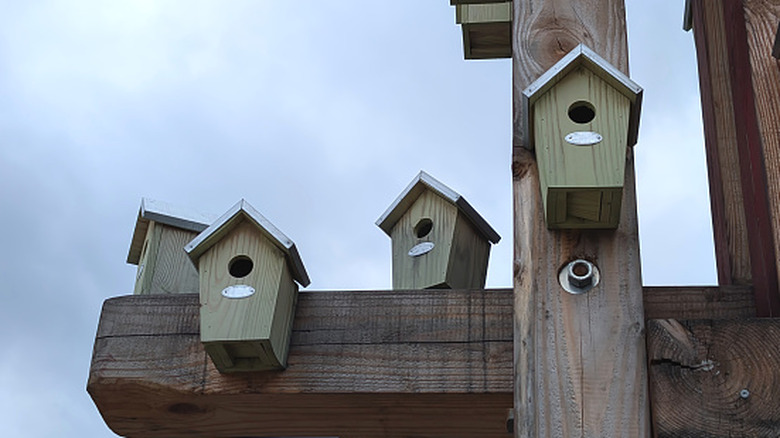
As unlikely as it seems, it's quite possible to encourage birds to nest on, or at least near, your patio. The trick is to identify which "nesting niches" the birds in your area prefer, and whether you can realistically offer them. For example, cavity nesting birds, like woodpeckers and chickadees, will readily accept shelter in the form of a bird box. Alternatively, some bird lovers have had success in encouraging house finches to nest by hanging small strawberry baskets. To further encourage nesting birds, you could leave out supplies of nesting materials. Place them in a quiet spot, and be sure to include natural items like twigs, dried grass, and pine needles.
Keep birds safe from your patio windows
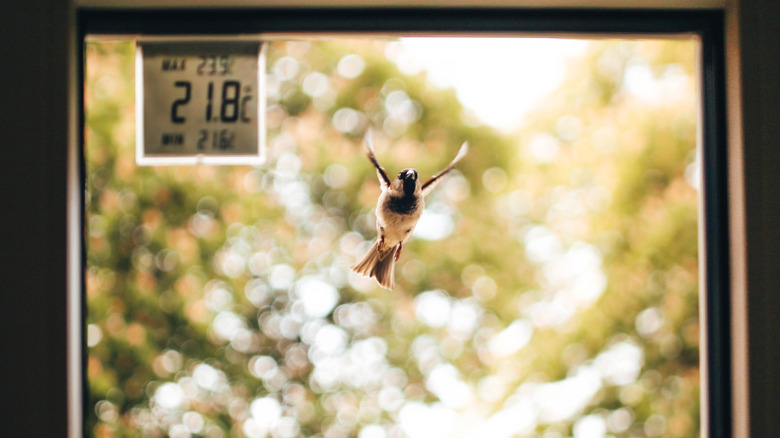
A 2024 study in PLOS One estimated that more than billion birds die in the United States each year due to window strikes. It's both a sad and startling reality, and if you're actively trying to encourage birds to visit your patio, it's one you could all too easily experience for yourself. Window strikes happen because the glass reflects trees and vegetation, which birds are naturally attracted to. It's also thought that some birds actually attack their own reflection. Some species are certainly known to be territorial, especially when it comes to food or during the mating season.
To stop birds from flying into your windows, you need to make them as obvious as possible. There are various ways you can do this. You could apply decals to the glass, or tape. Zen curtains, or bird curtains, are another good option. To make bird curtains, you just need some lengths of cord and some wood. Thread the cords through drilled holes in the wood to create a "curtain and pole," then fix the wood in place above your window. The hanging cords will help to break up the sight of the glass, helping birds to recognize your window as an obstacle instead of mistaking it for an oasis.