

The Low-Growing Perennial Alternative To Ferns That Makes An Excellent Ground Cover
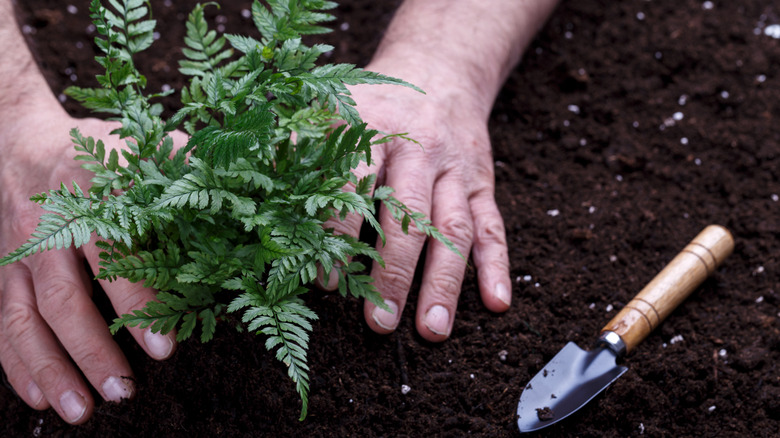
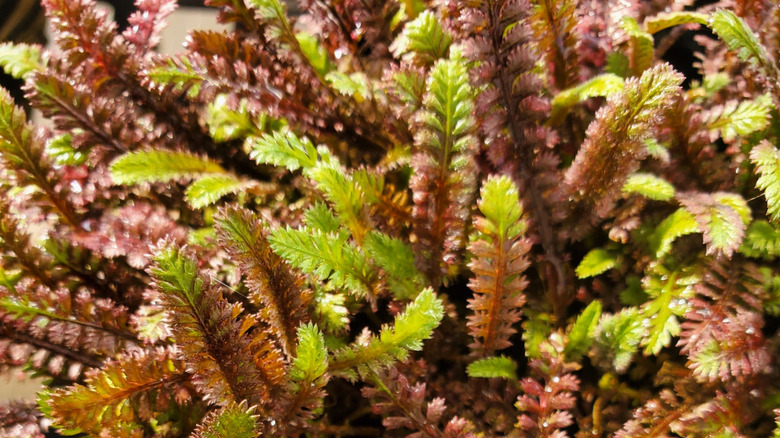
It's easy to make the mistake of using ferns as a ground cover only to discover that they're just too tall to meet your yard's needs. If this is your situation, don't despair — the brass buttons (Leptinella squalida) plant family possesses the look of actual ferns, but is an unrelated species that's much more low-growing. To add even more kick to this already unusual plant, choose the cultivar 'Platt's Black,' which brings a hauntingly beautiful goth vibe to the party. As its name suggests, this ground cover has unusually dark foliage, giving it the look of a short, blackish-bronze or purple fern.
Native to New Zealand, the brass buttons group of plants all share a ground-hugging silhouette and fern-like leaves. 'Platt's Black' is prized for its nearly black leaves that feature pops of green. The cultivar was discovered in an Oregon garden and is now the variety most commonly found in garden centers.
'Platt's Black' only grows about 2 inches tall, but its underground rhizomes allow it to spread up to 12 inches. It's useful as a ground cover, especially in smallish patches, or to add a feathery, mysterious touch to rock gardens. Consider placing the inky-hued plants among lighter-colored stones for maximum contrast. The striking, low-growing plant is even recommended as a landscaping feature in miniature gardens , perhaps adding a truly spooky touch outside a bewitched castle's walls!
'Platt's Black' prefers a mostly sunny, rich patch in which to spread out
The brass buttons family of groundcovers will thrive in sun or part shade, depending in part on your region. Choose full sun for cooler or moderate regions and part shade for the hot end of its ideal Hardiness Zones of 4 to 10. Work plenty of organic matter into the soil before planting 'Platt's Black.' If your region's soil is on the alkaline side, consider amending it with peat moss in order to create the slightly acidic base these brass buttons prefer. Space each plant between 9 to 12 inches apart. Water them regularly, because the 'Platt's Black' dislikes drought conditions.
In early to mid-summer 'Platt's Black' develops the "brass buttons" that the species is named for. The yellow disk flowers are especially showy and can be removed by hand or even a lawn mower when the flowers have gone by. You can do a bit of walking over this ground cover, but heavy foot traffic isn't recommended. Some people grow the greener versions of brass buttons as grass substitutes, but perhaps a feathery, purple-black "lawn" of 'Platt's Black' will suit your particular aesthetic!
In Zones 9 and 10, 'Platt's Black' is evergreen — or perhaps "ever black" in this case. In cooler climes, the leaves die back in winter and regrow starts in late spring. 'Platt's Black' isn't notorious for specific plant diseases or pest problems, but in times of either drought or heavy rainfall, keep an eye out for weather-related issues like mites, stem rot, or verticillium wilt.