

If You Plant One Tree In A Pot This Year, It Needs To Be This Colorful Beauty
We may receive a commission on purchases made from links.
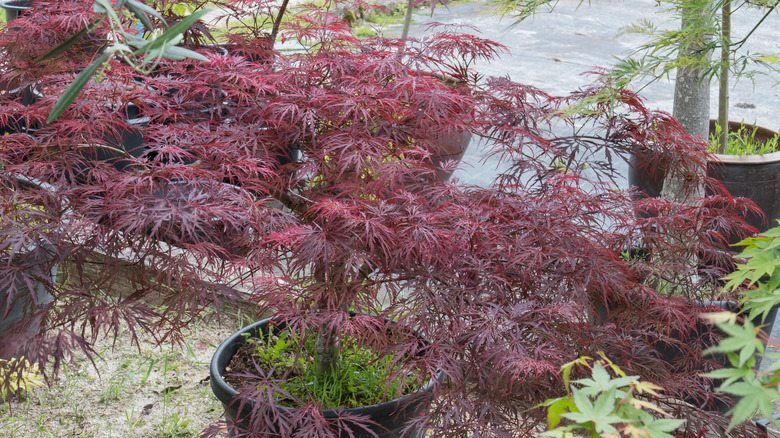
Sometimes gardening decisions are purely practical, like growing deer-resistant plants along your driveway. Other decisions are made by impulse and for the joy of it all. Whatever your reason for growing a container garden, if you're just venturing into this approach, you may be wondering what varieties of trees to grow in containers. With so many options, it can be a difficult choice, but if you plant one tree in a pot this year, it needs to be a Japanese maple (Acer palmatum).
That being said, there are still many cultivars to choose from, as there are several Japanese maple varieties that will bring beauty to your yard. A graceful tree that comes in a rainbow of colors, Japanese maples are ideal for containers because they are naturally slow-growing. They also have shallow, non-invasive root systems, and when you choose a dwarf or semi-dwarf cultivar that will stay under 10 feet tall at maturity, you're setting yourself up for success in the best possible way.
These trees grow best in at least partial shade, with lacy foliage that can slightly vary in shape. As a container garden specimen, Japanese maples can be used as a focal point, drawing attention to any area of the garden. From the bright, feathery leaves in the spring to the fiery fall color, being able to move a potted Japanese maple tree for the best display or to shelter it from the harsh sun is a definite advantage.
How to plant and care for a potted Japanese maple tree
Most Japanese maples are hardy in USDA Hardiness Zones 5 to 8, but keep in mind that container plants aren't as hardy as ones in the ground, so choose one rated for one or two zones colder than yours. Once you choose the variety of Japanese maple that you want (this could be the hard part), you need a pot that's about twice the size of the root ball. For the soil, don't use garden soil or topsoil. Instead, you can make your own acidic, well-draining potting mix for Japanese maples, such as a blend of acidic soil and perlite or pumice for drainage. Otherwise, something like Dr. Earth Acid Lovers Planting Mix would be one of the best types of potting mixes to use for this tree.
Half-fill the container with potting mix, then position the tree in the soil. When filling the pot the rest of the way, make sure not to bury the trunk. You should plant the tree at the same depth as it was in its previous container. Also, leave some room to top the soil off with decorative mulch or pebbles to reduce evaporation. Avoid the temptation to include other plants in the pot, because with their shallow root systems, Japanese maples fare better on their own. As for watering, keep the soil moist but not soggy. Check the soil frequently, and remember that the tree's leaf canopy will block rainwater. Lastly, use a slow-release fertilizer in the spring, and provide winter protection in cold zones or overwinter in a warmer area.