

The Companion Plant We Don't Recommend For Your Tomatoes (It Will Hinder Your Harvest)
We may receive a commission on purchases made from links.
As you're sorting out your veggie patch for the growing season, you're probably working out which plants you can grow together as worthwhile companions and which ones won't really get along. Good companion planting can make the best use of available space and be mutually beneficial for both plants. While a companion plant like asparagus can give garden tomatoes a healthy boost, there's one plant you should avoid as a companion: blueberry bushes. Blueberries and tomatoes don't play well with each other because they prefer different soil pH and their fertilizer needs vary, which will ultimately hinder your tomato harvest.
If you've ever grown blueberries before, you'll know that they prefer an acidic soil. Ideally, the pH should be between 4.8 and 5.2. With soils that are more acidic, iron becomes more freely available, and this is one of those essential micronutrients that blueberries need in decent amounts. However, high soil acidity can limit the availability of various other nutrients, like nitrogen, potassium, magnesium, and calcium, in the quantities that tomatoes need to thrive. That's why tomatoes prefer to grow in soil with a pH level of between 6.2 and 6.8 (which is considered close to neutral). At this level, most of the necessary nutrients are in a form that's easily accessible to plants. This allows the roots to draw enough of the available nutrients from the soil for a nice, healthy crop of delicious fruits. So, when you're deciding on which plants to grow together, remember to group species that like a similar soil pH for optimum growth.
Fertilizer needs are different for tomatoes and blueberries
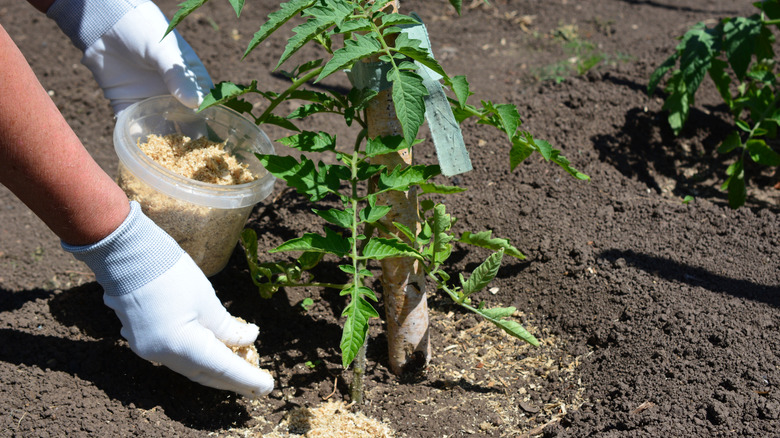
As blueberries are perennials, they need regular applications of fertilizer each year in spring and summer. Their nitrogen must be in the form of ammonium rather than nitrate, so a fertilizer formulated for other acid-loving plants such as rhododendrons and azaleas is ideal. There's also quite a complicated formula to follow, which indicates the amount of nitrogen the plants need as they age from year to year. On top of that, it's suggested that most soils contain adequate amounts of phosphorus and potassium to meet the needs of blueberry plants for good growth and fruit production. You'll find that there are quite a few companion plants that will make your blueberry bush thrive, but tomatoes aren't one of them.
While tomatoes do need enough nitrogen initially, too much of it will result in an abundance of green leafy growth at the expense of flowering and fruiting. Once flowering starts, tomatoes need a fertilizer that's higher in phosphorus and has a decent amount of potassium. For example, one with an N-P-K ratio of 5-10-5 would be ideal. You'll find that a fertilizer formulated for acid-loving plants like blueberries, such as Down To Earth's Organic Acid Mix, has a ratio of 4-3-6, which doesn't have enough phosphorus to produce an excellent tomato harvest. What this all means is that if you tried to grow blueberries as companions for tomatoes, you simply wouldn't be able to provide the conditions that each species needs to thrive in the same garden bed. But don't worry, because growing healthy tomatoes is a breeze when you plant them near one fragrant herb.