

Everyone Owned This Tree In The 80s - How They Became A Total Nuisance

The 'Bradford' pear tree (Pyrus calleryana) was inescapable in the 1980s. It's a Callery pear tree cultivar with stunning white flowers that bloom in early spring. Touted as an affordable, sturdy tree that could grow under a variety of conditions, it took off in popularity after its commercial introduction in 1961. To this day, it's one of the most popular ornamental trees in North America, but they are increasingly marked a nuisance by many. For starters, 'Bradford' trees tend to collapse when faced with wind or heavy snow as they grow older. Despite originally being dubbed "sterile," these plants have managed to become quite invasive. Moreover, the white blooms put off a foul smell some people compare to rotting fish. To really get a full understanding of why this stinky tree is still so prolific today, we have to trace back the origin of 'Bradford' pear trees.
Pyrus calleryana first made an appearance in the United States when the United States Department of Agriculture (USDA) made a big push towards importing new plants from abroad. The French pear (Pyrus communis) wasn't doing well in the Pacific Northwest, and this wild Chinese pear tree was introduced as a more resilient alternative. It was praised for its ability to grow quickly in all kinds of different conditions. It wasn't until 1954 that USDA botanist John Creech formalized the 'Bradford' cultivar, a clone tree, and planted it in residential subdivisions around University Park, Maryland. Soon enough, the cultivar was released commercially and took off almost immediately. Once the 1980s rolled around, this tree was everywhere. But now, with many of the trees originally planted in the '60s getting older, the issues started to emerge.
The spread of 'Bradford' pear trees and other cultivars
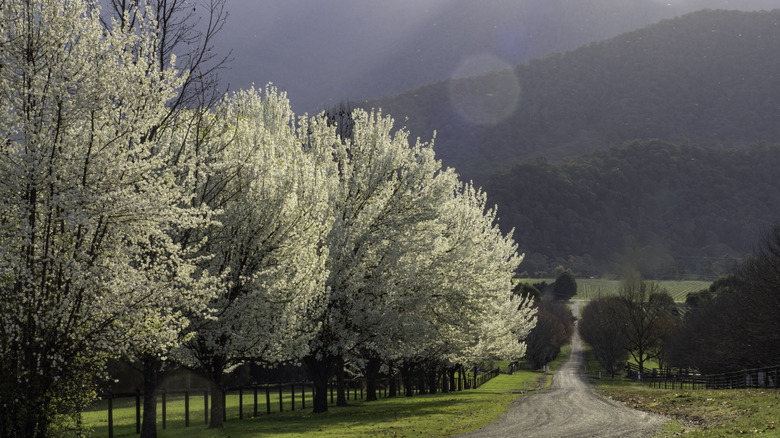
From the '50s into the following decades, this prolific tree steadily grew in popularity. Closely related Callery pear cultivars such as 'Whitehouse,' 'Redspire,' and 'Autumn Blaze,' also emerged in the '60s and '70s. A true testament to the resilience of the Callery pear, a tree near the World Trade Center miraculously survived the tragic events of September 11, 2001 with burns and some structural damage. The tree was rehabilitated and replanted at the memorial site where it remains to this day. So with so much commercial success and the impressive resilience of these plants, why on Earth does it seem like no one has anything nice to say about 'Bradford' and other Callery pear trees?
Well, soon after these plants became favorites for landscaping, it became clear that they were not easy to contain. Their will to survive and thrive also comes along with an unfortunate tendency to readily reseed. Soon after introduction, Callery pear trees could be spotted popping up on the side of the road and even far into natural areas. Over the decades, it's become more and more apparent that these plants were spreading viciously where they were never intended to grow. This tendency has marked this tree as invasive throughout the eastern U.S. as well as in a few western states.
The enduring problem of the 'Bradford' pear — and the solution
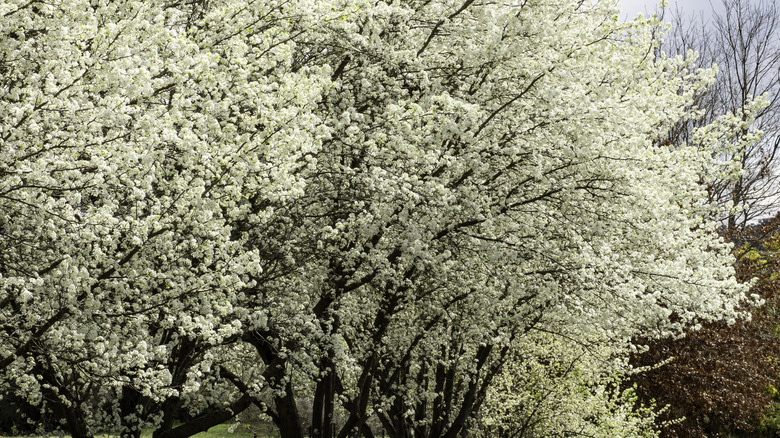
'Bradford' trees were first marketed as "sterile" since they could not cross-pollinate or bear fruit. When grown in isolation, they don't pose a risk of spreading. However, if you recall, other cultivars were gaining popularity around the '60s and '70s, too. Sure, most were advertised as "low fruit" or "sterile," but when planted near each other, these resilient plants had everything they needed to stubbornly breed and multiply despite every effort to prevent them from doing so. The spread of these pesky trees is steady and difficult to snuff out.
The solution lies in slowly phasing out the Callery pear. Over time, consumers, producers, and nurseries alike can opt to favor more manageable alternatives. The hope is that, eventually, they won't be readily available to buy any longer. But that still leaves the issue of all the plants still out there in lawns and natural areas. If you find a 'Bradford' pear or related cultivar in your backyard, you can simply cut it down. As heartbreaking as it is to part ways with a perfectly healthy tree, this is the best way to help phase out 'Bradford' pears. Luckily, there are plenty of alternatives to grow instead of the 'Bradford' pear. Crabapples, redbuds, and flowering cherries are all stunning, sustainable options to consider. If you're not ready to part ways with your tree, you can do your part by spraying the blooms with ethephon to prevent them from producing fruit.