

The Beautiful & Fragrant Shrub We Can't Recommend Planting Along Your Fence
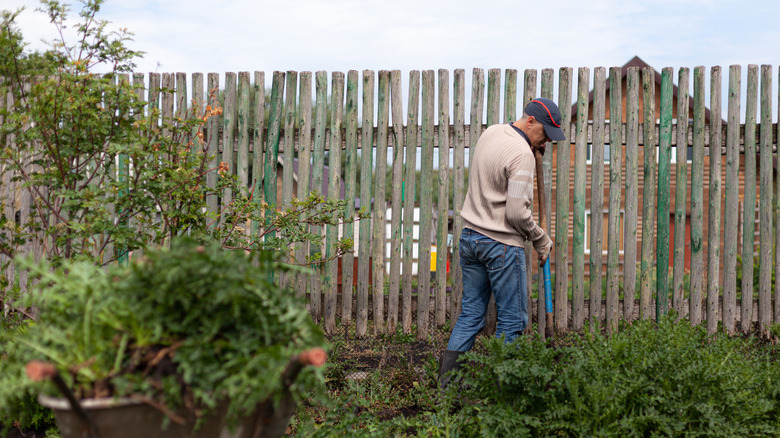
There's no doubt that there are many stunning plants to grow along your pre-existing fence. If you take a visit to your local garden center, you can probably find a number of gorgeous species that catch your eye. Or perhaps you've taken a walk around your neighborhood and spotted a truly stunning shrub that you think would look fantastic in your yard. Before you choose anything to plant along your fence, check with your local extension office to make sure that the species you're so keen on is not regarded as invasive. Any species that's prone to spreading is much more difficult to control when it's grown along a fence line, especially if it borders a neighboring property. One example of a beautiful and fragrant shrub that we simply can't recommend planting along your fence is leatherleaf mahonia (Berberis bealei).
This beautiful, blooming shrub that can survive frost in winter is in the barberry family and originates from China, but has become quite a problem in large parts of the South and Northeast. States that specifically regard this species as invasive include Alabama, Georgia, Maryland, New Jersey, Kentucky, South Carolina, North Carolina, Tennessee, and Virginia. At first glance, leatherleaf mahonia is quite attractive thanks to its leathery, holly-shaped leaves and fragrant, pretty yellow flowers. To add to its alluring qualities, it also produces blue, grape-sized fruits that are adored by birds. Unfortunately, its propensity to spread beyond your boundary makes it an unwise choice.
What makes leatherleaf mahonia invasive?
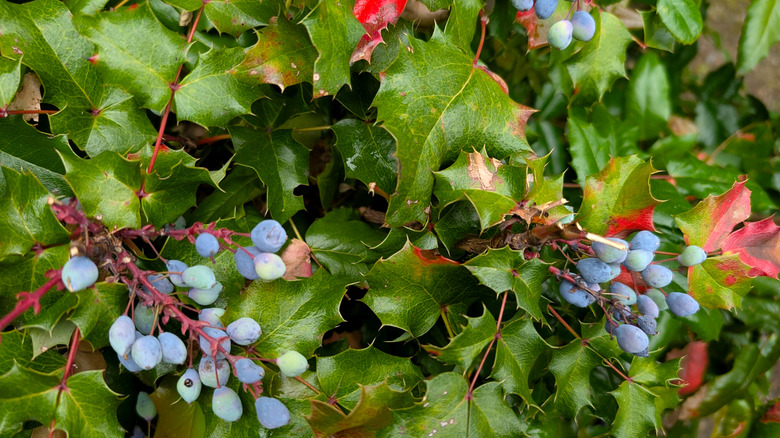
There are a couple of major reasons as to why this species is regarded as invasive and why you shouldn't grow it along your fence. Firstly, it spreads via suckers, and these can be quite difficult to control and contain. If grown next to a boundary fence, the suckers can easily escape into a neighboring property, making it nearly impossible to control the spread of the plant. The seeds also germinate quite readily, and this is made worse by the fact that the fruits are loved by birds, who then tend to spread the seed into neighboring areas as they fly over your fence. In certain parts of the Southeastern United States, the shrub has become naturalized, and its somewhat aggressive growth via those suckers is crowding out native species. That's why it's not recommended for planting. If it's already growing in your yard, you should try to remove it or control its spread.
If you're still looking for an attractive shrub to plant along your fence, consider a native species instead. American barberry (Berberis canadensis) also has pretty yellow flowers and red berries that are enjoyed by songbirds. Or, if you're looking for a holly plant variety that can add year-round interest to your garden, perhaps you might like American holly (Ilex opaca), which also has those serrated leaves (although not as sharp) and lovely bird-attracting red berries. Another alternative you might like if you're after a bit of fragrance is the anise tree (Illicium floridanum), which has leaves that exude a spicy aniseed scent when crushed.