

It's Been Around For Centuries — The Valuable Kitchenware Brand To Hunt For At The Thrift Store
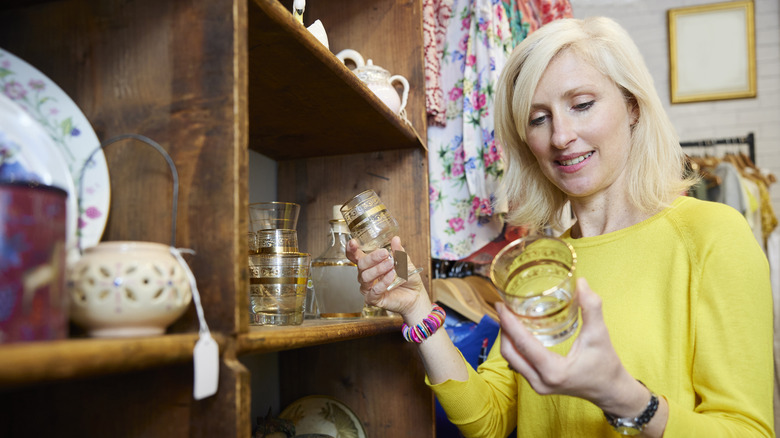
Hunting through thrift stores is always a fun way to spend a rainy weekend. But between the garish patterned shirts you always buy your best friend and the huge, exquisite dressers that make you sad you live in a rental, there are quite a few valuable items to seek out at a thrift store – and some may be in the kitchenware section. The next time you are in your local thrift, keep your eyes peeled for blue and white porcelain items. These may be Spode's Blue Italian, and can be worth an incredible amount of money.
Spode's Blue Italian was launched in 1816 by Josiah Spode II, who was influenced by the blue and white ceramics from ancient China. Around this time in the UK, Chinese porcelain was incredibly popular, and this was affecting the industry in Britain. Josiah Spode II had the idea of blending the striking cobalt blue and pure white colors of Chinese porcelain with European scenes, and Blue Italian came into existence. Over the last 200 years, Spode's Blue Italian has stayed popular, and the rural scenes and vivid colors feel nostalgic for many of us.
Spode is still producing its Blue Italian line, and a brand new teapot from the company costs around $200. However, when it comes to second hand items, their value can vary a lot. Age, rarity, style, and condition all play a roll into how much a Blue Italian piece is worth. Earlier pieces, often labeled "Spode England" or "Copeland Spode England", tend to be more valuable than later items, with some pieces worth nearly $500. Larger items or sets can even go for thousands of dollars.
How to spot valuable Spode's Blue Italian
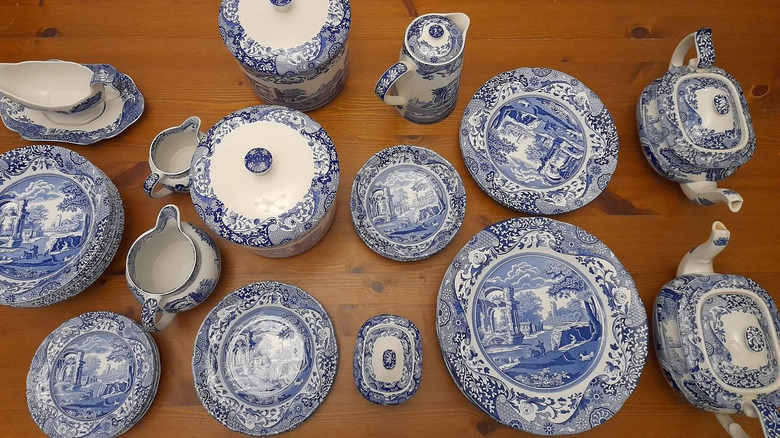
There is no avoiding that breathtaking blue and white pattern when you see it in a thrift store. But just because you see the iconic Spode design doesn't mean it is necessarily valuable. Firstly, there is quite a lot of imitation Spode's Blue Italian out there. Furthermore, even if it is actually Spode's Blue Italian, it may not be worth buying. Modern items are usually pretty easy to get your hands on, with outlets such as Wayfair selling sets of Blue Italian. You don't want to waste money, and this means that you need to know how to spot valuable, high-end items at your thrift store. When it comes to Spode, the backstamp and date marks are usually a good place to start.
A backstamp that was often used for Spode's Blue Italian from 1891 to 1970 is an oval design with the words "Copeland Spode's Italian England" within it. Items that were created in the earliest years are often simply stamped "Spode." Spotting these backstamps suggests the piece may be valuable. Furthermore, Spode used date marks from the late 1800s to 1963, with the number revealing the year the piece was created. For example, the number 37 suggests the piece was made in 1937. The older pieces that were manufactured before 1970 are usually the ones that are valuable.
Alongside the dating of your thrift find, you should also consider its condition before buying. Pieces with cracks or discoloration are usually not as valuable. If it is in good condition and has stamps and marks that suggest it is valuable, make sure to authenticate your latest thrift store find with an appraisal to see exactly how much it is worth.