

Turn An Old Basketball Into A Unique Bird Feeder For Your Yard
We may receive a commission on purchases made from links.
It's time to retire that old basketball of yours that's seen so much action. But don't say goodbye to a ball that's brought you so many good times. A few simple adjustments can turn this sphere of fun into a bird feeder that's both capacious and quirky. The sporty and creative Mylan Murphy wowed us with a TikTok tutorial for a basketball-based birdfeeder. A ball equipped with a filling hole, feeding holes, and a platform for perching and seed spillover is both easy and inexpensive to make. More importantly, though, is how this feeder is both fun to look at and effective at feeding feathered friends. Murphy's video showed how his backyard visitors took to the contraption, but we couldn't help noticing the birds weren't feeding from the side holes. To keep birds flocking to your yard with this imaginative upcycle, adding perches and drilling larger holes for birds to access seeds is all it takes to make the feeder more inviting.
In addition to a ball, you'll also need a round, lightweight yet durable tray, a utility knife, a Sharpie, a drill, nylon cord, a wide, 1-inch nut, bolt, and a washer, and an optional four to six sets of repurposed chopsticks for perches. Since regulation basketballs have roughly a 9 ½-inch diameter, you'll need a platform with at least a 14-inch diameter to give the birds a 2-inch or wider landing ledge around the ball. For something that won't let moisture accumulate on the tray, this 17-inch Metal Mesh Birdfeeder Tray is both the perfect size and price at just over $6.
Cut the filling hole and attach the tray, hanging cords, and perches
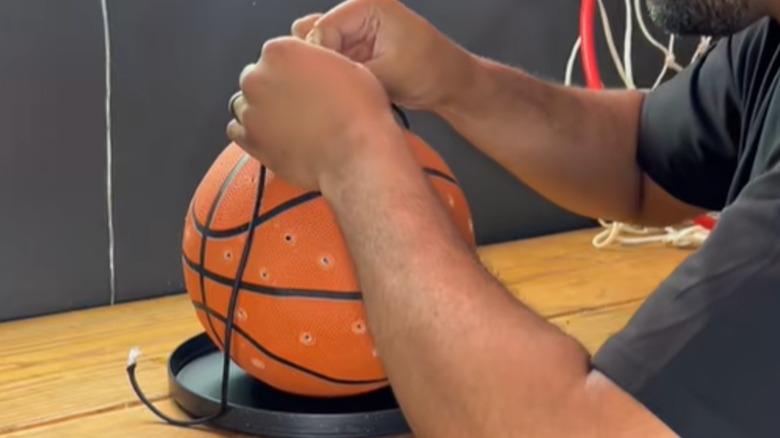
To make this basketball bird feeder, trace a circle around the top of the ball using something like a large soup can or water bottle as a pattern. Poke the utility knife along the marker line to start a hole. Carefully cut along the line, and remove the circle of ball material.
Drill a hole at the center of the tray. Flatten the ball so that the hole you cut sits at the center of the circle made by the deflated ball. Drill a hole through the base of the ball at the midpoint of the circle you cut. Attach the tray to the ball through these holes so that the nut and washer are on the interior of the ball. Drill four holes at even spaces around the ball's opening, about 1 to 2 inches in from the cut edge, and knot the nylon cord through the holes. Hanging the ball might provide enough tension on the ball's sides to help you drill the holes. If not, fill the ball with playground sand through the large top hole to firm up the sides.
Cut your collection of chopsticks in half, and fit your drill with a bit that's just a bit narrower than your chopsticks. Drill holes for the chopstick halves around the ball's perimeter, and insert about 2 inches of their cut ends into the holes.
Choosing the right seeds for your basketball birdfeeder
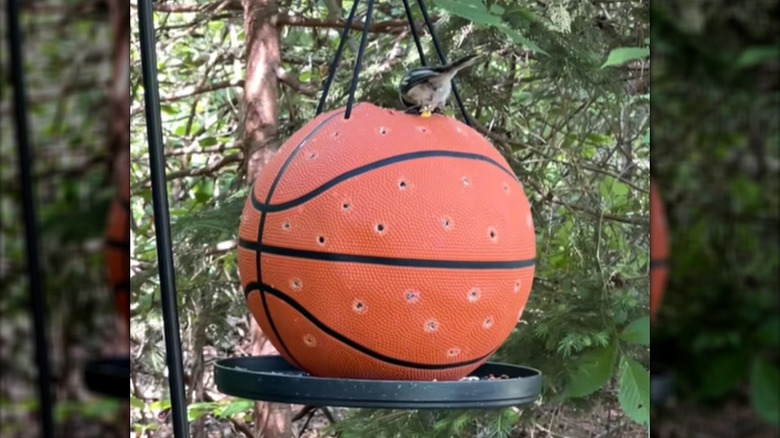
Before drilling feeding holes, consider what kind of seed you'll be filling the ball with. If you want to try using it as a DIY Nyjer bird feeder first, start by drilling several smaller holes above each perch for these tiny seeds to fit through. Drill holes below the perches so that birds can land on the tray and feed as well.
Starting with Nyjer is smart, because this seed is a good crowd-pleaser for birds and humans. It isn't tempting to squirrels, and you can find non-sprouting varieties that won't introduce weeds to your yard. After all, you can always make feeding holes bigger to work for larger seeds. If the birds aren't taking to the Nyjer seeds after about two weeks, you can drill larger holes to accommodate sunflower seeds. These treats tend to be the most popular with birds, but do know they're also a favorite of squirrels.
Another advantage of having the ball filled with seeds is that it should help the perches sit more securely in the sides of the ball. The grains surrounding the chopsticks' ends will give the perches just a bit more support that might make all the difference to the lightweight birds. Lastly, if the chopsticks look unsightly sprouting from the sides of the ball, consider painting them with a non-toxic black paint.