

Why Gardeners Love To Add Peanut Shells To Their Planters (And Whether It's A Bad Idea)
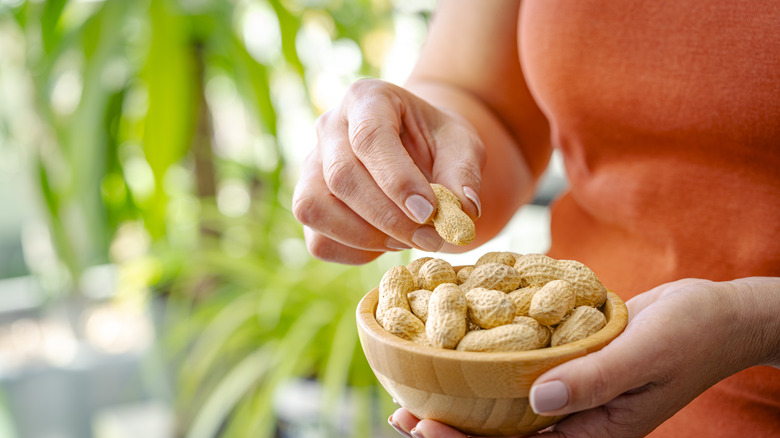
In general, gardeners are an innovative bunch, and you'll constantly come across ways that individuals use ordinary household products and even waste to improve their growing successes. One idea you might have seen is gardeners adding peanut shells to their planters, and you may well wonder if this is a bad idea or one that has merit. There are actually a few valid reasons why gardeners love adding peanut shells to their container plants — they're a free product that would otherwise end up in the trash or compost, they can help to bulk up potting mixes and improve the structure for aeration and drainage, and they'll eventually release nutrients as they decompose.
These are all perfectly good reasons to add peanut shells to your planters, as long as you crush them up a bit first and then mix them in with your regular potting mix. This would be similar to adding vermiculite, which is a clay mineral ore great for efficient seed germination. However, while vermiculite is mined and you'll have to buy it from your local garden center, peanut shells are a free waste product. Even extension offices and universities recommend adding peanut shells to bulk up potting mixes. The one thing you don't want to do is just load them into the bottom of a planter and then add potting mix on top, as this may result in water pooling and the roots of your plants getting waterlogged. Plus, the shells could go moldy if they're constantly wet. You also want to avoid using salted peanut shells as the salt can be harmful to your plants. However, you can overcome this problem by soaking the shells in water for around 12 hours, remembering to change the water at least once to get rid of the salt.
How peanut shells can be beneficial when added to your planters
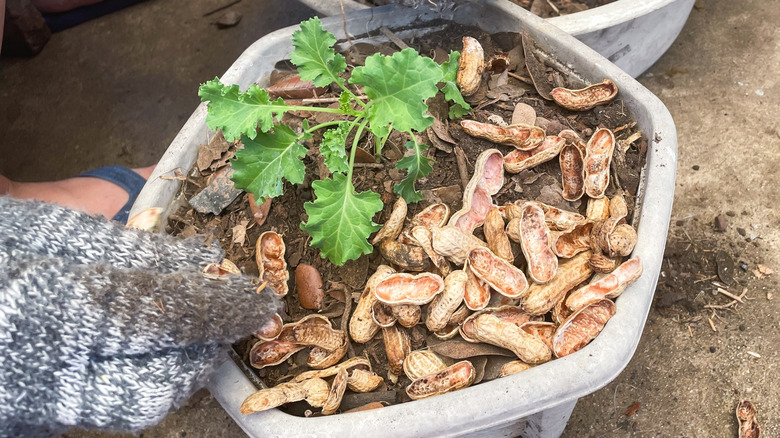
Peanut shells can be added to your potting soils to bulk up the mixture and save you a bit of money. They do add some nutrients to the mix as they start to break down and are valued for their carbon content, and this is far more important than you might think. It's also a good reason why you'll want to start using peanut shells in your garden. It's an interesting fact that 45% of a plant is made up of carbon, and while the majority of carbon uptake is from the atmosphere during photosynthesis, research has shown that some carbon may also be taken up from the soil. Apart from that, carbon is essential in soils as it can increase water-holding capacity and aeration. Peanut shells also contain small amounts of important minerals such as magnesium, calcium, and potassium, which is why they make a great kitchen scrap you can reuse in the garden as a natural fertilizer.
You'll even find that a number of commercially available potting mixes will contain peanut shells as a way to rely less heavily on peat moss for moisture retention. So, you can certainly consider adding them to your own planter mixes to help bulk out any soil you might be using. You could also use the shells as a type of mulch on top of the soil in your pots to help retain some moisture. Just be aware, though, that there are people who have severe peanut allergies, so if you're in the habit of giving away plants that you've propagated, be sure to make the recipient aware that the mix contains peanut shells.