

The Drought-Tolerant Plant With Velvety Flowers That Attract Hummingbirds In Summer & Fall
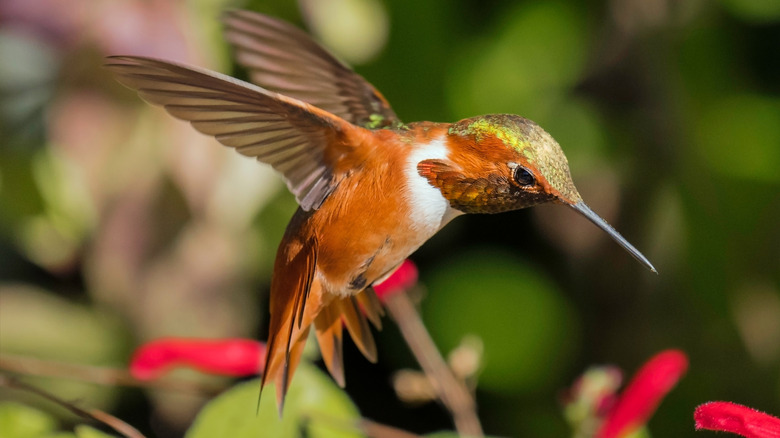
It isn't often that a flowering perennial is equally at home in the cutting garden, within a sunny patio container, or rubbing elbows with other ornamentals that turn your yard into a hummingbird heaven. But the kangaroo paw (Anigozanthos flavidus) isn't your ordinary plant. This tall plant of Australian origin is perennial in USDA zones 10 and 11, and it can take your floral arranging game to the next level. As a bonus, the tubular flowers draw hummingbirds, and can also tolerate periods of drought.
From the "waist down," so to speak, the plant looks a bit like an ornamental grass variety. But above that 3-foot leafy base rise strikingly unusual velvety flowers that look a bit like colorful hands — or kangaroo paws. The flowers themselves sit on stems reaching 3 to 6 feet high, and the bushy perennial can spread to about 4 feet in width. Consider using this exotic flowering plant in a pollinator garden, a tropical garden, or as a striking border in a spacious yard.
Depending on the variety or cultivar, these hummingbird-attracting flowers come in a range of tropical colors and different sizes, blooming from spring through fall. It's easy to find a hue that will complement your garden. Red cultivars and varieties include 'Bush Games,' 'Big Red,' and 'JoeJoe Red.' For yellow types, consider 'Bush Dawn,' Yellow Gem,' or 'Big Roo Yellow.' There are also bewitching yellow-red or yellow-orange bicolors, such as 'Bush Tenacity,' 'Harmony,' and 'Orange Cross.' Finally, if you're thinking pink, seek out 'Bush Pearl,' 'Coral Pink,' or 'Kanga Pink.'
Care for kangaroo paw to enjoy more hummingbirds
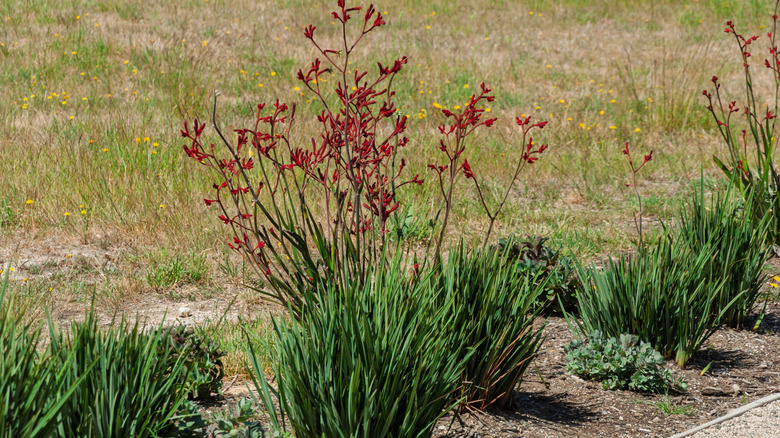
A drought-tolerant survivor, kangaroo paws grow best in full sun or with partial shade. The plant needs quite a bit of drainage, and sandy soils are ideal. Plant kangaroo paws about 3 to 6 feet apart. The flowers can be cut as indoor decoration at any point. Even if you don't use kangaroo paws for floral arrangements, the plant's health will be boosted by cutting and removing individual spikes at the soil line after the flowers have faded. Just be careful not to take leaves with it, however, as the plant relies on them for overall vigor.
As an ornamental from Australia, it's not surprising that kangaroo paw plants don't do well with frosts. During cold snaps or strong winds, protect the perennial by using a blanket or burlap shield. While the plant is drought-tolerant, it flowers best when the soil is kept consistently moist while it blooms all summer long. After that, water can be withheld to some extent, especially in colder months. If you feel the need to fertilize the plants, avoid products containing phosphorus, as many Australian plants are sensitive to it.
The good news for northern gardeners is that kangaroo paws can be grown in large containers. Set the plant on a sunny patio in the summer to attract hummingbirds and other pollinators, and bring it indoors and let it thrive as a houseplant during the fall and winter. Ideally, it needs to be kept at room temperature, between 70 and 80 degrees Fahrenheit, so avoid unheated garages. Look for a potting medium with plenty of grit, and err on the side of underwatering rather than overwatering.