

This American Shrub Looks Just Like Its English Cousin — So Why Is One A Blessing And One A Nightmare?

Although they bring year-round interest to gardens, many people assume all types of holly fall into the same category. They have glossy, pointy leaves, bright red berries, and a nostalgic look that instantly triggers thoughts of winter wonderlands. Sure, American holly (Ilex opaca) and English holly (Ilex aquifolium) have some similarities, but these evergreens have very different reputations.
American holly is native to the eastern United States and is well-behaved in ornamental landscapes. Although it can eventually grow into a sizable tree, it doesn't overwhelm neighboring plants. English holly, on the other hand, is native to parts of Europe, North Africa, and western Asia. Also called common holly, it became super popular for hedges, privacy screens, and holiday farms throughout the Pacific Northwest. At first, it seemed like the perfect landscape plant. The problem came when English holly escaped cultivation and began spreading into nearby forests and parks. Over time, it formed dense evergreen thickets that crowded out native vegetation and blocked sunlight from reaching forest floors.
It's easy to confuse American and English hollies, but once you know what to look for, you can't unsee the differences.
American holly vs. English holly
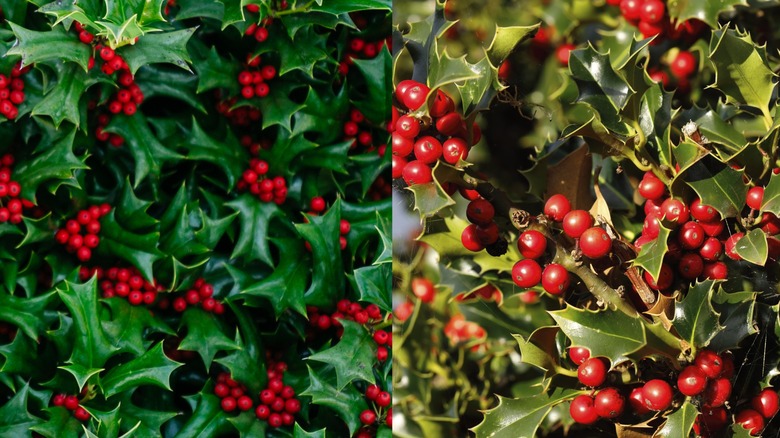
If American holly is the quiet cousin at a family gathering, English holly is the one that arrives loudly and takes over the room. Both have that holiday-card aesthetic, but American and English hollies grow very differently.
American holly is a slow grower that thrives in USDA Zones 5 through 9, usually adding less than 1 foot of growth a year and eventually reaching up to 60 feet tall and 20 feet wide. English holly, which is hardiest in Zones 7 through 8, is a more vigorous grower, putting on 1 to 2 feet annually until reaching heights of up to 50 feet and widths of up to 25 feet. Both can be splendid privacy shrubs that grow outside your window, but that's where the similarities stop.
American holly is well-mannered in landscapes and rarely overwhelms neighboring plants, boosting curb appeal all year long. On the other hand, English holly becomes aggressive once birds begin dispersing its berries. Its seedlings can spread way beyond where the original shrub was planted, allowing it to compete with native vegetation and lead to it eventually overtaking it. This unruly behavior became so severe that English holly is considered invasive in parts of Oregon, California, and Alaska, as well as in national and state parks.
The moral of the story is that, despite their nearly identical appearance, American holly will be a blessing to your landscape, while its invasive cousin, English holly, will be a real nightmare.