

Skip Hydrangeas: The Alternative That'll Look Beautiful All Year Long
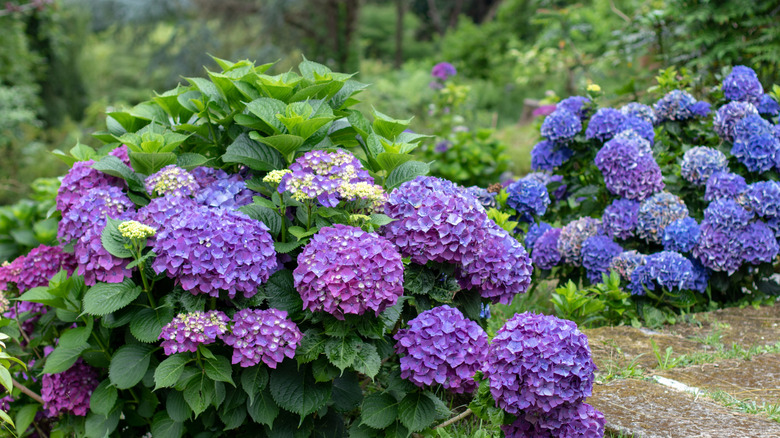
Hydrangeas are often the go-to for foundation screenings and to anchor borders. And why not? The shrub classics add greenery and flowers throughout the spring and summer. But what happens after the temperatures plunge can be a little, well, grim. The giant leaves fall away, and its blooms dry up, leaving you with a twiggy heap to stare at all winter. That's why you might want to think twice about planting hydrangeas in your garden and instead opt for azaleas — specifically, Encore azaleas (Rhododendron Encore® Group).
If you're seeking an alternative to that bleak cold-weather sight of scraggly hydrangeas, look no further than Encore azaleas (Rhododendron Encore® Group). For those living in USDA plant hardiness zones 6 to 10, these shrubs not only provide blooms from spring to fall, but their evergreen foliage remains year-round. Started in 1998 by Louisiana-based breeder "Buddy" Lee, the Encore series now consists of 33 varieties. The group is known as "Encore" because just when you think the spring flowers have gone by, summer brings a fresh crop. The same phenomenon follows in autumn.
Encore azaleas are divided into small (2.5 to 3 feet tall), medium (3 to 4.5 feet tall), and large (4.5 to 5 feet tall). Bloom options within each category include pink, red, purple, white, and bi-color options such as the coral-pink and white of 'Autumn Starburst.' Along with a range of color options, the height variations allow you to grow them as container specimens and low hedges, or as back-of-border ornaments and foundation screens.
Give Encore azaleas a low-pH soil and dappled sunlight
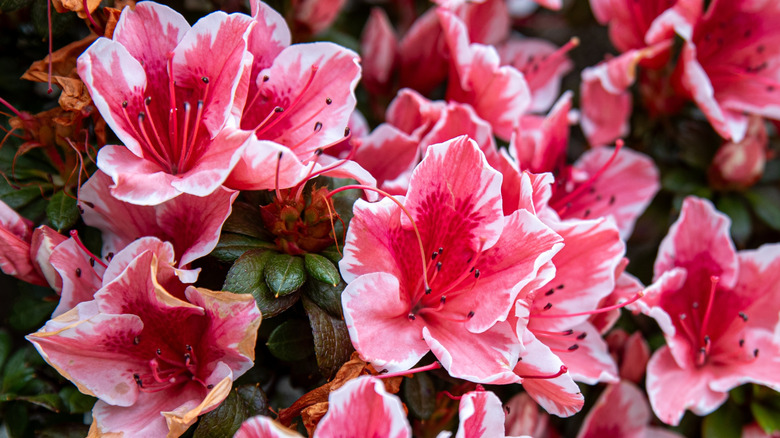
When it comes to siting and prepping your Encore patch, there are a few things to know before planting the azaleas. Unlike many members of the rhododendron and azalea family, Encore azaleas can handle some sunlight. In fact, they produce bountiful blooms when sited where they can get about four to six hours of sun, preferably with afternoon shade. Give them a good start with a well-draining soil that's on the acid side. The shrubs prefer a pH of 6.0 or under, or ideally 5.0 to 5.5.
When you want to start using azaleas as low hedges or foundation groupings, the spacing depends on the variety of Encore you're planting. Check label directions for recommendations, which are based on the shrub's overall spread. In general, you'll be advised to set the smaller varieties 1 to 3 feet apart, and the larger ones 3 to 6 feet apart.
During their blooming months, make sure to keep the soil consistently moist. They can be pruned after the first spring flush is over, to avoid scraggly growth. When it comes to plant disease, Encore azaleas' main enemy is Phytophthora root rot. If you notice leaf loss or dying branches, work to improve drainage around the shrubs. This can be done by creating soil berms to strategically direct rainfall or adding more organic material to the soil to loosen it.