

It Was Rare, Even In The '60s — Now You'd Be Lucky To Find This Vintage Pyrex Anywhere
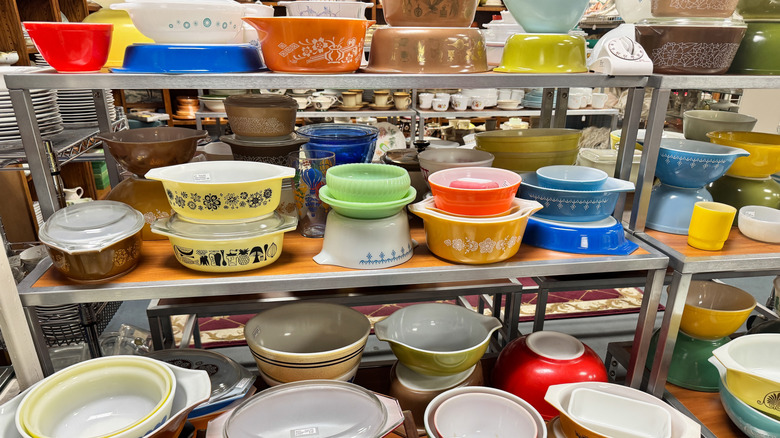
If you're on the lookout for valuable vintage Pyrex patterns, you've probably noticed that some dishes boast sales tags in the hundreds of dollars. You're not alone in wondering why these seemingly common pieces of cookware command such high prices. Not all old Pyrex pieces are valuable, however. Utilitarian prints frequently pop up in thrift stores, and you can snag a full vintage set for yourself for around what you'd spend on a modern alternative. Things are a bit different when it comes to rare patterns — Clover Berry is one of the most elusive. Thanks to its incredibly limited production, this pattern is the holy grail for many collectors.
Information on this coveted Pyrex pattern is scarce, likely due to its rarity. For one, the name Clover Berry references the pretty floral print that adorns the dishes, but it's not the official name given by Pyrex; instead, it's a collector nickname. It appears that Clover Berry had a very short run in the 1960s. In fact, it may never have been sold on the mass market at all. "The limited production was probably due to the introduction of microwave cooking," Jolene Forrester, owner of JoRetro and host of the Pyrex & Vintage Fest, shared with Country Living. The pattern is metallic, so the dishes are not safe for use in a microwave.
The risk of damage led to low marketability, which together encouraged Pyrex to stop producing Clover Berry. Still, a few pieces made it out into the world, and the pattern has become legendary in collecting circles. It's unlikely that you'll stumble across one of these dishes when thrifting, but it's still worth keeping your eyes peeled. After all, you should always snag this vintage dishware brand from thrift stores and estate sales, even if what you've found isn't ultra-rare.
How to identify rare Clover Berry Pyrex dishes
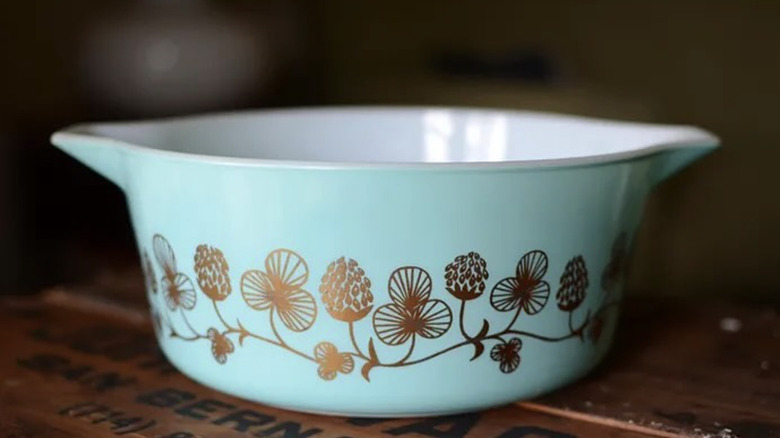
The Clover Berry Pyrex pattern is printed onto a turquoise background and features three-leaf clovers and so-called berries. Though they're often assumed to be raspberries or strawberries, a more realistic interpretation is that they're puffy red clover flowers. This pattern winds around the bowl, creating a whimsical border that only serves to enhance its popularity. A wraparound motif is a trademark of Pyrex glass cookware.
What sets this Clover Berry apart — and the most likely reason for its limited production run — is the fact that the pattern is printed in metallic gold. Similar to Starburst dishes, another of the most valuable Pyrex pieces to keep an eye out for while thrifting, the Clover Berry pattern glistens attractively in the light and acts as a gorgeous contrast to the turquoise-hued glass of the bowl. As mentioned, it also means you should avoid putting the thing in the microwave. Do so and you risk arcing (visible sparking) or overheating the metal and melting or warping the pattern. What's more, metal finishes on dishes produced before the 1970s may contain lead — it's safer to use the dish for display.
If you're lucky enough to come across Clover Berry in the wild, you can expect a major payday. Dishes featuring this highly sought-after pattern can go for anywhere between $5,000 and $6,000 on the resale market. Because of their rarity, they tend to attract strong demand from collectors willing to pay such steep prices.