

What Happens When You Spread Yogurt On Your Window
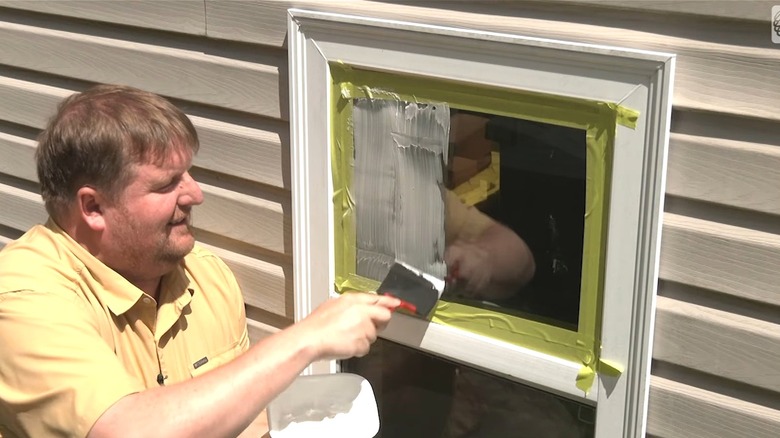
Keeping your doors and windows closed and turning on the AC to cool down your interiors might seem like the only way to beat the extreme summer heat. But with the days getting hotter and temperatures rising by 2.6 degrees Fahrenheit on average across the U.S. (per Climate Central), it isn't a sustainable option. This is especially true if you don't want your electricity bill to skyrocket dramatically. Besides being bad for your wallet, using the AC constantly will have an adverse impact on the environment. Considering this, many homeowners are trying out creative ways to cool a room without air conditioning. And one such method is to spread yogurt on a window.
But what happens when you coat your panes in this dairy product? To find out for certain, Dr. Ben Roberts, Loughborough University's senior lecturer in healthy buildings, and doctoral researcher, Niloo Todeh-Kharman, conducted a week-long experiment. According to BBC, they discovered that this strange hack can cool down your interior by an average of 0.6 degrees Celsius or 1.08 degrees Fahrenheit. This happens because the spread yogurt creates an opaque layer on a glass pane and prevents free entry to the sun's rays. Instead, being white, it reflects the rays back to cool down your humble abode. But, keep in mind, this effect won't be pronounced throughout your house if not all your windows are smeared with yogurt. The cooling effect will be most immediately felt in the room with yogurt-covered panes. Moreover, this slightly messy solution may invite pests and could even damage your window with repeated use.
Spreading yogurt on your windows can make your home cooler, with tradeoffs
The biggest pro of spreading yogurt on your windows is that it can noticably lower your home's interior temperature. In fact, Dr. Ben Roberts revealed to BBC that the difference between your exteriors and interiors could be as much as 3.5 degrees Celsius (6.3 degrees Fahrenheit) on particularly hot days when the sun is merrily shining overhead. Plus, he mentions that you don't have to worry about the smell since it dissipates as soon as it dries; the 10% fat Greek yogurt used in the experiment settled in about 30 seconds. Moreover, the application process doesn't take long and you don't need yogurt in large quantities — a few spoons should be enough to cover an average-sized window. It's a weird but budget-friendly solution for cooling down homes during summer. Just stick with non-flavored yogurts for the best results.
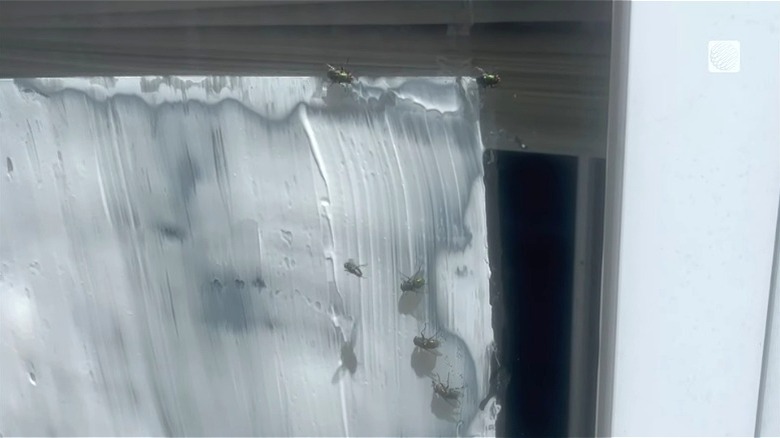
However, there are certainly some downsides to consider before coating your windows in dairy. This method is not as effective as covering your windows in aluminum foil, which offers better protection from the sun's unrelenting glare. As you might expect, smearing a food source outside could attract flies and other pesky pests to your home. Additionally, yogurt's acidic, sugary, and fatty properties might wreak havoc on your window's seals, which could lessen their energy-efficiency over time. Plus, cleaning the sticky substance later may be difficult and time-consuming, and you'd also be wasting perfectly good yogurt. However, in a severe heat wave, it's worth noting that yogurt is an effective barrier!