

The Right Way To Prune Tomatoes In June For An Abundant Harvest
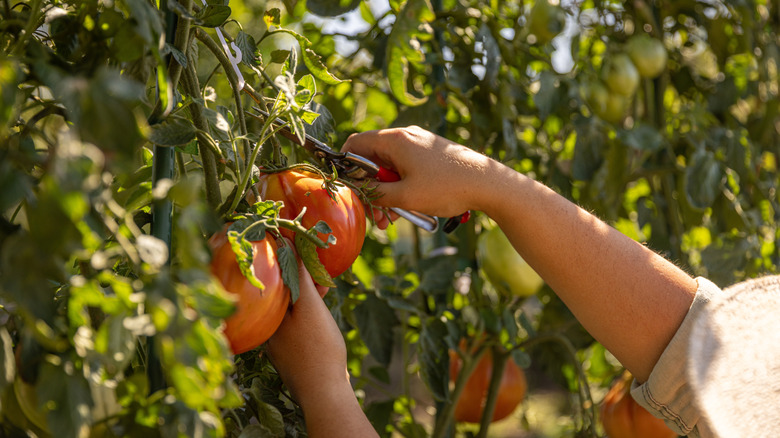
A common rule of thumb for gardeners is that you can never have too many tomatoes. Along with their health benefits, tomatoes are great companion crops for parsley and basil, and they produce a high yield for a relatively small amount of real estate. You can enjoy fresh caprese salad and gazpacho all summer, and freeze tomatoes to create soups and sauces in the colder months. You can even create a summer simmer pot with them. If your tomato plants are already starting to grow, June offers a crucial window for pruning that will catapult your yield — in case you want to share your bounty with the neighbors, as well.
The best time to prune your tomato plants for more fruit is as soon as your crop is transplanted into the ground. This should be done after the last spring frost, when soil temperature consistently reaches at least 60 degrees Fahrenheit and doesn't dip below 50 degrees Fahrenheit at night. In most of the U.S., this happens by late May or early June.
Once your plant is in the ground, you'll want to snip off early flowers so that it can focus on growing bigger and taller early in the season. A larger, hardier plant will produce many more tomatoes than one that spends energy on early flowers. As late spring turns into early summer, the growth of your tomato plants will accelerate rapidly during these longer, warmer days. Early and continued pruning will dramatically increase production later in the season.
How to effectively prune your tomato plant
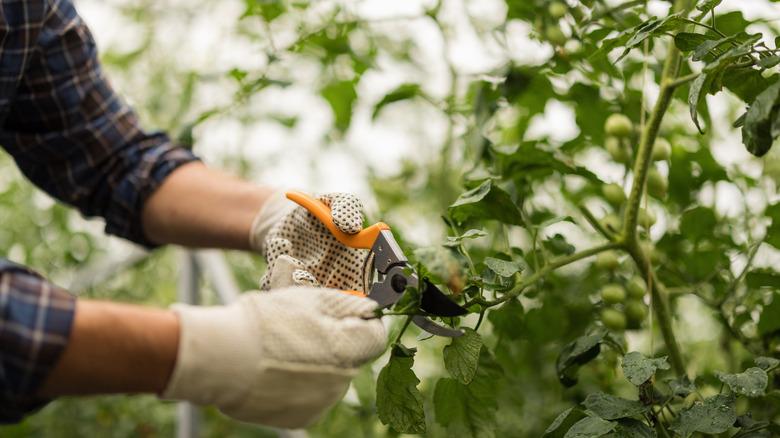
First things first — check your plant's tag to verify if it is indeterminate or determinate. For indeterminate, or vine tomatoes, pruning improves circulation and increases the amount of sunlight reaching inner leaves. Determinate, or bush tomatoes, have one harvest, and therefore shouldn't be pruned. If your plant is indeterminate, you'll want to start careful pruning as soon as it is in the ground and at least 12 inches tall, which typically happens by early June.
Before your plant reaches 12 inches tall, you can pull off any early flowers by hand. Once it has topped a foot, you will notice new stems growing off the main stem. These are called suckers. The leader, meanwhile, is the main stem growing from the root of the plant. Suckers are smaller, thinner stems that shoot out along the main stem. Cut back all suckers and other vegetative branches (which are suckers without flowers) from the main stem right at the joint — but be careful not to snip the leader. Smaller stems can be snipped using a small thumb knife, while larger pruning shears may be required for thicker stems.
Some gardeners select only one main stem, though the general suggestion is to select two to four. Trim all remaining offshoots. Beginning in early June, regularly prune your plants every week or two throughout the growing season. This will allow the main stem to grow taller and hardier. It may get so tall, in fact, that you'll need to reinforce it with a trellis or ladder. How do you know when it's too late to prune tomato plants? Not until the first frost.