

15 Weird Tools That Are Surprisingly Useful
We may receive a commission on purchases made from links.
Most households have some kind of basic toolkit that lets them handle things like hanging pictures, tightening a loose handle on the kitchen drawer, putting together flat-pack furniture, or even doing some simple DIY and carpentry. But anything beyond that often requires specialist tools that most people don't have until they need them. With the right tool, a job that would be an afternoon of knuckle-scraping with the random assortment of inappropriate tools in your toolbox can become a short, manageable repair. A basin wrench is a perfect example. Without one, you can spend ages lying under a vanity cabinet, trying to loosen a faucet nut with a standard wrench that simply cannot reach the right angle. With a basin wrench, the same job is faster, less painful, less frustrating, and completed in pretty short order.
Outside of the things we all recognize (like hammers, saws, and drills) there are an impressive number of puzzling and weird-looking tools that are the solution to very specific problems. A jab saw, an offset screwdriver, or an inflatable shim are all bizarre-looking things, but each has a very specific single purpose that nothing in your standard toolbox can replace cleanly. You might not need these tools every single weekend, but having the ones on hand that solve the most likely problems your home may encounter is a sensible move for an enthusiastic DIYer.
Basin wrenches can be a game-changer for replacing faucets
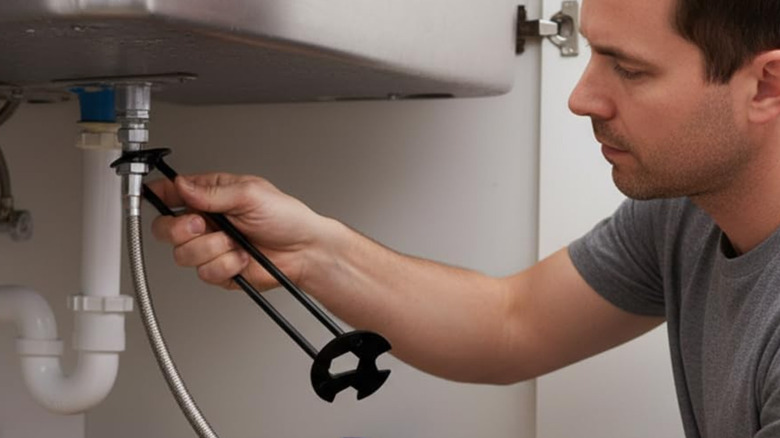
One of the best tips for changing a faucet is to use a basin wrench. It's a weird-looking contraption that you use to tighten and loosen mounting nuts that are pressed flat against the underside of a sink. No conventional wrench can reach these nuts at the right angle. A basin wrench has a long shaft and a pivoting spring-loaded jaw that grips the nut. Many ratchet in both directions. Using one of these means that you can replace a faucet without having to remove the cabinet below.
Many, like Klein Tools' 10-17-inch basin wrench, are telescoping models that adjust in length so you can reach mounting hardware at different depths. You can reverse the wrench from tightening to loosening by flipping it 180 degrees on the shaft. The basin wrench eliminates the frustration, pain, and bleeding knuckles that come with working under a sink, trying to turn a nut with a pair of pliers and lots of cursing. It lets homeowners tackle a simple plumbing job without the expense of hiring a pro.
Jab saws negate the need for pilot holes
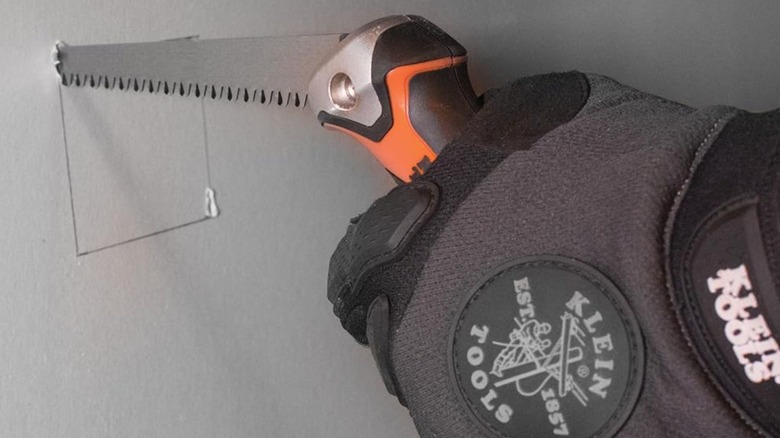
You don't necessarily need a power tool to perfectly cut out electrical boxes in drywall. A jab saw, also known as a keyhole saw, has a pointed tip that pierces the drywall surface without you needing to drill a pilot hole. This means you can start the cut exactly where the opening needs to be, without having to haul out another tool.
This saw has a short stiff blade so once it is inside the wall, you can easily follow layout lines and get precise rectangular or circular cutouts. Because this is a manual hand tool, it produces less dust and noise than a jigsaw or oscillating multi-tool. Many jab saws can also handle thin wood, plastic, and paneling so you're not just confined to making cuts in drywall. While you probably don't want to cut huge areas with a jab saw because of the manual work involved, these little tools are useful and convenient for making small cutouts.
Pocket hole jigs are indispensable for basic woodworking DIYs
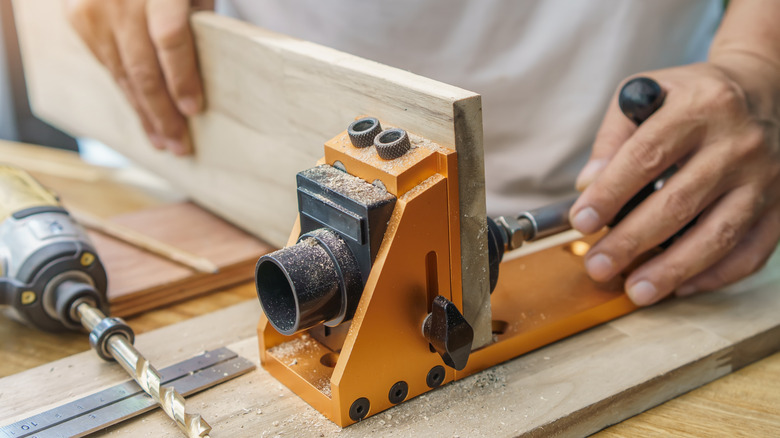
Most woodworkers will immediately recognise a pocket hole jig. These weird little contraptions are used for pocket hole joinery. They drill angled pilot holes into one board so that a self-tapping screw can draw that board tightly to a second. The process creates joint that's easy to hide and strong enough for furniture, cabinet face frames, and shelving. This useful tool lets you create strong joints without clamps or glue and doesn't require mortise work or complex cuts.
A pockethole jig is not a tool that every household would need. But for anyone interested in joinery, or popular woodworking DIYs, it's a fairly basic tool for things like face frame construction and box assembly. Do note, though, that it's not suitable for fine furniture joinery or applications where the joints are under significant stress.
Seam rollers can lock down the edges of both wallpaper and vinyl flooring
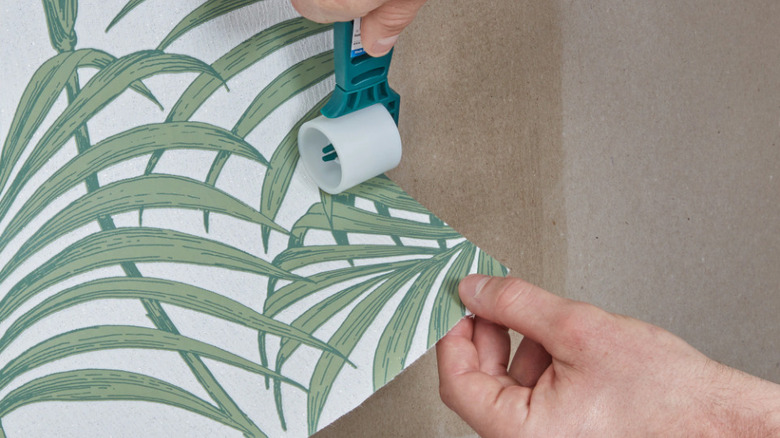
Seam rollers look more like a craft item that you'd use to make sure the little plastic diamonds in your diamond painting kit are all firmly pressed down rather than a purely practical DIY tool. However, they are one of the best ways to hide vinyl floor seams or minimize wallpaper seams. You just can't achieve the same level of even consistent pressure with your hands or feet. A squeegee also doesn't do a good job of generating enough consistent pressure in a long, narrow line.
When you use a seam roller, however, it applies consistent, focused force with its small, narrow roller on a short handle, and it presses joins and edges flat without tearing the material. These tools look like tiny lawn rollers, and they essentially act in the same way. They apply consistent pressure to flatten a surface. Yes you can use them for getting tight, minimally visible seams, but you can also use them for tasks like vinyl wall base installation along baseboards and/or around door frames where the material needs to bond firmly, especially at corners and transitions, which can be particularly tricky without a tool like a seam roller.
Deck board straighteners are the answer if you're adhering warped planks
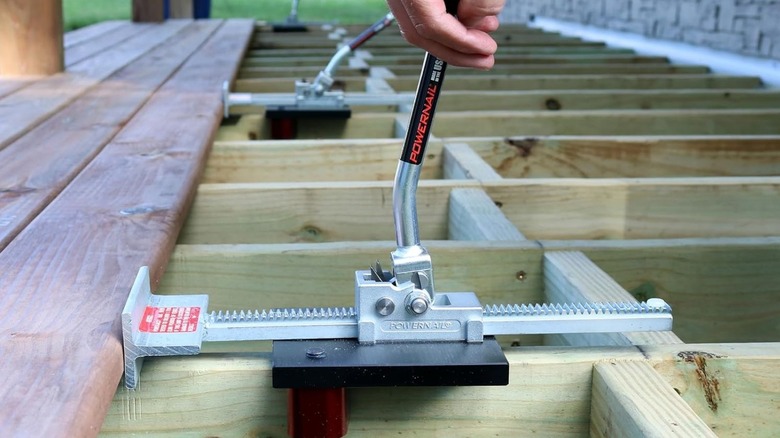
Laying a deck is an achievable DIY project for many homeowners. However, trying to install and align boards that are even a little bit bowed or warped is a real challenge that requires at least one extra pair of hands. Attempting to force a warped board into alignment with a pry bar while the second person desperately holds the board in place, and you or a third person tries to fasten it and secure it, is definitely not easy — and it can be very frustrating too.
Using a deck board straightener is one of the cleverest tips to help you get the perfect deck. It doesn't have much use beyond straightening deck boards, but for that one specific job, it's a lifesaver. Most models work by clipping to the joist with adjustable pins. There's a cam lever that presses directly against the bowed section and then one firm swing from you brings the board into alignment and holds it steady, so that you have both hands free to drive in the fastener while the cam holds the position of the board. The boards are straightened mechanically, so they end up with uniform spacing and aligned faces. If you're fairly certain that you're only going to use this tool once in the next decade or two, you can rent one rather than buy.
Offset screwdrivers are a godsend in tight spaces
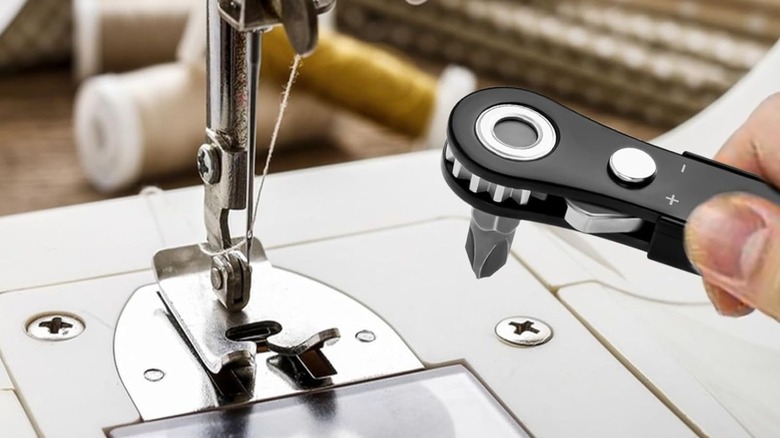
Some offset screwdrivers look more like an otoscope (that little device that the doctor uses to look in your ears) than an actual screwdriver. The tip is positioned at a 90-degree angle to the handle. This means you can reach screws in tight spaces where there is no room for you to use a straight screwdriver or to line up a drill. For example, screws around the edge of a door knob (that's just big enough to obstruct the shaft of the screw drive), and fasteners that are inside cabinet interiors, and appliance access panels.
You can get offset screwdriver sets that look more like Allen keys or Z-style ones with a Phillips at one end and a flat head at the other. You can also get low-profile models that are useful for quick jobs in very tight spaces: These are fairly budget-friendly and often come as a lightweight set attached to a key ring, such as this Railer set. For more robust or professional requirements, you can get chunkier offset screwdriver sets with interchangeable heads and a ratcheting mechanism (such as this Pocione Ratchet Wrench).
Ratcheting pipe cutters make quick, burr-free work of plumbing cuts
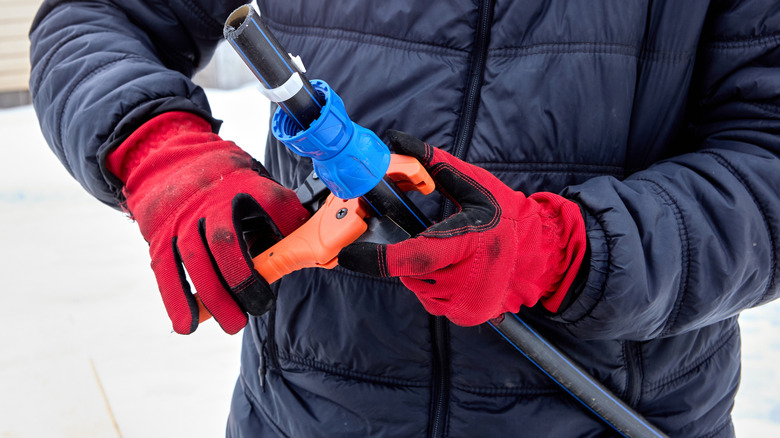
Ratcheting pipe cutters do a much cleaner and better job of cutting PVC, CPVC, or PEX compared to a hacksaw. With a ratcheting pipe cutter, the cuts are straight and clean, whereas with a hacksaw, the cuts are usually rough-edged and slightly angled. This causes potential leak points and problems when fitting.
A ratcheting pipe cutter has a scissor-style blade that works with a geared mechanism that advances the cut by only a small increment with each squeeze; hence you get a clean, square, burr-free cut. These odd-looking tools are also good for working with pipes in tight spaces, such as inside walls, under sinks, or in crawl spaces, where you wouldn't be able to properly operate a saw anyway. Most of these tools are designed for homeowners handling pipes up to an inch and a half in diameter, which is perfect for the majority of residential supply line work. It's still a good idea to check the size range before you purchase, as some specialist ones have a larger or smaller cutting diameter.
Inflatable air shims can make leveling doors, appliances, and windows a breeze
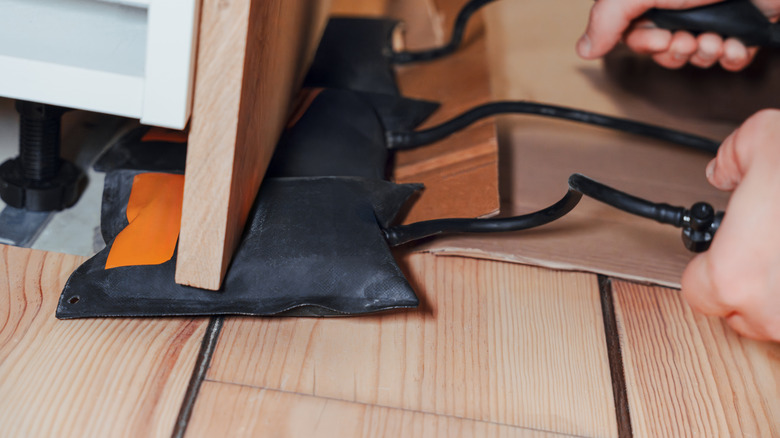
Inflatable air shims look more like a blood pressure cuff or perhaps an industrial-grade whoopee cushion than an incredibly strong type of wedge. Many people are surprised that such a seemingly small thing that gets filled with air can hold such heavy weights. Basically, you slide the deflated bladder beneath the thing you want to lift, whether that's an appliance, a door, a cabinet, or something else, then you inflate the bladder, usually with an attached pump, by hand. As it inflates, it lifts and adjusts the load in small increments. Because the shim spreads pressure over quite a large area, it's far less likely to damage surfaces than a wooden wedge or a rigid pry bar.
For wider objects you can use two shims, with one at either end, to allow for more precise adjustments. These tools are especially useful for when a single person is trying to level a countertop, place an appliance, or install or adjust cabinets, doors, or windows. The air shim safely holds the object in place while the DIYer works, as long as the load stays within the shim's range.
Broken bulb extractors
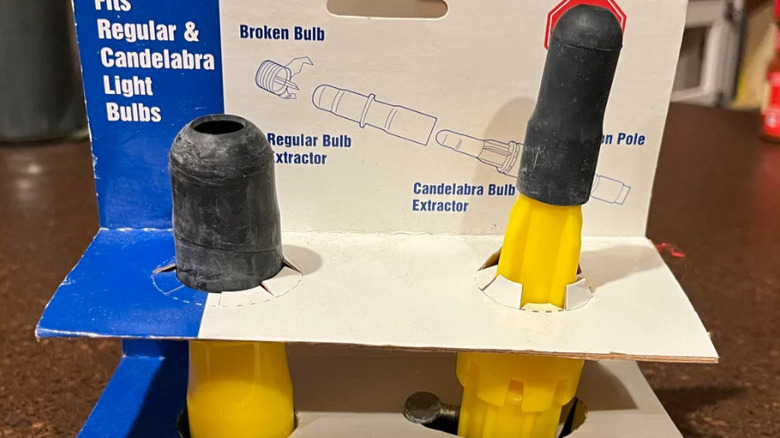
When someone tries to unscrew a stubborn light bulb with too much torque, it can snap off at the base, leaving the threaded metal shell locked in the socket. To get it out safely without a proper tool, you would have to turn off the current to the light sockets in that room and then use pliers or other improvised solutions to try and get a grip and coax the metal base out. Remember, never to attempt this without first making sure that there is no electricity running to the socket, as putting metal-tipped pliers into an energized light socket is a really, really bad idea.
A broken bulb extractor usually has an expanding tip that goes on the inside of the bulb's shell, grips from the interior surface, and lets you unscrew the whole thing cleanly with a couple of twists. Again, for the sake of safety, make sure you turn the power off at the breaker before attempting this. Broken bulb extractors are comparatively inexpensive (the Bayco Bulb Extractor set on Amazon is under $14) and usually have a kit with multiple tip sizes. You can also get ones with extension handles so that you can safely remove broken bulbs even on high ceilings.
Drywall lifts can make installing ceilings a relatively easy, single-person job
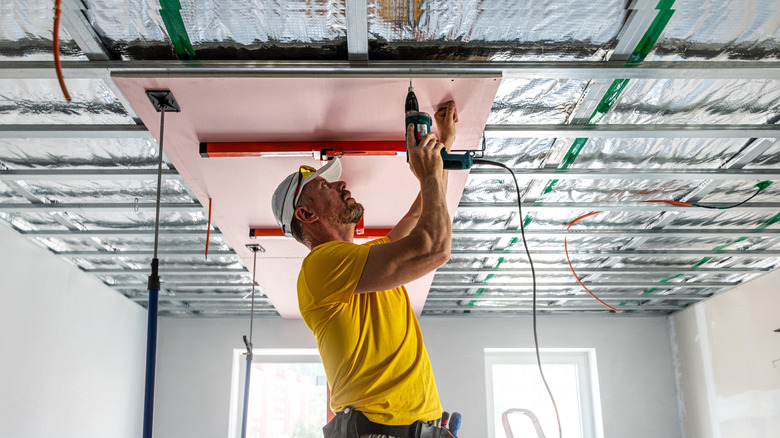
Hanging drywall, especially on a ceiling or a slope, is genuinely miserable work, even with two people to help. The sheets are heavy and awkward, and trying to keep them in place, especially above your head, is difficult. A drywall lift is an odd-looking contraption that can make putting drywall on a ceiling easy. It also has an adjustable tilting frame so that you can raise the drywall via a hand crank and angle it in whatever position you need it.
Once it's in position, you just stop cranking and maneuvering it, and get the fasteners driven in. This lets one person do the job more comfortably. These lifts aren't that expensive to buy, generally costing somewhere between $150 and $250. However if you don't think that you will get enough use from a drywall lift to make the purchase worthwhile, you can hire one from a local equipment rental store or chain like Home Depot for a daily or weekend rate.
Nail holding pliers can prevent fingers injuries
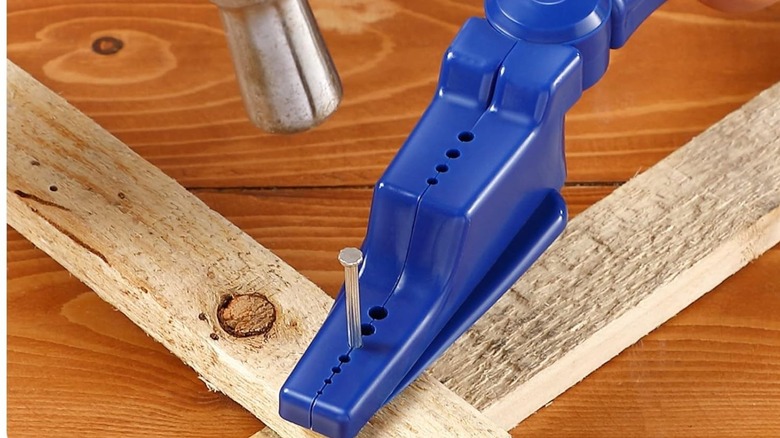
Nail holding pliers save your fingers. They are tough plastic contraptions that let you safely hold a nail in place while you start to hammer it in so your fingers don't get smashed by the hammer if your aim slips. They work by holding or gripping the nail through a hole in the jaw. They keep it stable and in the right place without your fingers having to be near the impact zone.
Although they're super simple, nail holding pliers are something many people lack in their toolbox, which they'd actually get quite a lot of use from. If you are not a great aim with a hammer or you are having to drive a nail in a hard-to-reach spot or at an awkward angle, your fingers will most definitely thank you for switching to nail holding pliers. Most of them have multiple holes of different sizes down the length of their jaws to accommodate nails of different thicknesses.
Grout saws are the most precise way to remove old, crusty grout
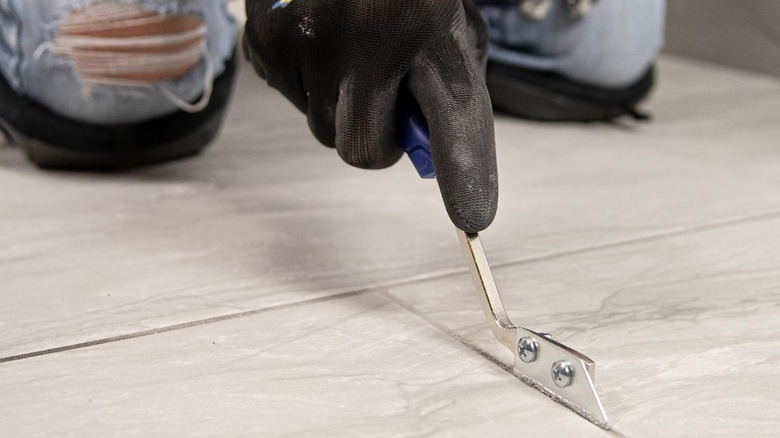
If you've got old, cracked, and stained grout, it will just get worse over time. There's only so much those grout whitening pens and cleaning products can actually achieve. For a proper fix, you've got to remove and replace the old tile grout. But the challenge is removing grout cleanly without disturbing the surrounding tile. It's very easy to accidentally pop a tile off the wall or cause cracks while you're trying to dig out the old grout.
Grout saws have carbide grit blades that are super-narrow and work between the tiles, in the grout line. To get the material out, grout saws use an abrasive cutting action. It's true that it takes more passes than using a power oscillating tool, but it also produces cleaner, more controlled removal and there's less risk of chipping the tile. Work it in short, controlled strokes in the grout line rather than using one long continuous pull so that you've got better control over the cut depth.
Pivot drill bit holders are another solution for fasteners in tight places
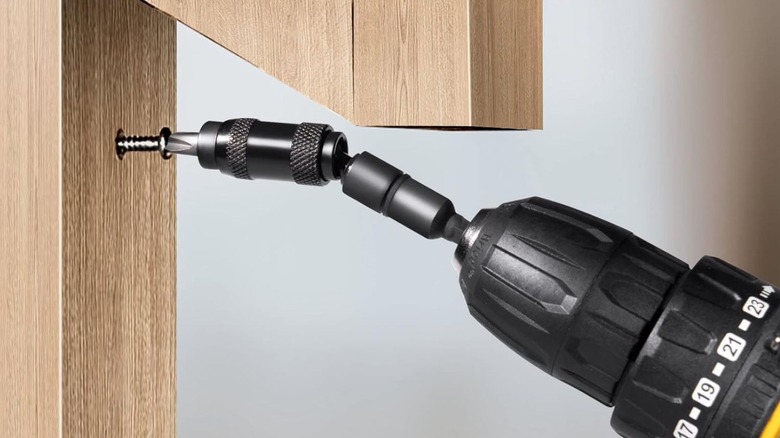
Pivot drill bit holders are for those times when you are working in tight or awkward spaces where you just can't get a regular drill properly aligned with the fastener. For example, where you're working close to a corner, and you're trying to fasten something, but the drill keeps hitting the wall on the side. A pivot drill bit holder is just a short attachment that angles the drill bit 15 to 30 degrees off the drill body's axis.
Using one of these lets you operate the drill cleanly at the correct angle without worrying about obstacles. Most models, such as Dewalt's Impact Ready Pivot Holder Set, are universal and accept hex shank bits and fit most drills. Fastening hinge plates where the door frame prevents you from using a standard drill, or installing shelf brackets inside a built-in, are good examples of where this budget-friendly attachment is invaluable.
Froes are an old-fashioned but highly handy tool for splitting wood
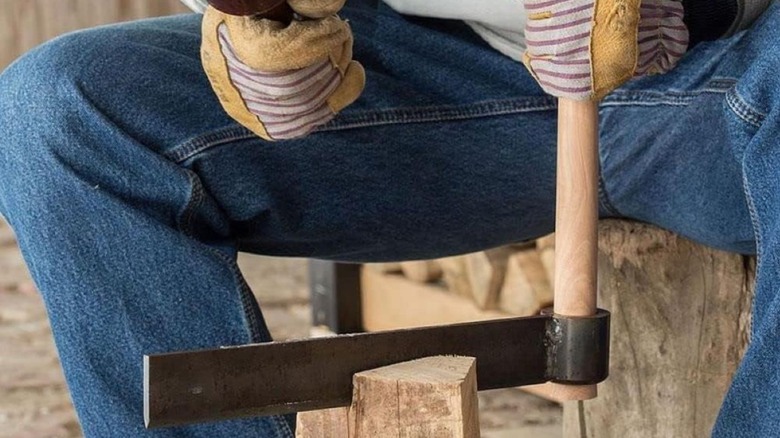
A froe is a very old woodworking tool that looks like a combination of an upside-down axe and a scythe. It's got a long blade set at a right angle to a wooden handle and requires a striking mallet. You can buy them as a set, like this wood froe and mallet set from LemonRoad. It's a traditional tool for hand-riving shingles, cleaving barrel staves, and splitting logs in a controlled manner. It's basically used to split wood following the natural structure of the grain and separating the fibers cleanly rather than cutting across the grain as you would with a saw.
Most people don't use froes for making their own shingles or barrel staves anymore. However, they are also used to split wood into kindling. Even if you are not a traditional woodworker or involved with green woodworking, if you have an open fire, a froe is a nice, simple tool that lets you easily split wood for burning, without needing to go swinging an ax from over the shoulder.
Contour gauges take the guesswork out of awkward cuts
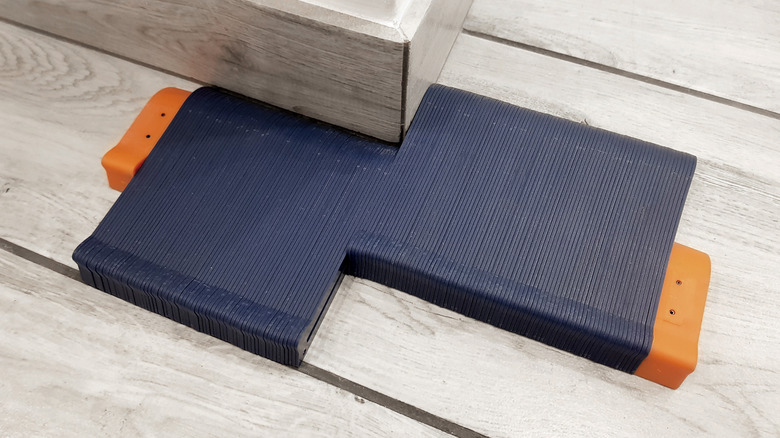
When you're laying tile, flooring, wallpaper, or trim, you will inevitably encounter shapes other than a straight line, such as the curve of a toilet, a sink, a drain pipe, or decorative trim. Accurately measuring those so that you can get clean, seamless cuts for a well-finished installation is something that a tape measure and pencil just can't do. A contour gauge, like this connectible 20-inch model from Toolife, is the tool you want for this kind of situation and is something that most households could do with in their toolkit.
Contour gauges press against odd shapes and you can lock the gauge in place so that it captures the close profile of the shape. Then you can trace that shape onto the tile or flooring or wallpaper that you're cutting. There are lots of different options when it comes to contour gauges and many are expandable and can connect with extra pieces for long runs.