

What Happens If You Put A 100W Bulb Into A 60W Socket

Unless you have plenty of experience, electricity isn't something you want to play around with. There are plenty of electrical projects you shouldn't attempt at home unless you're a pro, but even something as simple as changing a lightbulb could cause a major risk if you're not careful. In 2024 alone, the National Fire Protection Association identified over 48,000 fires in the United States that were caused by home electrical problems and missteps. This should, of course, encourage you to watch out for signs that you need to call an electrician, but it's also a great reminder to educate yourself about how electricity works and what might be considered unsafe, including using 100W bulbs in 60W sockets.
Before you screw in a replacement bulb into a socket, make sure you check the wattage. Wattage simply refers to how much power a device needs to operate, and in the case of lightbulbs, this measurement is very clearly displayed on the packaging. Many sockets are only rated for 60W, so using a true 100W bulb could cause major issues like a circuit overload, resulting in heat buildup or even a fire.
With that being said, however, things can get more complicated when you bring LEDs into the picture. Now that most people have started to make the switch from incandescent lightbulbs to more energy-efficient alternatives, the risk of fire, production of heat, and amount of energy required to light a space have seen some major changes.
Why do LEDs make a difference?
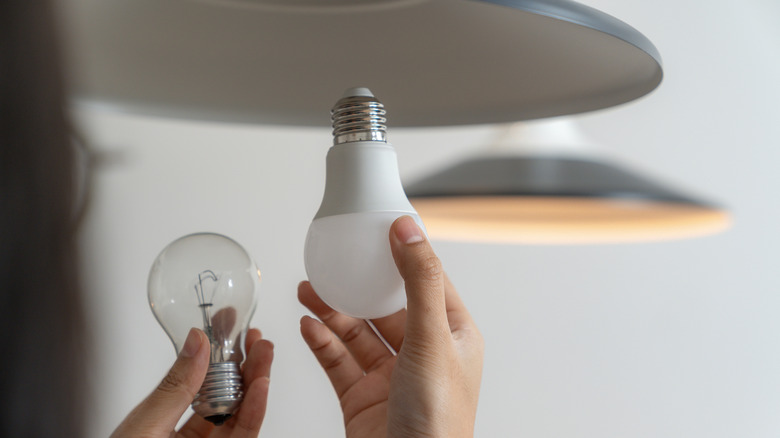
In an effort to make LED brightness levels more understandable to consumers who previously only used incandescent bulbs, many lighting brands market their products using equivalent watts. Essentially, this number reflects the wattage you'd require out of an incandescent bulb to get the same level of brightness as the LED you're purchasing. It's not a measurement of the actual power draw of the bulb, just a representation of brightness that is easier to understand for many customers. Because of this, screwing a 100W-equivalent LED bulb into a 60W socket shouldn't cause any issues.
This translation can be a bit confusing to customers, but it doesn't need to be. As Ledvance notes, a 100W-equivalent LED bulb produces anywhere from 1380 to 1600 lumens, the same as a 100W incandescent bulb, but it only draws between 12 and 14 watts of power. LED lights are much more energy-saving and produce significantly less heat, so there is little to no fire risk when using them.
As such, if you're worried about the risk of a fire or just want to reduce your energy costs at home, LEDs are always a better bet. However, if you crave that true incandescent glow or still have a stock of old lightbulbs lying around, it's necessary to exercise caution and check the wattage on both the bulb and the socket to confirm you don't have a mismatch. Either way, it's best to do your due diligence and double-check the items you're working with — it might be a hassle to buy a new bulb, but it's much more of an undertaking to recover from a house fire.