

The Antique Dolls You'd Be Thrilled To Find At The Thrift Store
If you don't have any little ones in your life, you might be tempted to skip the toy section while you're out thrifting. But buried among the worn-out board games, plastic keyboards, and abandoned plushies you could find a treasure worth hundreds, if not thousands, of dollars: a Jumeau doll. It's a valuable vintage doll you should definitely buy at the thrift store — if you can find it. These elaborate French playthings are named after their creator, Pierre Jumeau, and they were incredibly popular in the late 1800s. It's not going too far to say they revolutionized the toy industry at the time. Despite making their first appearance in children's rooms so long ago, these stylish dolls are coveted today for their quality, originality, and antique aesthetic. In fact, quality is built into every component of these toys.
With heads made from hand-painted bisqued porcelain and couture-inspired clothing in luxury fabrics, Jumeau dolls were toys for the upper crust, not commoners. They were typically only found in the nurseries and playrooms of children from wealthy families. Today, given the rich history, rarity, and craftsmanship of Jumeau dolls, their value has only increased. A rare thrift store find could earn the seller thousands of dollars if the doll is in prime condition. However, even a damaged Jumeau can — and usually does — go for triple-digit prices. Aside from authenticity, large or first-run dolls garbed in original clothing and flaunting their original face paint fetch the most money. Of course, a brand new doll is not going to be authentic, so you need to keep your eyes peeled for imitators when out thrifting.
How to identity an authentic Jumeau doll versus an imitation
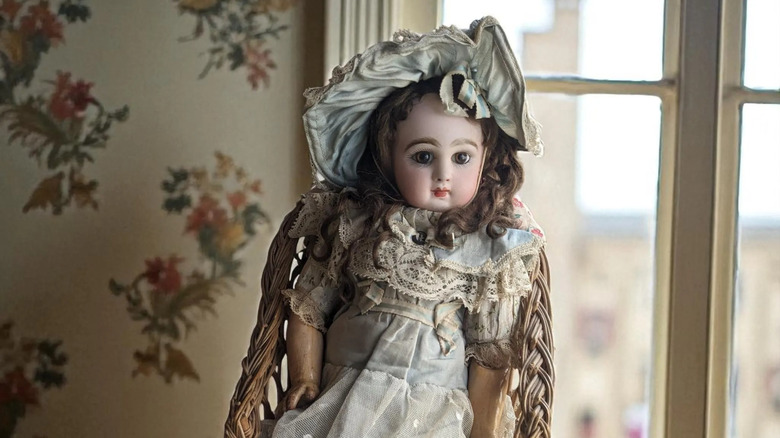
If you find this vintage doll at the thrift store, you may be sitting on a small fortune. But like any popular collectible, Jumeau dolls have their fair share of imitators. A quick search for Jumeau reproductions on Etsy, for example, will yield over 500 results — even the dupes go for hundreds of dollars. Some doll collectors and fans of the Victorian aesthetic aren't perturbed by reproductions, while others are wary. A proportion of the so-called authentic dolls on the resale market are new dolls with antique parts; some even sport forged maker's marks. Unfortunately, a gullible collector can easily spend $500 or more on these imposters. Whether you're interested in Jumeau doll collecting or just want one as quirky home decor, you'll need to brush up on how to authenticate your latest thrifting find.
Start by giving the doll a head-to-toe quality check. Jumeaus are finely crafted with smooth bisqued porcelain parts in natural skin colors. Anything overtly glossy or stark white is likely not a Jumeau. The intricate eyes, lashes, brows, and lips were painted on by hand, typically in delicate, blush colors. The doll's hair will be real human hair or mohair — it won't be synthetic. An authentic Jumeau doll will also be over 100 years old, so it's likely to have an obvious patina. Another big indicator of authenticity is the doll's eyes. There were made from layers of clear and colored glass and look uncannily real, with obvious depth and shimmer. The earliest — and most valuable — Jumeau dolls have slightly asymmetrical, almond-shaped eyes. If your thrift store find has all of these telltale signs, take it to an appraiser to confirm its value.