

New Harbor Freight Items To Avoid In 2026 (So Far)

Harbor Freight is well-known for being a reputable destination for everyday tools at affordable prices. With essential DIY items like storage cases, pliers, tarps, clamps, and screw sets priced at $10 and under, there are many Harbor Freight tools you should know about. What makes some of these popular tools great is that they can easily replace expensive brands. On the downside, not every item is worth buying, as some product lines like Pittsburgh and Chicago have a reputation for not lasting as long as other options. Many of the products sold under those brand names prioritize low cost over long-term durability. They can be an inconvenience if you discover they don't work when you need them. At worst, they can fail in the middle of a job.
However, not every questionable Harbor Freight tool suffers from poor build quality or reliability issues. In many cases, the drawbacks are less obvious. Some tools carry hidden costs that significantly increase the total price of ownership, while others include design issues that limit their practicality. Even products that receive generally positive reviews can have shortcomings that make them less appealing once you look beyond the marketing claims and advertised specifications. Among Harbor Freight's newer offerings, culprits include the Hercules cordless surface conditioning tool, Braun's rechargeable slim headlamp, Quinn's master technician tool set, and Doyle's dual-range noncontact voltage tester. That's why knowing which Harbor Freight tools to avoid in 2026 is just as important as knowing which ones are actually worth buying.
Hercules Brushless Cordless Surface Conditioning Tool
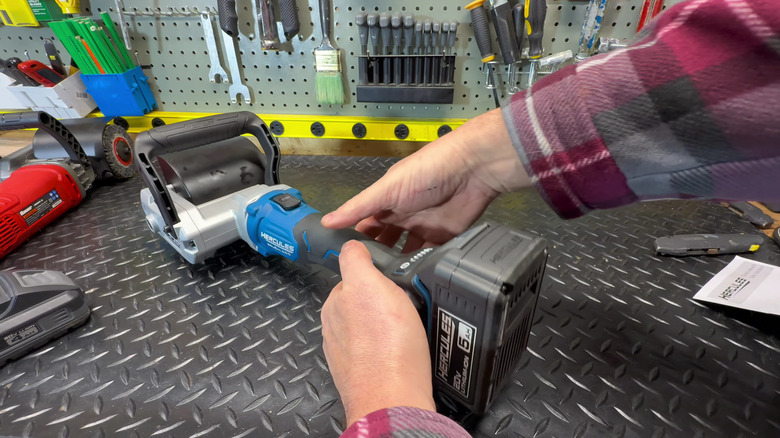
The Hercules Cordless Surface Conditioning Tool is one of the newly added additions to the Hercules lineup at Harbor Freight. Many can argue that it's one of Harbor Freight's Hercules power tools that is worth buying. On paper, it sounds like an especially appealing device, as the cordless design adds portability and convenience, which allows users to work away from power outlets without dragging extension cords around a jobsite. The biggest issue, however, is that the advertised price doesn't tell the whole story. While the tool itself is reasonably priced, it is sold without a battery or charger. To acquire those, you'll have to purchase them separately at around $100 for the 8 Ah lithium battery or $71 for two 4.5 Ah batteries at Amazon, and about $35 to $67 for the charger. This means that the combined cost of the tool and its charging necessities can exceed the price of the tool itself.
In addition to that, the battery itself adds a weight to a rather heavy device, making it more difficult to use the tool. The cordless design also raises questions about whether the trade-offs are truly worth it. Surface conditioning can take time depending on the job, and it can become a power-hungry application that often requires larger batteries for acceptable runtime.
Quinn Master Technicians Tool Set
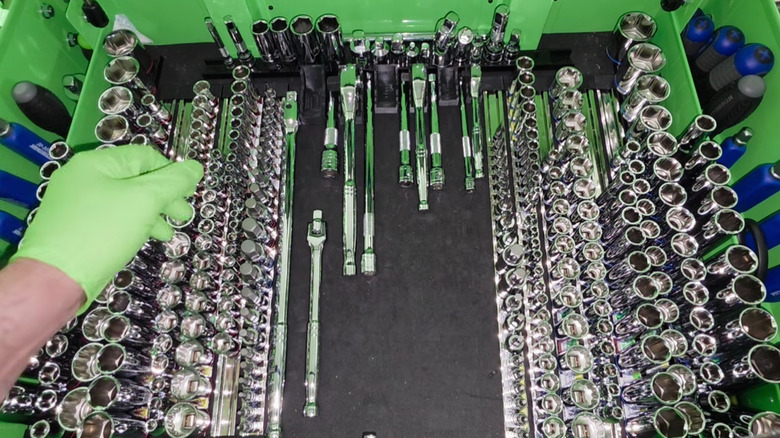
Large mechanics' tool sets are often marketed as the easiest way to build a workshop. Instead of purchasing sockets, ratchets, wrenches, and accessories individually, buyers can get everything in one package and start working immediately. That has always been the appeal of the QUINN Master Technician Tool Set. With more than 400 pieces included, it appears to offer a comprehensive collection of tools that can serve as the foundation of a home or professional workshop. Harbor Freight recently replaced the original version with an updated model, switching the old 72-tooth ratchets with ultra-thin sealed-head 90-tooth ratchets. These new ratchets offer a tighter 4-degree arc swing for improved access in confined spaces. While the upgraded pieces are a welcome improvement, they don't fundamentally change the overall value proposition of the set and don't justify a repurchase if you already have it. This is especially true since many of the same shortcomings still exist.
One of the most common criticisms is the socket and wrench selection. Despite the large number of pieces, the set is not a true full collection, with several sizes omitted from the lineup. Many buyers have questioned whether a set carrying the "Master Technician" name should have these kinds of gaps, particularly at a price that now sits around $430. The impressive piece count can also be somewhat misleading, as a significant portion comes from bits, hex keys, and other small accessories rather than additional sockets and wrenches that mechanics frequently use.
Doyle Dual-Range Noncontact Voltage Tester
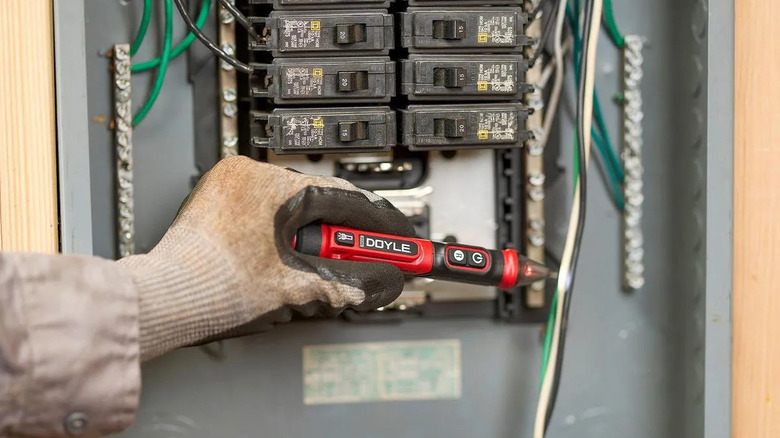
Non-contact voltage testers are designed to answer a simple question: Is this wire or outlet energized? The new basic noncontact voltage tester from the Doyle product line does that job reasonably well, but its design makes it difficult to use all the features to their fullest potential. One of the tool's main features is the built-in flashlight, which sounds useful until you actually consider how the tester is used. Because the flashlight is positioned on the back end of the device, you can't effectively use it while simultaneously checking for voltage. Customers also report that it emits a dim light in comparison to what you actually need for a maintenance job.
The voltage indication system is another drawback. Rather than displaying an actual voltage reading, the tester relies on two broad detection ranges that you switch between using the same button: a yellow LED for 12 to 1,000 volts AC and a green LED for 70 to 1,000 volts AC. In other words, it can tell you that voltage is present, but not how much voltage is actually there. While that's sufficient for basic go/no-go testing, it offers limited diagnostic value. More broadly, the Doyle doesn't do much to separate itself from the countless budget non-contact voltage testers already on the market that are unreliable. At the end of the day, Harbor Freight's slightly more expensive non-contact voltage tester with an infrared thermometer is arguably the more practical choice, since the added display and IR features provide a clearer benefit during troubleshooting.