

Need A Budget-Friendly Alternative To Landscape Fabric? Try This For Natural Weed Barriers
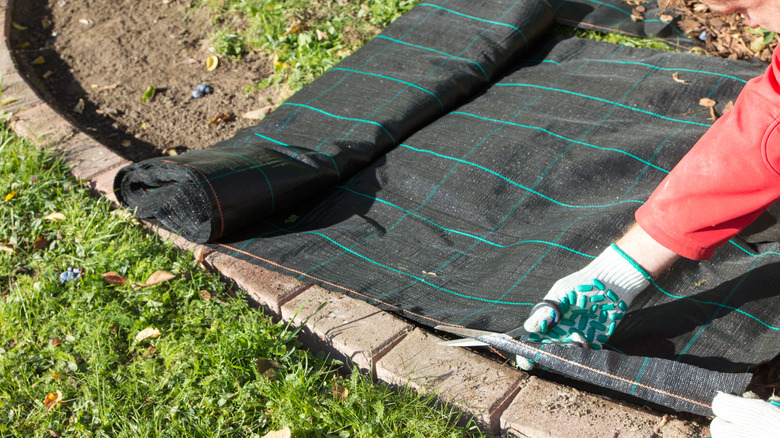
If you're preparing a new garden bed for planting, you probably want to put down some type of weed barrier once you've cleared the ground, so that the plants you want to grow don't have to compete with the weeds. It's also likely that you won't want to spend all of your weekends constantly pulling out the weeds that will persistently continue to pop up. At this stage, you may have gone and priced the various landscape fabrics available at the hardware store, and the better quality ones that are worth using to prevent weeds might just be out of your price range right now. Lucky for you, there's a budget-friendly alternative that you can use as a natural weed barrier — straw. You'll find that this is one of many ways you should be using straw in your yard.
Now, you do need to be aware that straw may not be as effective at keeping all the weeds at bay and may not be quite as good as landscape fabric, but it is more affordable and actually has additional benefits. The type of straw you buy is also important. You want to ensure that you purchase wheat or barley straw that's guaranteed to be weed-free. Stay away from hay, which will have seeds in it. The bales of straw you can purchase at your local garden center are usually tightly packed and will cover quite a large area once you spread them out. On average, a single bale should allow you to cover around 80 square feet if you lay the material 2 to 4 inches thick.
Other benefits of using straw as a budget-friendly alternative to landscape fabric
Apart from the initial cost-saving of the material, there are plenty of other benefits of using straw as a weed barrier. To begin with, you can lay the straw on top of the soil, water it a little, and that's it. The same cannot be said for landscape fabric. Since it's fairly lightweight, you'll need to use landscape staples to hold it in place. It's also not that aesthetic, so most gardeners will cover it up with soil before planting and then even add a layer of mulch afterward. This can all add to the initial cost and take you a little more time. Even planting in an area covered with landscape fabric is going to take a little longer because you have to cut holes in the fabric where you want the plants to go. Of course, this will also expose some soil where weeds can pop up.
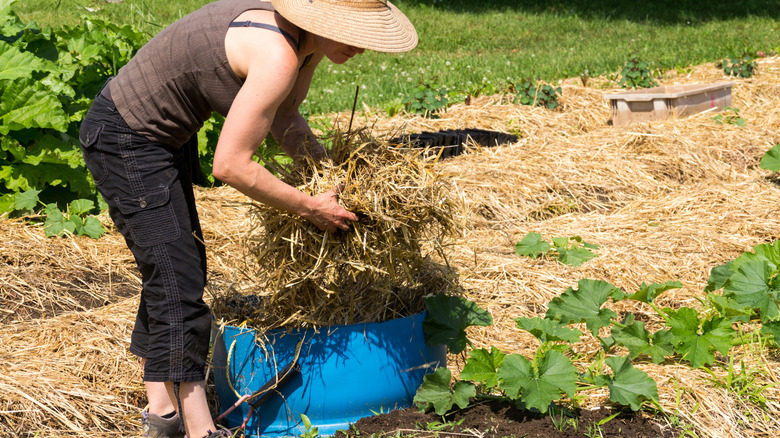
If you use straw instead, all you have to do is rake it back a little, insert the plant into the soil, and replace the straw around it. The straw will also act as a mulch to keep the soil at a more even temperature and help to hold in moisture, all while allowing water to drain through. In fact, it's the best type of mulch if you live in a wet climate. On the other hand, water penetration can actually be a problem with some of the cheaper landscape fabrics that may not let water through as readily, and you'll find that the soil underneath is quite dry. Finally, the straw will eventually break down and add nutrients to the soil, as well as keep all the microbial activity moving along.