

The Toxic Furniture Material That May Be Hiding In Your Home

Not all scary dangers that are lurking around your home announce themselves. They do not hiss, flash, leak, or smell strange. Instead, they just stay hidden, tucked under throw pillows, buried inside reading chairs, or deep within the sofa. Everything about them feels normal. Soft. Comfortable. Even familiar. Yet beneath that coziness may be a toxic material hiding in plain sight. It is called furniture foam, a synthetic material, usually polyurethane, that is commonly used as cushioning in homes. Scientists have repeatedly flagged it as one of the most consistent sources of indoor chemical contamination. Even worse? Traces of its byproducts have even turned up in breast milk. So, for some unlucky people, exposure to it started before they could even sit on a sofa.
The problem started when manufacturers began soaking foam with chemical flame retardants in the 1970s to meet California's Technical Bulletin 117 flammability standard. These flame retardants are not chemically bonded to a material. So, over time, they come out, disperse into the air, drift into household dust, settle on the floor, and eventually enter your body. And that is where the problems start!
Exposure to furniture foam and flame retardant compounds has been linked to fertility problems and hormone disruption, among many other things. Childhood exposure to these compounds has been associated with altered neurodevelopment, so furniture foam could be one of those child home hazards you may have missed, and it's not something you want in your home.
Spotting, removing, and replacing furniture foam in homes
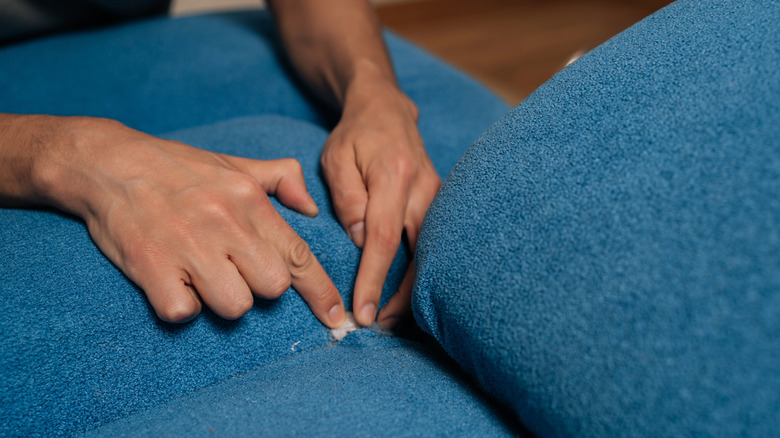
The tricky thing about furniture foam is that whether you can spot the problem depends almost entirely on when your furniture was made. Anything manufactured before January 2015 carries no label and no obvious warning. Manufacturers back then were simply not required to say what was in the foam. For pieces made after January 2015, though, things are slightly clearer. California's SB 1019 law requires every upholstered furniture manufacturer to include a label with one of two checked statements: either "contains added flame retardant chemicals" or "contains NO added flame retardant chemicals."
If there is no label, you can still check if it has flame retardants using Duke University's Nicholas School of the Environment, which offers a completely free program. All you have to do is cut a small foam sample and mail it in. Once analyzed, you will receive a full chemical breakdown back. If results confirm harmful compounds, replace the furniture or at least remove and restuff your couch cushions with something non-toxic. Just do not rip old cushions apart indoors to investigate. It can cause the damaged foam and dust to spread through the room, making the issue even worse. And if, for some reason, you cannot remove or replace the foam, keep dust under control with damp dusting, wet mopping, handwashing, and vacuuming.
Lastly, for the future, when buying new furniture or cushioning, choose items that you know have no flame retardants added to them. Or buy items using natural rubber, latex, or wool. Wool, for instance, is harder to ignite naturally. Plus, it is one of those materials that gives your home the perfect cozy look and feel.