

Homeowner Transforms Entryway With Stairs Made Entirely From Concrete Blocks
We may receive a commission on purchases made from links.
If getting into your home from the outside feels like doing step-ups at the gym, it might be time to add an exterior step or two. Maybe you already looked up how much it would cost to have them installed. If that number made your eyes pop out of your head, you may want to bypass the professionals and, instead, follow a straightforward DIY to make your own exterior steps with concrete blocks.
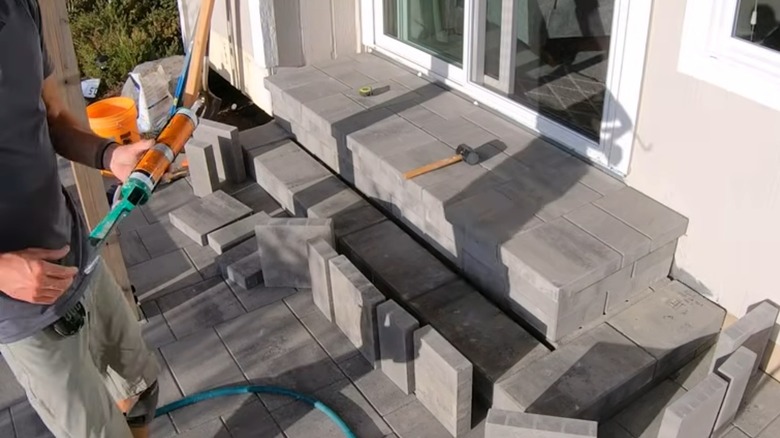
In a recent TikTok video, @vongalleria digs out a platform beneath the doorstep and packs gravel down to make a flat surface. He then lays four concrete blocks perpendicular to the doorstep, using an existing grout line to keep them level, and fills the gaps in the blocks with sand and dirt to stabilize them. However, loose materials like sand and dirt are worse for stability than filling with concrete, as they can shift and settle over time. He then glues rectangular pavers on top with cement adhesive to create a smooth step surface.
Following @vongalleria's method, you can build a single four-block-wide step for around $32, way below the estimated minimum cost of $400 to have concrete steps professionally installed. It's also a great way to repurpose concrete blocks you might have lying around your yard. However, it does come with an additional cost: time. To ensure your steps are safe and will last, it's key to properly grade the ground, build a solid foundation first so the steps are stable, and make sure everything is level each step (pun intended) of the way.
Start by creating a stable foundation for your DIY steps
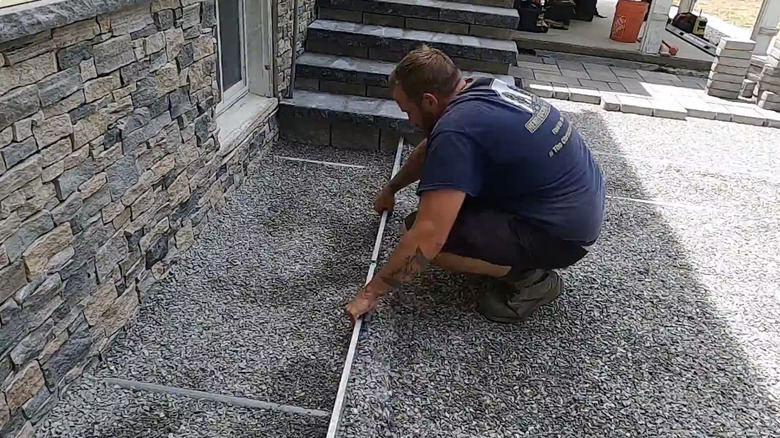
Start this basic DIY home improvement project by creating a solid base. While it's easier to set the blocks right on dirt, as mentioned above, dirt settles over time, potentially taking your steps with it and making them dangerous. That's why the prep work of digging the foundation and grading is so important. Start by digging a space 4 to 6 inches wider than your blocks, so you have some extra space to work, and firmly pack down the dirt with a hand tamper (we like BlumeTrec Store's 8"x8" Steel Tamper).
How deep should you dig? We couldn't find a hard-and-fast rule, but recommend starting with about 8 inches. It will depend on the distance between the stoop and the ground, your blocks' height, and how high you want each step to be (typically anywhere from 4 to 7 inches high, but check local building codes to be safe). Next, add in a 1 to 2% grade (or, in simpler terms, the ground should lower about ⅛ inch to ¼ inch per foot.)
Here's an easy trick to check the grade: Lay your level on the ground with one end flush against your home's foundation. Clamp a spare 2-by-4 to the outer end of the level so it extends downward by the desired amount. For example, if your level is 24 inches long, the outer end should sit about ¼ to ½ inch lower than the end at the foundation. If the wood just brushes the ground, the grade should be good to go. If not, grab your shovel and dig a bit more until the depth matches up.
Install concrete blocks to create DIY exterior steps
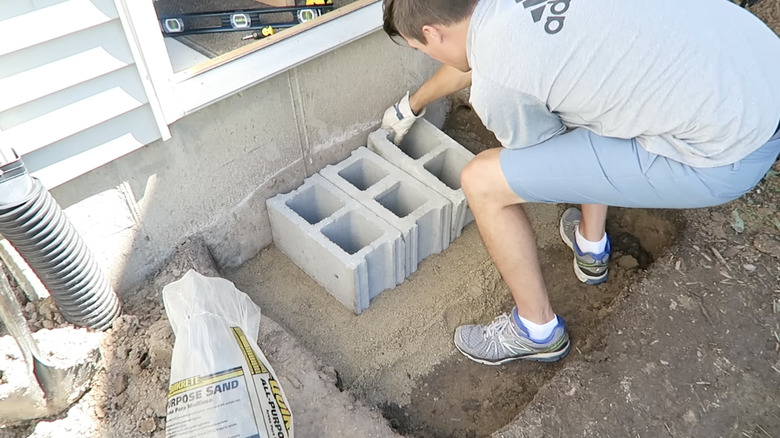
Let's start building! Lay down a 4-inch layer of ¾ inch of dense-graded mixture like crusher run on top of the packed dirt, and compact again until it's level and tight. Add the first layer of concrete blocks on top, fill around the blocks with crushed stone and press down, and fill in the blocks with concrete for maximum stability. Check that this crushed stone layer is level before brushing away, and remove any debris. Then add concrete adhesive, like Loctite PL Premium Polyurethane Construction Adhesive. We love to keep this one on hand for home and garden upkeep, so you might already have some lying around. Position the new block on top, check its level, then tap it into place with a trowel's handle or a rubber mallet. Check again with your level, and repeat until the stair is intact.
You could stop here, but the cells in the concrete blocks are potential tripping hazards, so we recommend adding a tread on top. Concrete or cement pavers are great options. Why? You already have the concrete adhesive handy, and it's easy to find a color and texture that matches the blocks for a cohesive look. For a little more grip and protection in rainy or icy weather, consider adding a rubber stair tread, like the Chelsea Rubber Stair Tread. Some manufacturer instructions recommend using a double-stick adhesive tape, while others call for construction adhesive or mechanical fasteners. Always follow manufacturer instructions.