

Not Stripes Or Checkered: The Lawn Pattern That'll Add Visual Interest To Your Yard

We may receive a commission on purchases made from links.
There are so many things that you can do to increase your home's curb appeal. For example, adding artistic touches such as fancy landscaping, colorful shrubs, and intricate pavers can turn an otherwise average-looking yard into one that oozes with upscale appeal. You can also step outside of the box and use your lawn itself as a canvas. But do mowing patterns actually make a difference for your yard? Many homeowners would argue that they absolutely do. So much so that several have taken to social media to illustrate one particular lawn design that boasts uniqueness, attention to detail, and a professionally-styled look. Introducing the zigzag lawn pattern. It's a design that looks just like it sounds, as it essentially resembles Z-shaped angles on your lawn — and it's easier to do than you may think.
To make this pattern really pop visually, having a lawn roller or grass groomer (also called "striping kits") is ideal, though you can do it with just a mower. These accessories attach to the front or back of your mower. As you mow, they roll or brush over the grass, bending the blades in one direction. This makes the grass that's bent away from you appear lighter as it reflects more sunlight, while grass bent toward you looks darker. When you change mowing directions, the contrast between them creates a distinct striped pattern. Then, as you add in the accented angles for the zigzag design, you end up with a sense of movement on the lawn that's almost mesmerizing.
How to create a zigzag lawn pattern
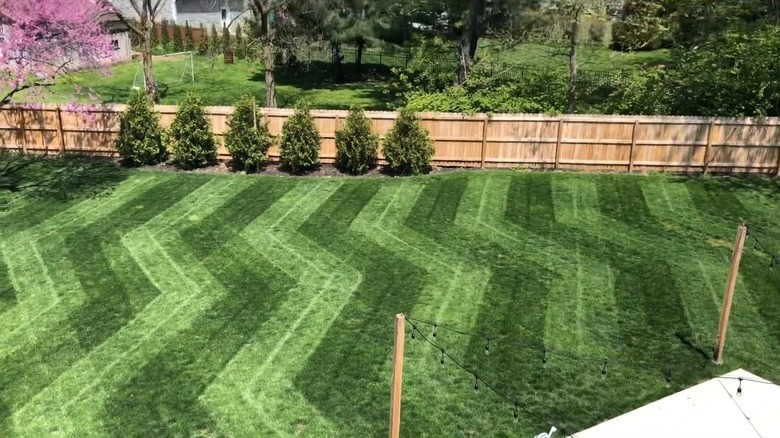
Lawn striping kits, such as the EGO AR2100, can be found on Amazon for about $120. It's also worth noting that creating this popular mowing pattern will take a bit of consistency and planning to get the best results — and it's worth it. Once you have your mower geared up, your first step is to mow straight, parallel lines, alternating directions to create your stripes. During the next mow, however, you'll reposition the mower at a 45-degree angle from the stripes you made previously, and mow diagonal stripes across the lawn. This step is going to set the stage for the Z-shape.
On your third mow, it's all about connecting the straight and diagonal lines. Start on the first diagonal line and then pivot when you reach the intersection of the adjacent straight line. As you mow your way down the straight one, pivot once again when you reach the next diagonal line. That pretty much sums up the steps to this pattern, which is simply repeating the process of pivoting at each intersection until you reach your lawn's edge. After a couple of rows, you'll see the zigzag design coming to life.
Tips to get the best zigzag lawn results
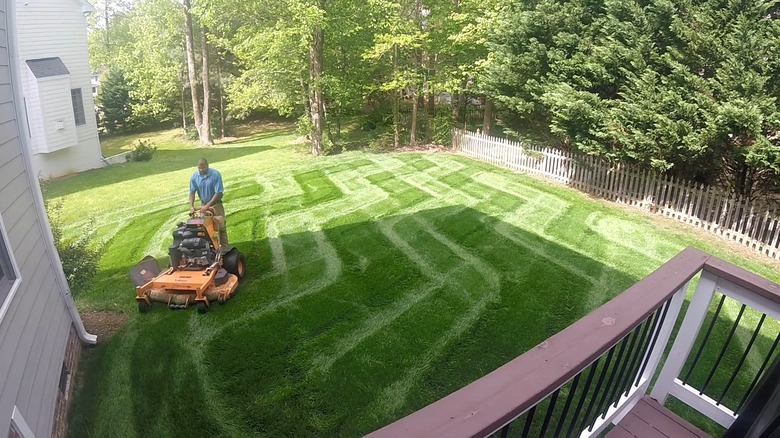
When creating this design it's imperative that you maintain consistent spacing throughout each pass. Doing so will ensure that you end up with sharp, even stripes and zigzags that actually look like zigzags and not designs that leave your neighbors with a shocked Pikachu face. Another thing to consider is that not all grasses are created equal, and their density can play a part in how well they stripe.
For example, Kentucky bluegrass, a finer turf, stripes exceptionally well. Then there are some warm-season turfs, like Zoysia, which are heartier and don't bend as easily, so the striping effect tends to be less dramatic. Another thing that can affect the end result of your dedicated mowing efforts is the overall health of your lawn. If your lawn is full of patchy, dry, or thinning sections, repairing these areas may be best to help the pattern stand out more clearly. So if you need to sprinkle a few seeds or add some fertilizer before embarking on this zigzag lawn masterpiece, it may be well worth the wait.