

The Beautiful Companion Flower For Peonies That'll Suppress Weeds

If you're wondering what companion planting is and how it benefits your garden, in broad terms, it's the practice of pairing different plants so that at least one of them helps the other grow. In the case of the lily of the valley (Convallaria majalis) and the garden peony (Paeonia), the benefits go in both directions: Lilies of the valley provide peonies with weed-suppressing ground cover, while peonies give lilies of the valley the shade that they crave.
Perhaps more importantly, both flowering perennials are known for their highly ornamental, fragrant blooms and showy foliage. That means that you can have months of pleasure from the duo, starting with the showy leaves of lily of the valley emerging, followed by its fragrant, white blooms, and ending with the big, showy blossoms of the peony. And the peonies will thrive all the more without weeds choking their stems.
Another reason to underplant peonies with lilies of the valley is that lilies of the valley bloom first. That makes them one of the perennials to grow alongside peonies for months more of color in your flower bed. Depending on your region, lilies of the valley often bloom in April, while, on average, peonies bloom in May. Lilies of the valley and peonies both thrive in USDA hardiness zones 3 to 8, making them ideal companions in terms of their climate preferences. Peonies prefer either full sun or partial shade, while lilies of the valley, which thrive in partial to deep shade, appreciate the extra protection peonies can offer from the sun. Both of them are fairly easy-going about soil conditions.
Underplant peonies with lily of the valley for ornamental weed control
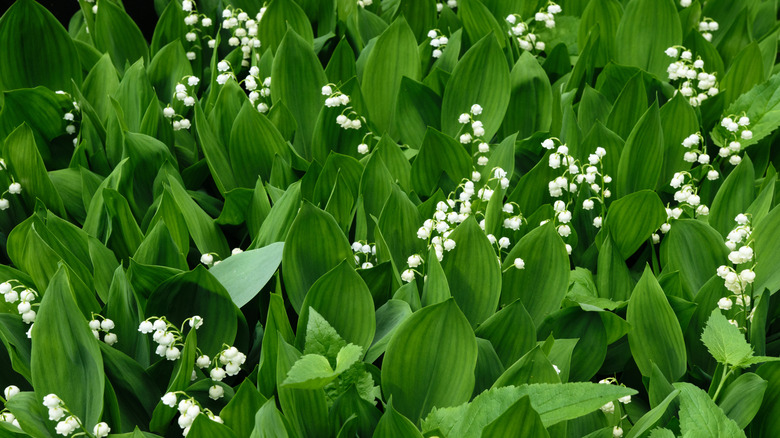
One of the things you should know before planting lily of the valley are its ideal spacing conditions, especially if you're interplanting with peonies. If you're setting out both plants at the same time, consider a grid pattern. Peonies should be between 12 and 36 inches from one another or other plants, depending on the cultivar, while lilies of the valley need a spacing of 12 or fewer inches . Therefore, staggered rows in which lilies of the valley and peonies are alternated and spaced at least 12 inches apart are one way to go. Check the specific labels of all your plants to best plan your planting grid.
If the peony garden bed already exists and you've realized it could use a ground cover such as lily of the valley, take care to plant the latter in the fall when the peonies aren't fully leafed-out. Carefully create small holes between the peonies, at depths of about 3 inches, and establish lily of the valley rhizomes in those holes.
Lilies of the valley spread quickly, so divide and transplant them in the fall after the foliage of peonies has died back to prevent them from taking over the space. If you notice problems like aphids or spider mites, hit the foliage with a strong jet of water to dislodge them. Virtually all parts of the plant are mildly toxic, so keep children and pets from eating them.