

Not Driveway Edging Or A Patio: The Idea To Add Visual Interest To Your Whole Yard
If you want to add interest to your landscape but do not have the time or patience to maintain the lawn pattern that'll add visual interest to your yard, and don't want to take on a large project such as driveway edging or putting in a new patio, consider adding a landform to your outdoor space. Landforms can be incorporated into just about any yard with minimal effort, and can be a stunning addition to your landscape, providing amazing architectural elements that are both beautiful and functional.
In the natural world, landforms are the way the terrain is structured. Examples include valleys, plateaus, mountains, and plains. Sand dunes, bays, and peninsulas are examples you might find in coastal areas. You can create something similar in your yard by changing the topography to add small hills and valleys. The simplest landform you can add to your garden is a grass-covered mound. They can be on a grand scale or something smaller to provide a focal point. Other options include sunken fire pit areas, tiered or terraced retaining walls, bioswales, and dry creek beds. In fact, a dry creek bed or something similar can even save your garden from flooding.
Use landforms to create a landscape that is pleasing to the eye
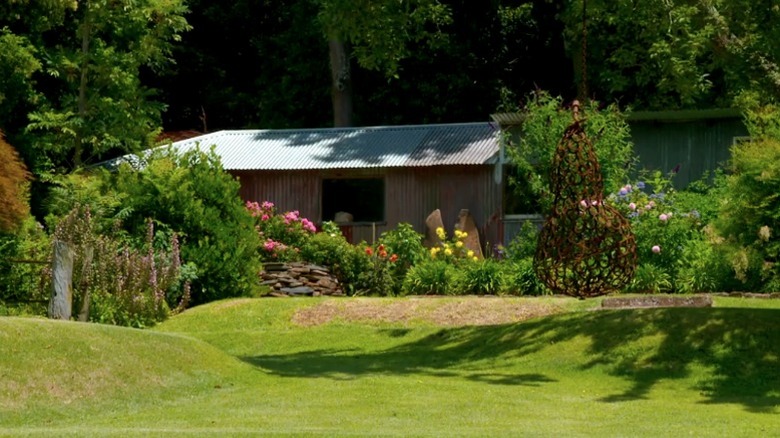
Creating a simple landform, such as a grassy mound, can be achieved by raising the ground level with soil and sand, then covering it with turf. This gives the impression that it's always been there and is part of the land's natural flow. Of course, to keep it neat, you want to use a slow-growing species like couch or zoysia, and invest in a hover mower. Or, you could try covering the mound with something like dichondra grass for a no-mow lawn alternative.
Adding a sunken fire pit or dry creek bed will alter the flow of the land by removing soil. In fact, you could incorporate a few of these elements together and use the soil that you excavate for the creek, for instance, to create one or more of the grassy mounds. Using retaining walls to terrace a sloping yard is another way to create an aesthetically pleasing landscape while providing the necessary function of helping to slow the flow of water during heavy rain. This type of landform is commonly used in countries that grow rice to help direct the flow of water on sloped fields. Similarly, bioswales, like rain gardens, alter the topography by creating a depression in the ground to slow down the flow of stormwater and direct more of it to replenish the groundwater table. Using a combination of these elements can significantly transform your garden into a gorgeous landscape.