

They Were Everywhere In The 1860s — Now It's The 19th-Century Decor Plant Lovers Can't Resist
Would it surprise you to learn that a rediscovered artisan decor style from two centuries ago is a fake? Even so, people, including Martha Stewart, find it hard to resist. Once you know the trend's name, "faux bois," it's obvious that the fakery is deliberate. Translated from French, "faux bois" means "fake wood," and the art form involves creating decor items, from furniture to planters to fountains, that look like wood but are made of other materials, such as concrete. Faux bois planters were introduced at the Paris Exhibition of 1867, and remained popular for about half a century before modernism overtook the early 1900s. Today, the style is enjoying a resurgence due to the natural-looking beauty and artistry it brings to gardens and homes.
The creation of faux bois is credited to French gardener Joseph Monier. Both Monier and fellow Frenchman Joseph-Louis Lambot were pioneers of the material known as ferrocement, in which concrete, mortar, and grout are affixed to a metal framework. While Lambot used ferrocement to construct rowboats, Monier was trying to develop a planter that wouldn't break during freeze and thaw cycles, as his clay and hollowed tree stump vessels were known to. Both processes showed the value of metal-reinforced concrete, which was on the rise in building construction. As a design concept, Monier drew inspiration from rock structures in Paris' Parc des Buttes-Chaumont, constructed between 1864 and 1867. Years later, Monier also built a bridge over a moat with this technique.
Consider using stunning antique or contemporary faux bois planters
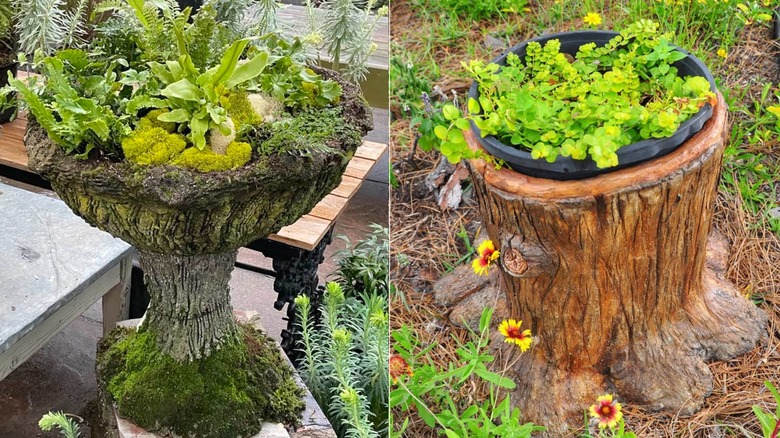
The downside of faux bois pieces made from concrete and metal is that they can be quite heavy and hard to move, especially with plants and soil inside. Nevertheless, antique faux bois planters are still popular with collectors. Martha Stewart has a collection of reinforced concrete planters at her Maine home and was even inspired to start her own faux bois planter line. Most faux bois manufactured today is made from resin, ceramic, and other materials that are not only lighter, but also more weather-resistant. Many of today's planters look more like realistic versions of tree stumps, driftwood, and other plant materials.
If you're looking to create an enchanted forest feel using faux bois, you can find both antique and contemporary planters in this style. Antique dealers are the obvious choice for vintage pieces, along with online retailers like Etsy. Reproductions are sold at garden art venues and various online sources, including Amazon, which carries a selection of modern faux bois planters.
Adapt your faux bois planters to your plants' needs
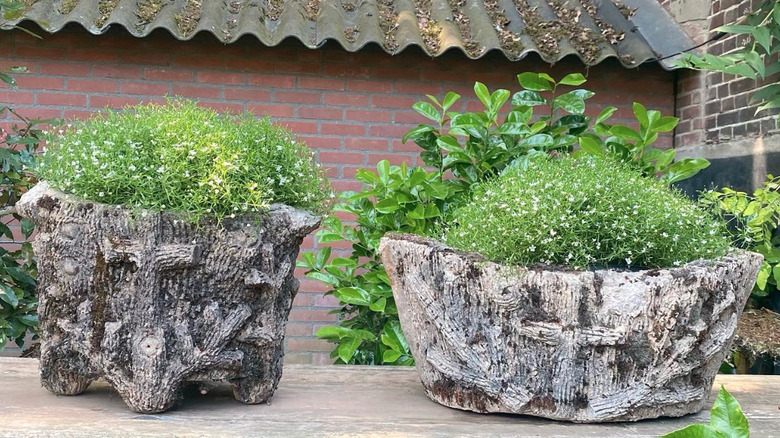
A few adaptations may be necessary if you choose an antique faux bois planter. There is a chance that these older pieces won't have drainage holes, and you'll need to provide an outlet. It might be possible to add drainage holes, but your drill could run into the metal reinforcement, causing damage. Also, the planters could lose their value as antiques if altered this way. A better solution is to place your plants in plastic pots that fit into your faux bois planters, take them out to water them, and allow them to drain. Plastic pots can also help you tackle the issue of heavy planters, or make moving heavy planters a breeze with Amazon's rolling stands that hold up to 440 pounds.
Many of the faux bois planters made today come with feet, which contribute to drainage by keeping the planter off the ground. Feet also facilitate air circulation and protect the surfaces the pots are sitting on. Consider a planter with feet to give your plants an optimal environment, and be careful to avoid the biggest mistakes with your container garden, such as overwatering and using the wrong soil.