

Love The Bees? The Blooming Vine You Don't Want In Your Garden
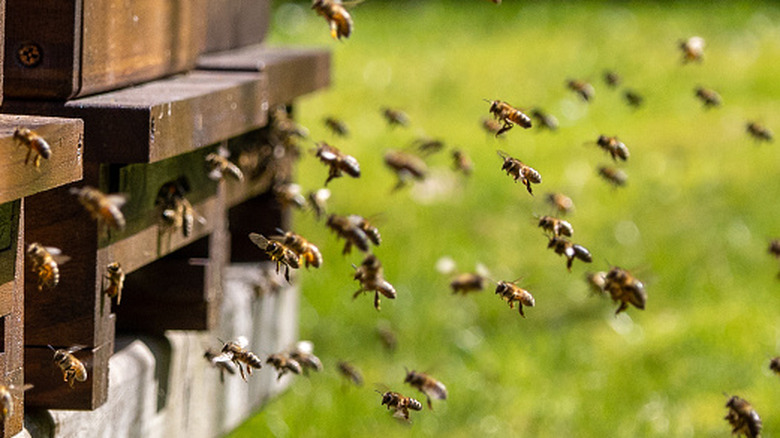
If you're an avid gardener, you are likely already aware of how ecologically important bees are. Perhaps you've purposefully filled your garden with flowering plants to ensure a steady supply of pollen and nectar. By cultivating an abundance of blooms, you'll bring more bees into your yard and garden. Any flowers will do, right? Actually, that's not the case. There are a few flowers that contain nectar that's toxic to bees. Some North American native species produce flowers that harm introduced bee species, like honeybees. Despite its attractiveness for gardeners, Carolina jessamine (Gelsemium sempervirens) is one such vining flower you should avoid if you want to support bees.
Carolina jessamine is native to the southern U.S., Honduras, Guatemala, and Mexico, and is beloved by gardeners for the fragrant yellow blooms it produces in spring and fall. However, there's a darker side to those bright blooms. All parts of the plant are highly poisonous to humans, pets, and livestock. This is due to the fact that it contains neurotoxic alkaloids — related to strychnine — and an indole called sempervirine. Strychnine was historically used as a pesticide but, due to its very high acute toxicity, has been restricted to manual below-ground application for pocket gopher control only. The plant's danger to honeybees is not recent news. A report titled Plant Poisoning of Bees, published by the U.S. Department of Agriculture in 1936, detailed how Carolina jessamine negatively affected entire colonies of honeybees.
Why Carolina jessamine isn't suitable for gardens visited by honeybees
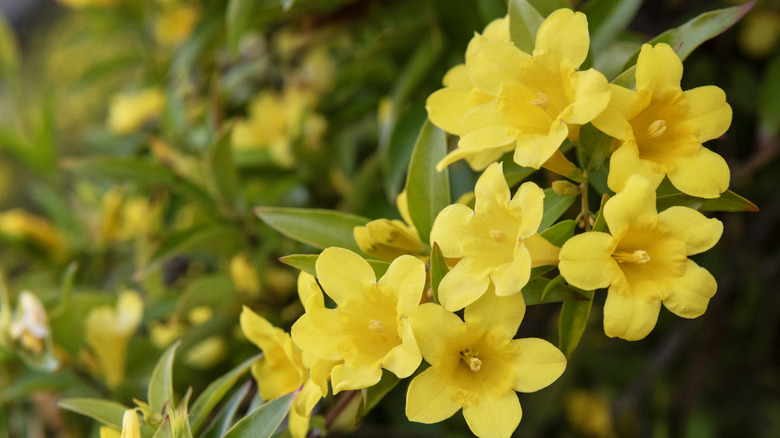
The problem with growing a highly poisonous plant like Carolina jessamine is that when it's in full bloom, honeybees will swarm the flowers, frenziedly collecting the nectar and pollen they contain. You see, honeybees are high floral fidelity insects, meaning that they'll continuously visit the same patch of flowers until the supply runs dry. This can happen even if there are other flowers nearby. Since the nectar in the blooms of Carolina jessamine are toxic to honeybees when consumed in large quantities, floral fidelity goes some way toward explaining why honeybees are more susceptible to harm from the plant than native bee species. In fact, bees too large to fit inside the flowers, like carpenter bees and bumblebees, will chew holes in the base to access the nectar.
When honeybees visit Carolina jessamine flowers, they also take the toxic nectar back to their hives. The bees that consume the nectar suffer from disorientation and muscle weakness and die quickly. Way back in the late 1800s, apiarist and book author Dr. J.P.H. Brown wrote in American Bee Journal (which is still in print, by the way) that the phenomenon had been witnessed by dozens of beekeepers in areas where the vine grows naturally. More recently, a member of the Jacksonville Beekeepers Facebook group wrote a post asking whether the dead bees outside their hives could be related to the Carolina jessamine vines flowering nearby. While these reports are anecdotal, if you care about protecting your local honeybee population, it's probably best to avoid planting Carolina jessamine in your garden. Instead, grow any one of the other gorgeous spring flowers to bring beneficial bees to your yard, from marsh marigolds to black-eyed Susans.