

How To Repel Ants From Your Yard And Garden Using Herbs They Can't Stand

Many herbs smell heavenly to humans, but have the opposite effect on ants. When you have an area in your yard or garden that's swarming with these pests, one way to combat them is to strategically plant these strong-smelling herbs in the areas where they're congregating. You can also dot the garden with ant-repelling herbs, especially around more vulnerable plants.
The first group of plants you can turn to is the mint family, especially peppermint (Mentha x piperita) and spearmint (Mentha spicata). Studies have found their essential oils effective at repelling ants, and though planting them in your garden is a less direct solution, they have a reputation with gardeners for keeping ants at bay. One downside to growing mint you should be aware of is the plants' penchant for sprawling over large amounts of ground and taking over other plants. That may be ideal in rare cases, such as a far-flung corner of the yard that's teeming with ants and no other plants are growing. Otherwise, your mint will need to be contained in pots.
Peppermint, perennial in USDA Hardiness Zones 5 to 9, can thrive in as little as three hours of sunlight a day. A pot that's about 12 to 16 inches wide is about right to contain each peppermint plant. Pinch its branches to keep it contained and in vigorous shape. If you like, you can sprinkle the dried leaves throughout the yard and garden for more ant repellent action! Spearmint is a little more cold-hardy than peppermint, thriving in zones 4 to 9. Like peppermint, it spreads rapidly, so a container works best when working to keep ants away from nearby plants. It has similar light requirements to peppermint. Both mints prefer moist soil.
Expand your herb garden to include other prized ant repellents
Mints are hardly the only anti-ant herbs in your potential arsenal. Another scent that ants seem to strongly dislike is basil (Ocimum basilicum). This classic is a fragrant herb you'll want to have on hand if you have an ant issue. Basil prefers full sun and well-draining soil. Keep it well-watered and it will reward you with bushy growth that's useful both for making pesto and for wafting ant-repelling scent through the yard.
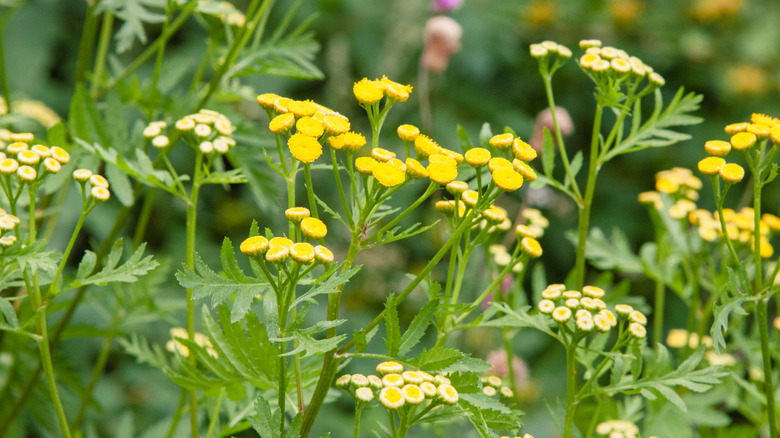
It's not just traditional culinary herbs that you can use as a non-toxic hack to repel ants. The flowering herb tansy (Tanacetum vulgare) not only adds cheerful, button-like yellow flowers to the garden, but additionally emits a scent that ants dislike crossing. Thanks in part to its plentiful, fernlike foliage, this perennial has the height and spread to quickly create a broad anti-ant "fence." Tansies prefer full sun or partial shade, and grow best in zones 3 to 8. Just be careful, as this flowering herb can cause contact dermatitis if handled without gloves. It's also highly poisonous if ingested.
Tansy, along with many other ant-repelling botanicals, is more supported anecdotally than scientifically, especially as garden plants. Herbs such as thyme and rosemary, along with oranges and cloves, are among those processed for their essential oils in manufactured insecticides. But if you're considering growing thyme (Thymus spp.) and rosemary (Salvia rosmarinus), anyway, you may find that they contribute some useful repellent action. Consider growing these heat-loving perennials in the sunniest parts of your yard and garden where ants tend to swarm.