

The Hosta Companion Flower That Attracts Young Butterflies
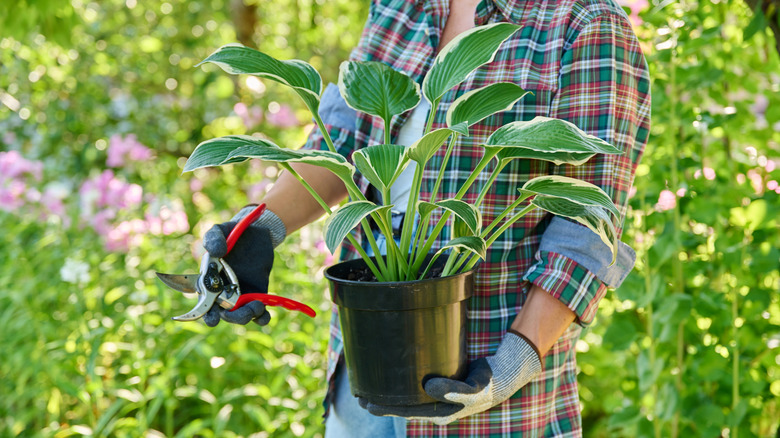
Do you have a shady patch in your yard that you have recently planted with hostas? Perhaps you're planning a new garden bed that's perfect for these large-leaved, shade-loving plants? While you can certainly create a garden entirely with hostas alone, adding some diversity with flowering plants is always a good design choice. While there are plenty of hosta varieties that grow striking leaves and flowers, including a few eye-catching flowering plants will only improve the patch. Bonus points if the plant also enjoys the same growing conditions as hostas and attracts young butterflies. We're talking about a native herbaceous perennial called goat's beard (Aruncus dioicus).
This plant is a larval host for the dusky azure butterfly — that's the young butterfly part. The adults of the species will visit the flowers to lay their eggs, and the resulting caterpillars will feast on the leaves before they pupate and turn into more dusky azure butterflies. Goat's beard pairs so well with hostas because it produces striking flowers, is bushy, and can grow up to 6 feet tall. It will add height and interest to garden beds dominated by bold, bulky hostas and also provide its sun-adverse companion with some shade. You'll love the finger-like flower trusses of goat's beard. The masses of small blooms rise high above the deep green foliage like white or cream clouds. They resemble astilbe flowers and appear in late spring and early summer.
How to grow goat's beard alongside your hostas
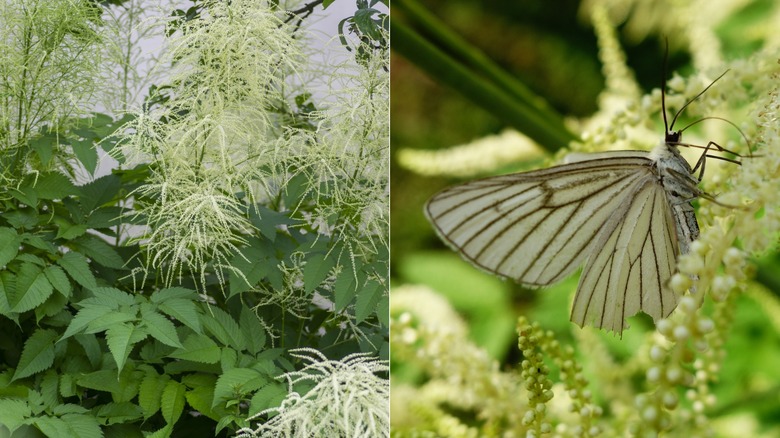
As goat's beard is taller than most hostas, put this companion plant in the ground at the back of a garden bed or border. It will grow happily in USDA Plant Hardiness Zones 3 through 7 and enjoys the same moist soil conditions as hostas. The plant spreads up to 4 feet in width, but it can take two to three seasons to grow that large. If you're looking for a more compact, low-maintenance perennial flower that thrives in shady yards, consider the goat's beard cultivar 'Chantilly Lace.' Whether you choose the parent species or a cultivar, trim your plant back after it's finished flowering to keep it neat. Apart from attracting dusky azure butterflies and feeding their caterpillars, the flowers also attract other pollinators, including other butterflies and bees. Did we mention that goat's beard is deer and rabbit-resistant? Plant it to protect your hostas.
This native species is dioecious, which means that the male and female flowers are produced on separate plants. The upright male flowers are widely considered more eye-catching than their female counterparts, which flop over. Plus, the small brown seed capsules produced by the female flowers are toxic to humans and pets. While you won't know which gender you're getting when you buy young plants from a nursery or online, it's handy knowledge to have on hand for later, when your established plants start flowering. You should avoid dividing this perennial at all costs, unless you have a lot of patience and a quality cutting implement, like a freshly sharpened gardener's knife or a hori hori. Goat's beard has thick roots that are challenging to cut through. Replant root sections with at least one eye.