

The Dainty Companion Flower For Strawberries That Fights Pests
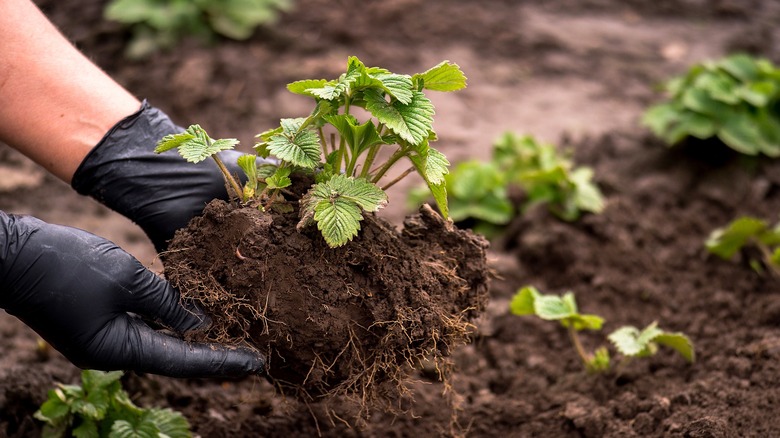
Do you look forward to a delicious harvest of juicy strawberries every summer? Growing these delightful berries isn't that difficult, especially if you can find some friendly plants to grow alongside them, making your job that much easier. While there are quite a few companion plants that are going to get along with your strawberries, there's one dainty companion flower that will help to fight off pests, like aphids and spider mites, that may be trying to ruin your berry harvest. It's known as catnip (Nepeta cataria), and you should grow it in your patch even if you don't have cats.
While catnip is particularly attractive to feline friends, the perennial has the opposite effect on certain insect pests. It's commonly known that catnip contains a compound called nepetalactone, an iridoid chemical, which the plant uses as a defense mechanism against said pests. Interestingly, the compound can mimic an aphid's pheromones, but it doesn't attract the pests because the tiny insects don't reproduce during warmer months. The nepetalactone in catnip instead attracts aphid predators, such as lacewings and parasitic wasps, who then destroy any aphid pests nearby.
Catnip's insect-repelling properties have also been confirmed in a study completed by Lund and Northwestern universities, which focused on how the plant repels another common outdoor pest: mosquitoes. In the study, the researchers found that nepetalactone has the ability to activate an irritant pain receptor known as TRPA1, specifically in mosquitoes (and in Drosophila melanogaster flies, a fruit fly). Applied to your summer garden and strawberries, this means that if you grow catnip, the plant can also send pesky mosquitoes the other way.
Growing catnip among your strawberries couldn't be easier
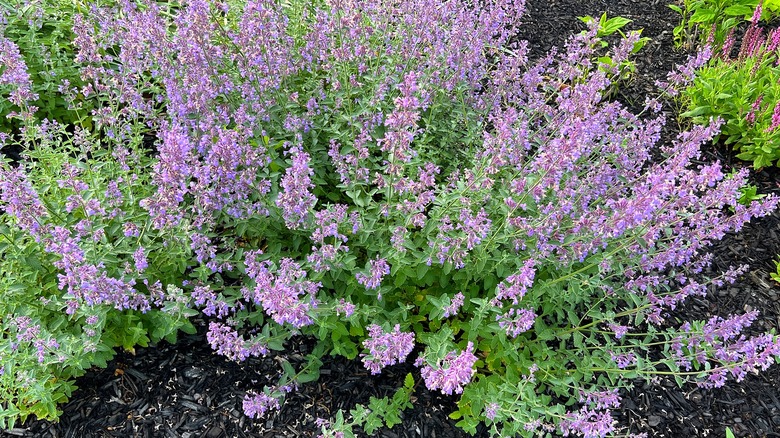
If you live anywhere in USDA hardiness zones 3 through 9, you'll be able to grow catnip successfully among your strawberry plants. To provide your berries comprehensive protection, it's recommended you space the catnip out every 5 to 6 feet.
Like most herbs, catnip is fairly low-maintenance and is happy to grow in the sunny beds that house your berries. However, in the hotter parts of the country, it does appreciate a little afternoon shade. This is ideal because strawberries grown in the same regions also appreciate a bit of protection from the afternoon sun.
What's more, catnip blooms not only keep aphids out of your edible garden, but they also help to attract to your patch plenty of pollinators, such as bees and butterflies. Once these insects find your catnip, they will also visit the strawberry flowers, which can spell a bigger harvest after all of that pollination. And if that wasn't enough, catnip is also deer-resistant, which even makes it perfect for creating a defensive border around your strawberry patch, so any visiting deer won't eat all your luscious berries.