

Not Pyrex: The Antique Dishware That's A Total Thrift Store Gem For Collectors

We may receive a commission on purchases made from links.
As Julia Child taught us, no one does cooking quite like the French. So while we love an all-American Pyrex casserole dish, what really makes us stop in our tracks (in the Goodwill home aisle, of course) is a brightly colored Le Creuset. The brand has been crafting colorful enameled cast iron cookware — it offers 12 stunning colors in its signature collection — since 1925. And for the past century, every piece has been crafted individually by French artisans.
The brand's new pieces can be quite expensive (small dutch ovens start around $250), but you can find the brand at the thrift for a fraction of the cost. And, certain models are quite valuable. Take, for example, the Raymond Loewy designed Coquelle, or oblong dutch oven, which was released in 1958. Considered the "father of Industrial Design," Loewy's oven for Le Creuset sports classically mid-century Modern design, with sleek, clean lines and elongated handles reminiscent of a car fender (he designed those too).
In 2014, the brand re-released the style as a limited release in celebration of Loewy's influence. Both the original vintage pieces and its contemporary reproductions can fetch a pretty penny, selling on sites like Ebay and Etsy for anywhere from $200 to $800. Used as cookware and displayed as collector's items, this is not any old casserole dish.
How to find and use the Raymond Loewy Le Creuset dutch oven
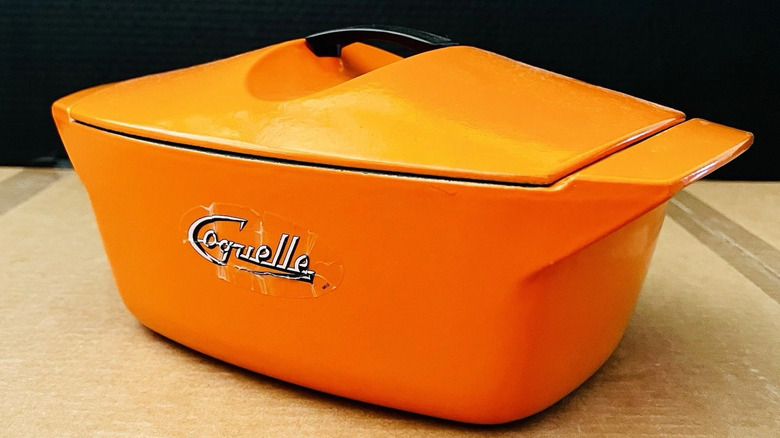
In both 1958 and 2014, the Raymond Loewy Le Creuset Coquelle dutch oven was released in two colors: a burnt orange called "flame" and turquoise. With a cast iron base and exterior, the cookware boasts superior heat retention for cooking stews, soups and pot roasts. Then and now, the wide handles make the pot easy to handle from countertop to oven to tabletop. And they're built to last, so it's no surprise pieces from 1958 are still in use today.
To ensure you've found the real deal, look for "Le Creuset France" and "2.5" engraved inside the lid. An original piece will likely have some chips or cracks in the enamel, which is normal. The contemporary reproduction should have the embossed brand name on the bottom of the pot, and lightly used pieces may still have a "Coquelle" decal on the front.
Be mindful of the one downside of thrifted Le Creuset pieces, which is the early edition's plastic top handle. These handles were not intended to withstand more than 390 degrees Fahrenheit, so you cannot put older pieces into a high-temperature oven without first swapping the handle for a contemporary one. This is pretty easily done by unscrewing the knob and replacing it with a modern option. Or, go full 1960s and use the Coquelle as it was intended: low and slow in the oven for a prize-winning pot roast. Cooks who also have an eye for interior design can use their bakeware as cute home decor instead. You can't go wrong.