

How Many Solar Panels Would It Take To Fully Power Your Home?
Electricity costs are on the rise. As a result, more people are thinking of going solar. If you are in the same boat, there is a good chance you have wondered how many solar panels would it take to fully power your home? It is kind of like figuring out how many pizzas you need for your party. The answer can vary depending on who is showing up, how hungry they are, and how large the pizzas are. Solar works somewhat in a similar way, too. For example, a small, energy-efficient home in a sunny location will obviously need fewer solar panels than a big house with a ton of appliances.
This is exactly why experts often recommend using the following formula instead of relying on a simple, standard number. The formula is: Annual electricity usage ÷ production ratio ÷ individual panel wattage = number of panels. Now, let's break down what this formula means. The first value, annual electricity usage, as obvious the name, refers to the amount of power your home consumes over an entire year. The second value is the production ratio. It estimates how much electricity your solar system is likely to generate.
The last value is individual panel wattage, which is basically the rated power output of one solar panel under ideal test conditions. Once you have these values, you can not only calculate how many solar panels you need but also talk to a solar panel installer more confidently. Just make sure that you are aware of the biggest scams to watch for with solar panel installers before talking to one.
Sample Solar Panel Calculations For A Typical Home
Let's use a practical example to see how the formula actually works. Say a home uses about 10,800 kilowatthours (kWh) of electricity per year. This is close to the annual electricity use of a typical U.S. household. Now let's assume the homeowner is considering using 430-watt solar panels (most modern panels are 400+ W). So, now the only number we need is the production ratio. It is usually calculated by comparing a solar system's estimated energy output over time (kWh) with its total installed capacity (W). The ratio is high for sunny areas and low for shady places.
Also, the production ratio is the only number that needs to change based on location, even if power needs remain the same. For example, in a lower-sun area where the production ratio might be around 1.1, the calculation would look like this: 10,800 ÷ 1.1 ÷ 430 = 22.8. Since you cannot install 0.8 of a panel, you would round up. This means the home will need about 23 solar panels. Now look at a sunnier area with a production ratio of 1.6. There, the calculations will look something like this: 10,800 ÷ 1.6 ÷ 430 = 15.7. Rounded up, that comes to about 16 solar panels.
This shows that the same home can need different system sizes depending on location and sunlight. This is also why borrowing a neighbor's system size as a benchmark might not work at times. Your home's conditions could be different — roof angle, shade, usage habits, panel type — the list goes on.
What can change the final number of solar panels?
The formula gives you the starting point. However, real life can push the final number up or down. Take, for instance, roof space. Now you may have calculated that your home needs 22 panels, but if your usable roof area only fits 18, you won't be able to meet all your electricity needs from roof panels alone. Dormers, vents, chimneys, and awkward roof shapes can all reduce usable space. If, however, you have plenty of roof space, shade can also influence things and reduce the energy production from your solar panels, which might push you to install more panels.
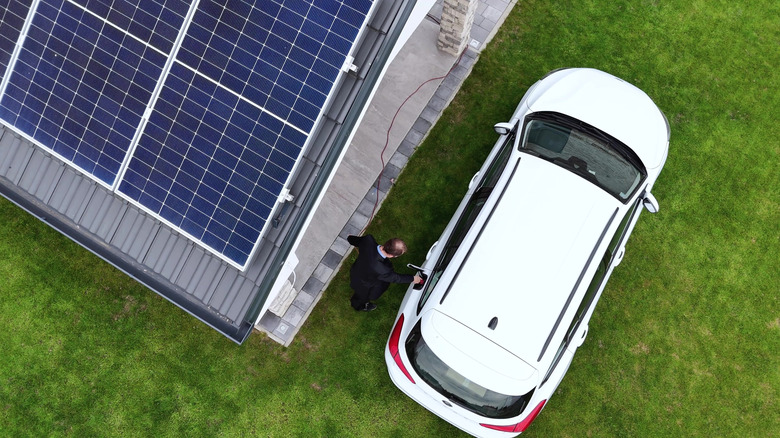
Although if you have a backyard, you can also consider ground-mounted solar panels. They are an energy-efficient alternative to roof panels that are definitely worth considering in places with ample space. Also, when installing solar panels, make sure you consider your future electricity usage as well. This is especially important if you plan to buy an electric vehicle in the future and want to install an EV car charger in your home. Those things use a lot of energy. So, sizing only for today could leave you short in a few years.
Lastly, keep in mind that fully powering your home can mean two things. For some people, it only means producing as much electricity as they use over a year. In that case, this formula works well. However, if by fully powering your home, you'd like to store extra power for if needed, that requires an energy storage system. It's also where the 20% rule for solar panels comes in.