

They Were Big In The '80s — Now It's The Vintage Canister Set We Want In Our Homes

Long before matching pantry jars became a social media trend, Otagiri canister sets were adding color and personality to kitchens across the country. During the 1980s, decorative ceramic canisters became a staple of cottage and country-inspired kitchens. The Otagiri Mercantile Company was founded in 1958. Rather than simply importing traditional Japanese pottery, Otagiri created pieces specifically for the American market, blending Japanese craftsmanship with Western designs.
That distinctive mix of artistry and everyday functionality helped the brand soar in the USA, and by the 1980s, Otagiri had become a familiar name in American homes, offering a wide range of kitchenware ceramic collectibles including its beloved canisters. In an era where minimalist kitchen spaces were far from the norm, Otagiri canisters were designed to be displayed. The pieces are hand-painted and feature motifs like mountains, marine life, birds, and Japanese-inspired landscapes. There are also plenty of whimsical designs, making them a lot like other funky, vintage storage options that are popular now. Depending on the design, rarity, and completeness of the set, they can sell well. The adorable home-shaped canisters are particularly prized, yielding $150 for a set of three, making them one thrift store find that's well worth bringing home.
Now that vintage kitchens and cottage-style décor are surging in popularity, collectors are rediscovering these colorful sets. Like other forgotten kitchen accessories making a comeback, Otagiri canisters prove that practical storage can also serve as eye-catching décor. You only need to know how to identify these unique pieces.
The hallmarks of vintage Otagiri canisters
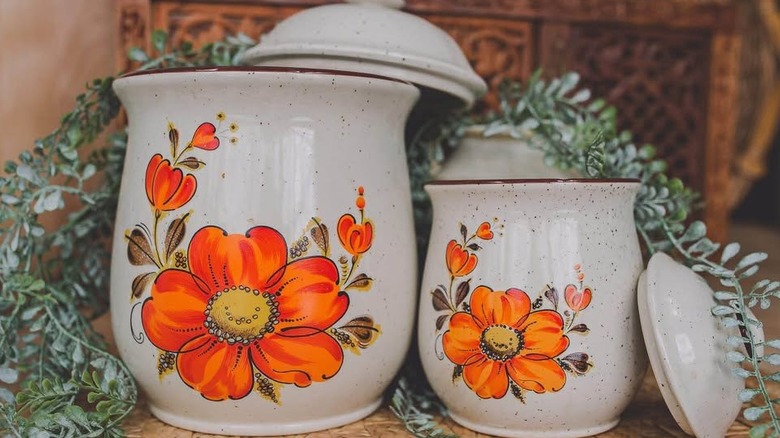
The simplest way to identify an authentic Otagiri piece is by turning it over and checking for an "OMC" or "Otagiri Japan" backstamp. Some pieces may have their original paper labels, although they might have worn thin with time. Because the company imported many different collections over the years, collectors often focus less on a specific pattern and more on finding complete matching sets with their original wooden or ceramic lids.
While common Otagiri pieces remain relatively affordable, complete canister sets in excellent condition are becoming harder to find as interest in vintage kitchens continues to grow. The company's house-shaped canisters are often the most valuable because they brim with charm. These ceramic canisters were often modeled after quaint cottages or townhouses, complete with hand-painted details like windows, doors, rooftops, and floral accents.
Condition of the canisters is especially important. Look for chips around the rims, hairline cracks, crazing, repaired lids, or faded artwork that can affect both appearance and value. Collectors also prize coordinating accessories, such as cookie jars, utensil crocks, and matching mugs.