

The Cold-Hardy Plant That'll Create A Hawaiian Backyard Vibe

In the frosty north or at higher elevations that bring a chill, there are definite limits on what you can grow in your yard and garden. Many of us who live in such places have given up entirely on fruit besides berries. Thanks to selective breeding, there's a tropical fruit-bearing tree that can survive winters even in zone 5 with the right protection. Figs are among the fruit trees you didn't know you can grow in colder climates, even with their warm-region roots. The 'Chicago Hardy' fig tree (Ficus carica 'Chicago Hardy') makes it possible to grow figs where low temps would otherwise make it impossible. What's more, they're self-pollinating, meaning that you won't need two or more trees in order for your fig to set fruit.
At one glance at its deep-green lobed leaves, you can imagine 'Chicago Hardy' tree branches framing a view of a Hawaiian sunset. Thanks to its improved cold hardiness, you can enjoy that tropical look even along the shores of northern Lake Erie. This tree is on the smaller side, reaching heights of 10 to 15 feet and widths between 10 to 12 feet. Its oversized leaves are the showstopper, since fig flowers reside inside the fruits themselves.
Before you get excited about planting one or two of these tough ficuses, do know that edible fig trees are considered an invasive plant in part of California. However, 'Chicago hardy' trees grow happily in garden containers which can help prevent the suckers from spreading and taking over.
Planting and raising a 'Chicago hardy' fig tree
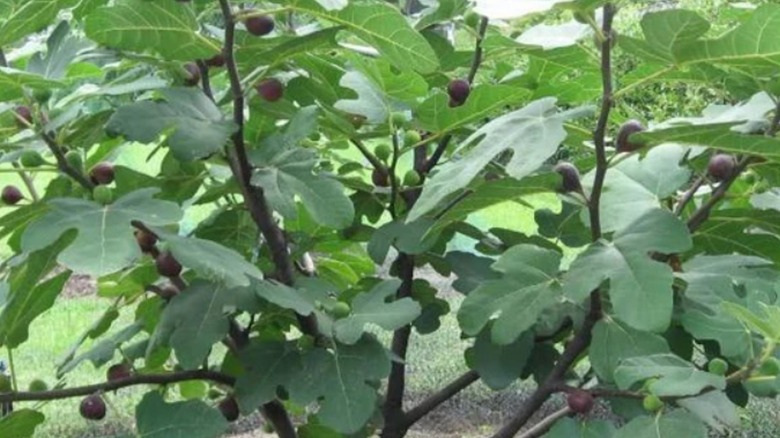
Edible figs aren't as finicky as other types of ficus species, but there are still some things you should know before planting one. 'Chicago hardy' figs can thrive in zones 6 to 10 without trouble, but they can also manage in cooler climes with the right treatment — the fact that they grow well in containers makes this possible. Set up your 'Chicago hardy' fig in full sun and well-draining soil. Dig the planting hole twice as wide as the root ball and shallow enough that the top of the root ball sits slightly above the surrounding soil. Layer mulch around the tree, leaving several inches between it and the trunk. You can also plant the tree in a pot and place it against a south-facing wall to provide it more heat. Bring the pot into a garage or other shelter before the first frost.
Give the tree plenty of water in its first season to help establish the roots. A twice-weekly deep soaking should do the trick in most areas. Once the root system is well-developed, give the tree less frequent, yet thorough, waterings. Your tree should only need fertilizing if your soil is poor or if the tree doesn't appear healthy. In those cases, feed it in spring with compost or balanced fertilizer.
Winter protection is important for fig trees. After a light pruning, safeguard your outdoor tree by encasing the plant from trunk to branch tips with burlap (or fiberglass insulation in cold zones), and place an inverted bucket over the top of the wrapped crown.