

The Perfect Companion Flower To Attract Pollinators To Strawberries
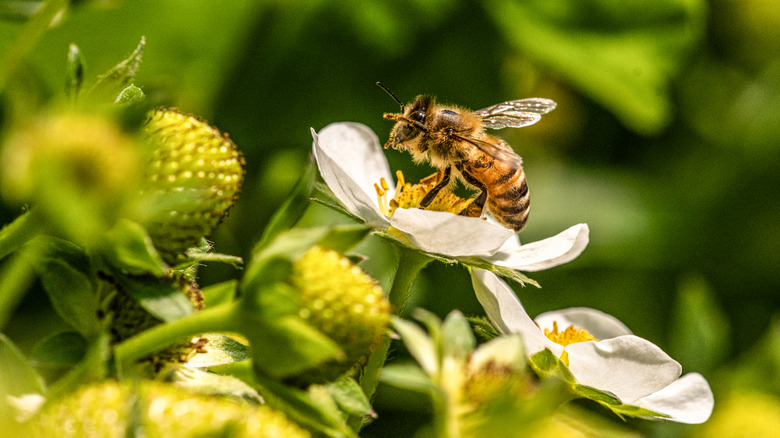
Because strawberries form in such a unique way, good pollination is essential. Those tiny specks on a strawberry aren't actually seeds, they're achenes, tiny one-seeded fruits that develop after the flower's ovules are fertilized. Strawberry flowers have an average of 200 ovules, each of which must be pollinated to produce full, well-shaped berries. The ovule getting pollinated tells the plant tissue around it to swell into the flesh of the berry. If a strawberry gets unevenly pollinated, you end up with lumpy, deformed, cat-faced berries. So the more thoroughly a flower is pollinated, the bigger, rounder, and more evenly shaped the resulting berry is likely to be. As a grower you need to do everything you can to make sure your strawberry bed is buzzing with pollinators during the flowering window.
As a master gardener and permaculture enthusiast, my favorite gardening technique is companion planting. In my edible gardens, I companion plant everything, thinking about biodiversity, pollination, and pest and disease pressure. With strawberries, the best way to ensure adequate pollination is to make a pollinator-friendly garden and one of the absolute best things you can plant is borage (Borage officinalis). Borage is an herb that's been used to draw in pollinators for centuries and it's so widely used that its results have been studied. The University of Sussex found that strawberry plots companion planted with borage produced 35% more fruits and 32% more yield by weight than the control plot that had no borage nearby. They also found that the fruit was of noticeably better quality. Borage is an easy, pollinator-friendly option because it grows in a wide variety of conditions and requires little maintenance beyond keeping its self-seeding habit in check.
Why borage works so well for strawberry pollination
Borage is such a good companion plant for strawberries and many other plants, partially because it's just so easy to grow. It's tolerant of a wide range of conditions and once it gets established requires very little maintenance from you. Plus it self-seeds incredibly easily. So once you plant borage, it's unlikely that you'll ever need to buy new additional plants. Borage has self-seeded all over the place in my gardens and I pretty much leave it be in the borders, along the hedgerows, and in the thinner, rocky soil alongside my driveway. If you don't want it to take over though, you will need to keep on top of cutting it back or pulling it up as the seedlings start to grow.
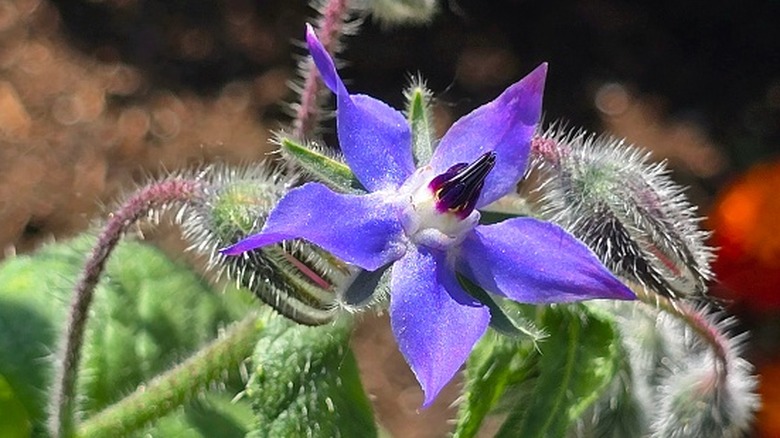
Borage has beautiful star-shaped blue flowers and, unlike many flowering plants that tuck their nectar deep inside long tubes that only long-tongued bees can reach, borage flowers have comparatively short tubes. This means that a much wider range of pollinators, rather than just honey bees, can feed easily on these flowers. While borage is fairly tolerant of many conditions, including drought, it does best in a sunny, well-draining site. In the shade borage will develop fewer flowers so you won't get as much pollinated traffic from it. This plant blooms continuously from early summer into fall so you don't just get a single short flush but rather a continuous stream of flowers for the entire time your strawberries are setting fruit.
Growing borage alongside your strawberry bed
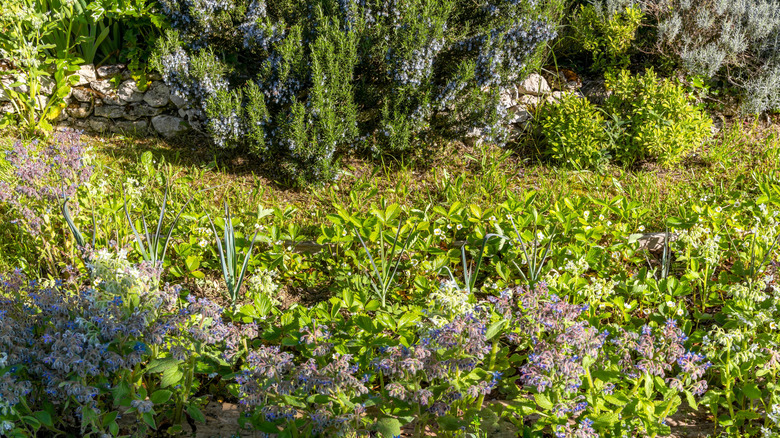
You can sow borage seed directly in the ground after the last danger of frost is passed. It's an easy-to-grow annual herb that draws endless pollinators to your yard. You're better off starting it in its final growing position than trying to do it in trays, as borage has a tap root that doesn't like being transplanted. Put it in a sunny spot with well-drained soil. While it's not terribly fussy, it prefers soil that's not overly rich, which is why mine does so well in the thin rocky soil of my driveway border. I would plant borage at the outer edges of the strawberry beds in small patches, as mature borage can get to about two feet tall and wide. You don't want to shade out the strawberries by crowding them.
Also remember that borage is toxic to dogs, cats, and horses. However, my animals have never shown any interest. Instead they go for the cleavers, the couch grass, and some of the other pet-safe herbs. Do be mindful if your pets tend to nibble on anything and everything in the garden. If you only have space for one companion plant for your strawberries, then borage is the one I'd choose. If you can interplant a few others, I'd add marigolds as they are great for attracting pollinators and can help keep slugs off your strawberries. Catnip is also a great choice because it can help reduce pest pressure. Given that anything and everything likes to eat strawberries, the more help you can get to fend off pests the better.