

Not Fountains Or Pools: The Serene Water Feature Idea To Add Visual Interest To Your Yard
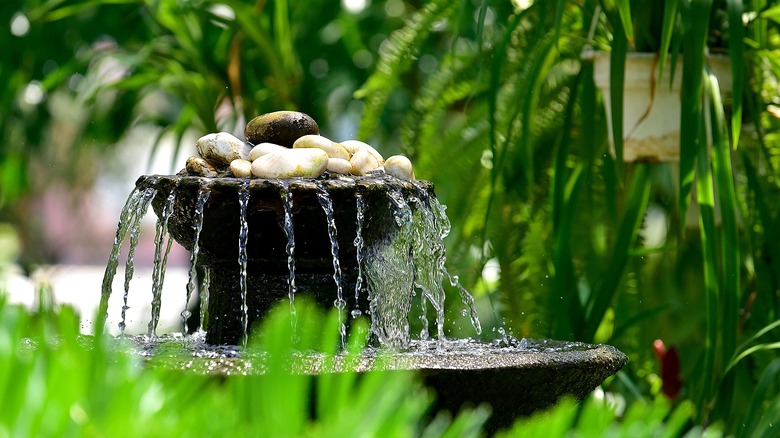
A prim lawn, a rose hedge, or foundation plantings all play a key role in beautifying a yard. But to bring in a touch of whimsy and serenity that truly awakens all senses, you need a water feature. Whether it's cascading down rough-hewn boulders, tiptoeing around tiny rocks, or idling in a reservoir, it instills the area with an oasis-like feeling, as if laying out an invitation to relax and unwind. But if you thought your only options were a full-fledged pond or an idyllic fountain, allow us to introduce you to the beauty of pondless waterfalls, sometimes also known as disappearing waterfalls.
If the name is any hint, pondless waterfalls come without a pond above ground, and hence without many of its pitfalls. At its core is a pump stowed away in a vault deep underground that recirculates water in the feature through pipes. But what you see above is a stream of water that languidly spills down steps, picking its way along the ground, until it ebbs in a bed of gravel and rocks. Beneath these rocks is a dug-up water reservoir, linked to the pump, which continually sends the water out from a beautifully camouflaged spillway.
Ultimately, a pondless waterfall creates a tranquil space, where the moving water masks outside noise while allowing your personal conversation to unfold uninterrupted. It's an underrated water feature that can give your yard a luxurious touch, provided your local and HOA rules allow for it.
Why a pondless waterfall makes sense
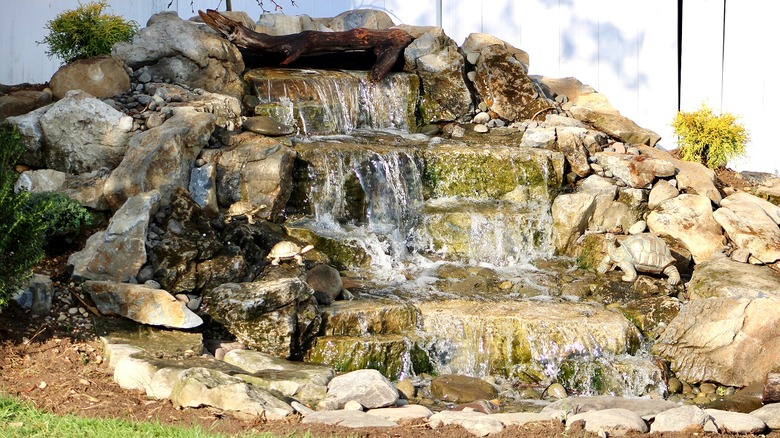
Of the many reasons households refrain from installing ponds or fountains in their backyards, the major one is that they present a fall hazard for little kids and pets. But as pondless waterfalls are mostly shallow, they do away with this predicament. What's more, pondless waterfalls are also highly versatile, translating beautifully to small or large spaces alike. You can use them to add privacy to your patio, hide an otherwise unsightly wall, create a meditative zone, or build a themed area reminiscent of woods or a fairy garden.
As long as your yard has a certain degree of gradient decline (or you're willing to dig deep), you can incorporate a pondless waterfall of any form and size, in accordance with your budget. DIY lovers can even install this water feature on their own in a few days using a ready-made kit, saving further on labor.
As a bonus, you can attract more birds with a natural water source feature in your yard, along with butterflies and even tiny amphibians. However, bear in mind that if you're into cultivating fish or are looking to create an aquatic wonderland, a pondless feature may not work for you, as one isn't deep enough to support such creatures. But on the positive side, you have far fewer mosquitoes to deal with, as they require stagnant water to breed.
Maintaining a pondless waterfall
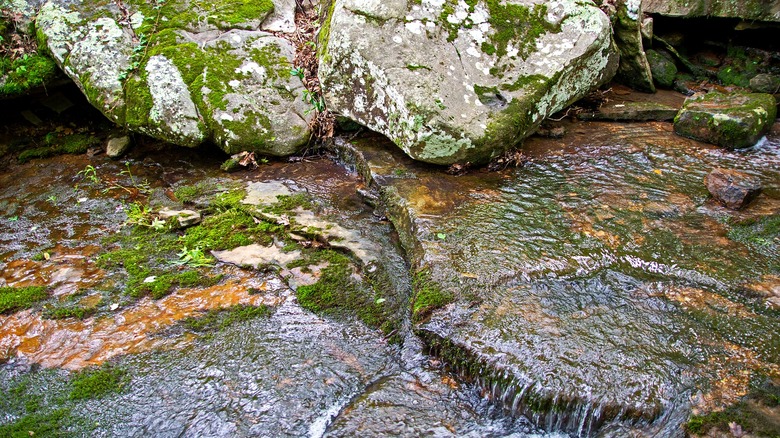
Compared to ponds and fountains, pondless waterfalls are easier to keep nice. Take cleanup, for instance. Since the water reservoir is buried underground, it doesn't collect unnecessary plant debris and such. You can simply pick out any waste above ground per your convenience.
Moreover, since the same water moves through the system continually, it isn't as quick to show algal blooms, which turn the water and the adjacent hardscape green. But, know that, if exposed long enough to sunlight, a pondless waterfall will eventually become inundated with algal growth. Since they don't usually come outfitted with a filtration system, you'll need to have the pump cleaned out regularly. If you would rather not deal with this hassle, you can also add UV filters and beneficial bacteria to keep the water clean.
One other thing you have to account for with a pondless waterfall is evaporation, wind, and splash loss. Ultimately, your water feature is working with a set quantity of water. This means during the dog days of summer or on dry, windy days, the water will be lost at a faster rate, thus reducing the amount remaining in the reservoir. Similarly, if the water fall rate is high or the stones are placed far apart, you may lose a lot of water that splashes out.
Given this potential water loss, to avoid damaging the pump system, you must either have the water topped off every week during the summer or invest in an auto fill valve that would replace the water lost as necessary by pulling it from an irrigation line. (Learn how to DIY a stunning waterfall for your outdoor space.)