

Do This Crucial Step Before Lawn Care To Protect Your Mower Blades
We may receive a commission on purchases made from links.
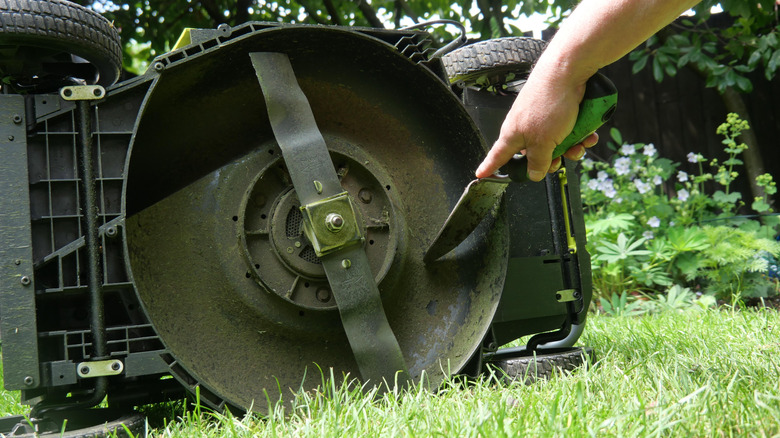
It makes intuitive sense to mow your lawn when it's most convenient for you. But such a convenience may exact a heavy price on the blades of your lawnmower if you skip the crucial step of checking the grass for moisture beforehand. This is because wet grass tends to clump and mat together due to excess moisture, which can dull the blades more quickly. The damp grass clippings also collect under the deck and over the blades, rusting the metal and preventing it from functioning as intended.
There are other potential issues from mowing wet grass. Sometimes, moisture may find its way into the fuel tank, leading to engine problems. And rather than being spewed out as intended, the clippings can remain stuck inside the chute, clogging it up. The machine may struggle to keep up and overheat or eventually stutter to a stop. This problem assumes its worst form in mulching, rotary, and electric mowers.
The take-home message? To protect your mower's blades and other parts, mow your lawn only after ensuring the grass is dry. Not only will this keep your lawn mower in tip-top shape, but it will also protect your lawn's health. Wet grass is prone to scalping and cutting unevenly, and through these rough cuts, disease-causing microbes and pests can enter and attack your lawn. On damp turf, mowers also tend to leave angry tracks and ruts, which can cause irreparable damage and compact the soil. Worse, retaining matted, wet clippings can kill the grass underneath, creating dead spots in your turf.
Making sure the grass is dry enough for a haircut

As you'll know from experience, turf can become wet for a multitude of reasons: morning dew, a drizzle, a heavy downpour, or watering. So, the best time to mow your lawn for healthy grass and undamaged mower blades is at least a few hours before or after these events. For instance, if you find dew droplets on the grass, wait until mid-morning or late afternoon to fire up your mower since they'll have evaporated by then. Similarly, you may have to wait for a couple of hours or even for the whole day for the grass to dry after a drizzle or a heavy bout of rain. A well-watered lawn may take up to six hours to dry on sunny days.
After the necessary duration has passed and you see no clear indication of water droplets on the grass, you can conduct a quick hand or foot test to double-check. In the shaded part of your yard, glide your hand over the grass blades. If your hand remains dry, it's safe to operate the mower. If not, give it some more time and check back. You can alternatively tread barefoot and check for any squishiness underfoot. Soil that holds firm generally indicates that the grass is dry.
Steps to take when mowing wet grass is your only option
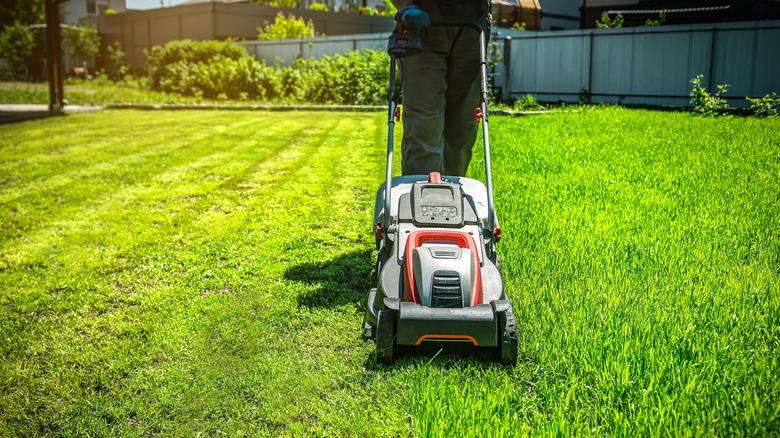
Cutting the grass when it's still damp is indeed one of the leading lawn mowing mistakes everyone makes. But if you live in an area that receives frequent rainfall, you may not always have the liberty to wait for the grass to dry out fully before mowing, or it'll become too overgrown. Worse, cutting longer grass is infinitely harder because the blades curl up, thus receiving uneven cuts.
In such cases, your best course of action is to ditch mulching mowers for variants that allow for side discharge. Also, make sure that the mower is lightweight, as running wet grass down with a heavy mower requires extra labor. If the area is small, consider a push-behind mower instead of a riding one, as it won't compact the soil as much. Naturally, you'll require a sturdier pair of boots to go with it, as damp turf is slippery.
Regularly sharpen the mower blades to get clean cuts, and set the deck at its highest setting so you won't have to deal with unnecessarily long grass clippings. You may have to make multiple passes to shred the matted grass clippings further. Alternatively, you can collect and add them to your compost. Finally, don't forget to wipe down the deck with a rag or a scraper afterwards. Follow up with a spritz of a deck spray, like the Stens Mo-Deck Spray, to prevent future gumming or caking.