

The One Thing You Need To Do For Your AC In July

We may receive a commission on purchases made from links.
July is the middle of summer, and usually the hottest time of the year in the U.S. It's also the time when your air conditioner is probably going to be working overtime to keep your house nice and cool. In the midst of summer, you definitely don't want your AC to fail, which is why there's one thing you need to do to ensure that everything runs smoothly and your home remains at a comfortable temperature — spray the dirt and dust off your condenser.
While you may have taken great care to give your air conditioner a good clean in spring to get it prepared for the warmer weather, you'll find that pollen, leaves, and dust have had time to settle around the unit and may end up clogging up your condenser (the outdoor part of your air conditioner). This could not only damage the unit but will also mean that it runs less efficiently and thus, cost you more money on your energy bill. Even worse, the dirt that accumulates could encourage the growth of bacteria and mold, and this could work its way through the system and into your home. This is one of the ways that your AC unit might secretly be making you sick, and precisely why you should clean the condenser during the peak dog days of the year.
How to clean your AC condenser in July
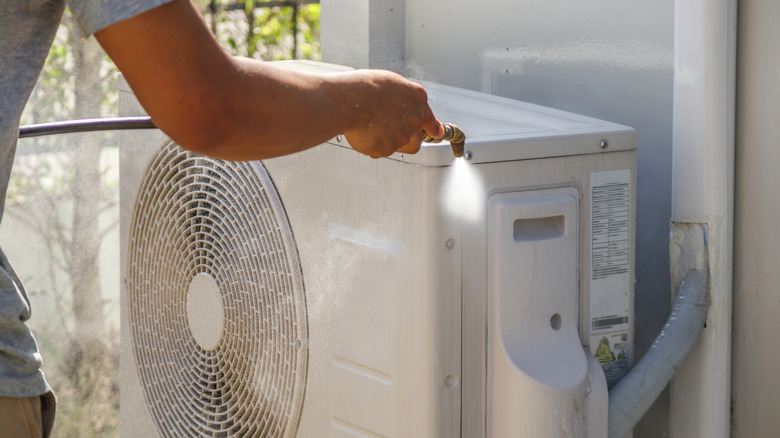
It just takes a few steps to help lower your AC costs during summer and get the condenser nice and clean. All you really need is your garden hose with a spray nozzle, a coil cleaner (like CRC Foaming Coil Cleaner), a fin comb, and a microfiber cloth. Before you get started, make sure that you turn off the power to your AC unit. Remove the cover or grille so that you can reach the condenser coils. Use a vacuum cleaner, a soft brush, or a microfiber cloth to remove any visible dirt and leaves.
Take a close look at the fins and use the fin comb to straighten any that appear to be bent. Following the instructions on the can of cleaner, apply this to the coils, making sure you get good coverage. Pay special attention to areas that appear to be really dirty. If you're using a foaming cleaner, leave it on for the recommended time before hosing it off completely with water. For non-foaming cleaners, you may want to use the cloth, soft brush, or fin comb to get the coils and fins clean. Just take care not to damage the fins while you're doing this. When done, hose off all the cleaner and let everything dry before replacing the cover and turning the power back on. Finally, as the temperature ramps up, you might want to try the most cost-effective way to run your air conditioner over the hotter months to get the most out of your freshly cleaned unit.