

Not Copper Nor Coffee Grounds: Use This Landscaping Staple To Help Keep Snails Away
We may receive a commission on purchases made from links.
Your garden will never be completely free of snails and slugs, but you can take measures to protect your plants from these slimy pests. Copper strips or used coffee grounds are go-to ecofriendly pest control options, but there's another material that may work just as well. You can use it to create a barrier around your plants, and improve the appearance of your garden at the same time. Yup, we're talking about coarse gravel or sand — it could be just what you need to create a snail-and-slug-proof fortress around your vegetable patch or flower beds.
The theory goes that any sharp or abrasive materials will deter these soft-bodied critters from crossing over or accessing plants growing inside the barrier. But not just any type of sand or gravel will do. In fact, smooth, rounded pebbles or large-sized patio gravel may make life easier for slugs and snails, especially in damp weather. Even if the big gravel has jagged or sharp edges, these slimy pests can still slide over the large surface area with little trouble.
What you need is small-sized crushed stone or gravel without any flat or smooth surfaces. Something like Seven Springs Farm CactiCal Crushed Limestone for about $17 a bag would work well. Coarse sand, which is sometimes referred to as horticultural sand, also creates a gritty and uncomfortable surface for snails and slugs. Try Biomand Horticultural Sand. This tip for keeping snails and slugs out of your garden doesn't look messy. In fact, when used for plant borders, neat lines of sand, gravel, or a mixture can level-up the design factor and aesthetic appeal of your yard.
Create a barrier of coarse gravel or sand to keep snails and slugs away
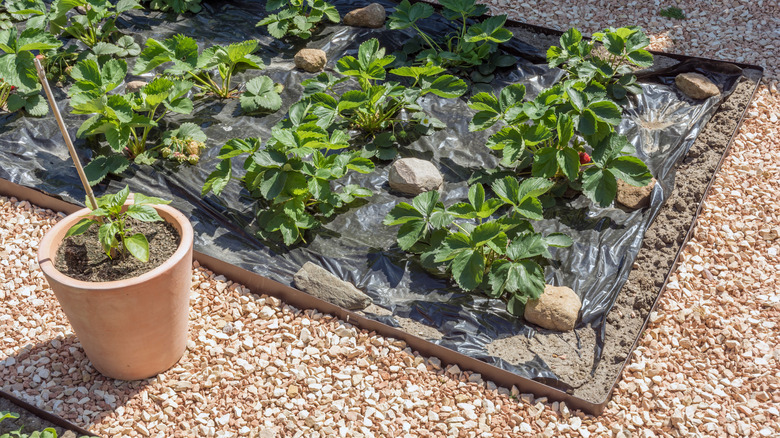
While it's unclear exactly which gravel or sand grain size works best for slug and snail control, the smaller and sharper the better. How wide you make the barrier and its placement are also keys to preventing snails from invading your garden. Remember, the goal is to dissuade the slimy pests from crossing over the gravel or sand, so a wide border is more effective than a thin line. If you're protecting a garden bed, a good rule of thumb is to make the barrier approximately 3 inches to 4 inches wide. It needs to completely surround your plants. Make sure to monitor the integrity of the barriers, especially following heavy rain. You'll need to rake the gravel occasionally to reduce compaction. Sand washes away over time — simply top it up with more.
Whether you have raised or in-ground garden beds, clear the lawn to create a pathway around them on all sides. That way, slugs and snails can't slide straight from the grass onto your plants. Then put down some weed barrier before covering the area with gravel or sand. To protect plants in flower pots, you can simply scatter gravel- or sand around the base of the planters. Or there's a tidier alternative — plant saucers and trays much larger in diameter than your pot. Fill them with with abrasive gravel or sand and position the planter on top, right in the middle. They have a rim, so you won't get the material all over the place. Give gravel or sand a try and you may never need to use a bathroom staple to help deter snails and slugs — or something far more problematic, like slug and snail pellets — ever again!