

What Are The Spots On My Hydrangea Leaves?
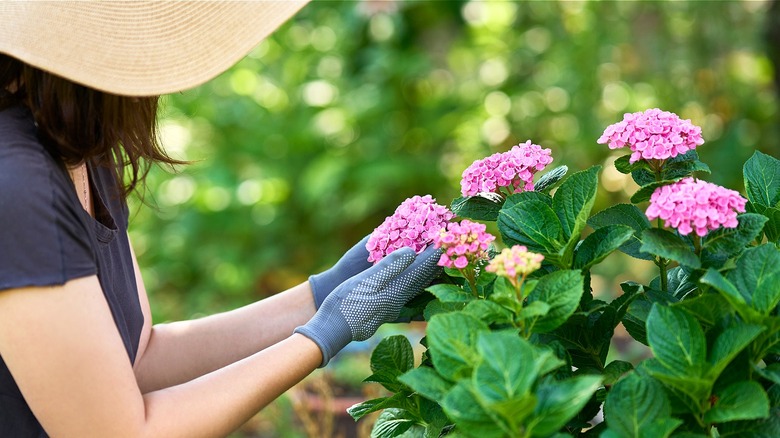
The big, bold foliage of hydrangeas (Hydrangea sp.) are almost as much of a garden star as the shrubs' showy flowers. That's why it's particularly worrying when mysterious spots show up on the leaves. When growing hydrangeas, it's important to understand common issues for the plant, such as two diseases that will manifest on the leaves: Cercospora leaf spot, and bacterial leaf spots caused by Xanthomonas campestris. Treating the problem starts with identifying the type of spots you see.
The main symptoms of Cercospora leaf spot, which is caused by fungi, are light spots that appear with a darker, reddish-brown outline, creating a halo effect; and sometimes the yellowing of heavily affected leaves. Several different types of hydrangea can be affected by this leaf spot disease.
At first glance, the bacterial leaf spots caused by Xanthomonas campestris can look frustratingly similar to Cercospora spots. For one, they each impact the "big three" — oakleaf, bigleaf, and smooth hydrangeas — and each start on lower, older leaves before spreading upward. But these bacterial leaf spots lack the paler center of Cercospora leaf spot, so they won't have a halo. They'll appear brownish- or reddish-purple in color with irregular edges.
Cercospora leaf spot on hydrangeas
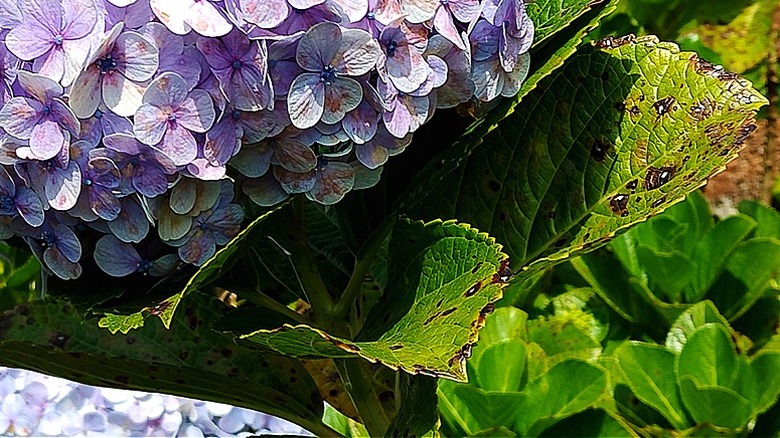
As said, you'll first find Cercospora leaf spot on lower leaves, so you can possibly address it before the disease spreads too high. Keep in mind, though, that if you notice the spots early, the halos may not yet be present. The fungal disease first shows as brown or dark purple circles that eventually become dark brown, irregular halos with lighter (tan or gray) centers.
Further, heavy moisture on the leaves themselves can make this fungal problem worse. If you have a sprinkler system, reposition it so that hydrangeas are out of the line of "fire" from above. The best method for watering hydrangeas is by hydrating them at the soil line, whether by a soaker hose or drip-irrigation system.
It's also important to remove leaf litter so that the spores won't overwinter and impact next year's growth. Once you notice the spots, consider a fungicide treatment that contains either myclobutanil or chlorothalonil, to catch the disease before it can fully ruin your hydrangeas' growing season.
Bacterial leaf spot on hydrangeas
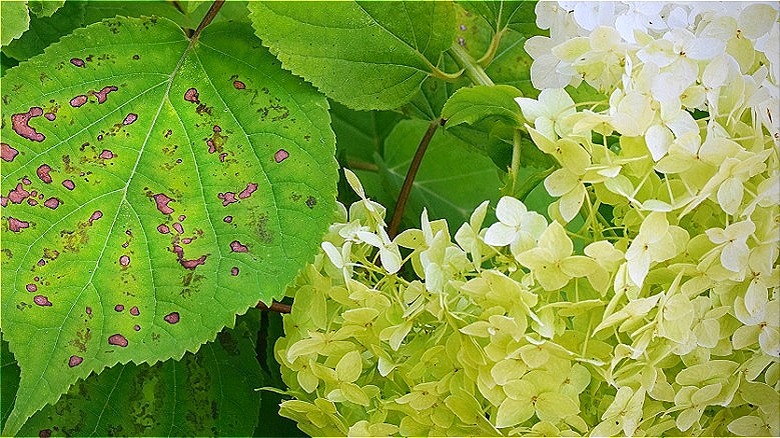
Both leaf spot diseases begin at the bottom leaves of hydrangeas, but the main visual difference between Cercospora leaf spot and spots caused by the bacteria Xanthomonas campestris, is that the latter won't display a two-tone halo. In addition, the spots resulting from bacterial leaf disease are more angular-looking, with more spots tending to appear on each leaf. These spots will often merge into larger "blobs." In addition, bacterial leaf spot can kill individual leaves.
Further, initial treatments for this disease are similar to those needed for the fungal type. You'll want to remove leaf litter under the shrub, and switch to ground-based watering systems. It's helpful to prune out spotted leaves, but only do so in dry weather, and when you can frequently disinfect your pruners.
If you routinely have trouble with Xanthomonas campestris, a copper-based fungicide might be effective, if applied in spring. When planting new hydrangeas, remember that confirming how much space a hydrangea needs in the garden ensures the kind of air circulation that can combat both bacterial and fungal disease.