

What The Red Color Means On Electrical Wires In Your Home
We may receive a commission on purchases made from links.
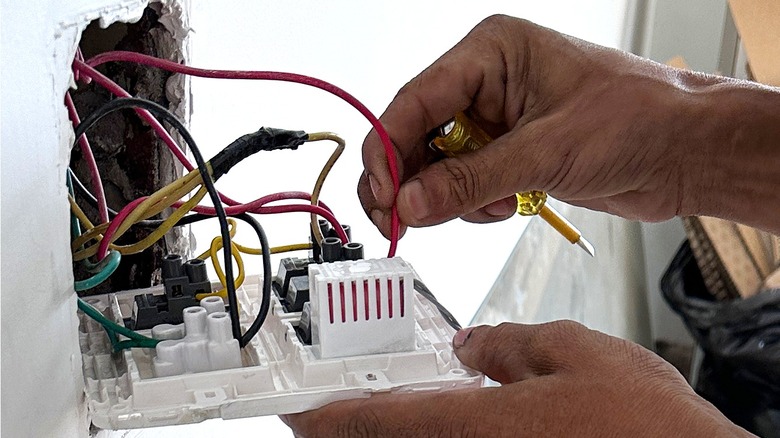
As a homeowner, at some point, perhaps even early on, you'll find yourself standing in front of an electrical panel box or a disassembled lighting fixture, staring at an array of colored wires with little idea of what any of it means — which, by the way, may be a sign to call an electrician rather than guessing your way through it. Still, it's always good to have at least some knowledge about what you see, even if the fix itself is best left to a professional. And one thing that may stick out to you the most, is the infamous "red wire."
Why? Because in our society, red typically signals stop, or at the very least, caution. Well, as it turns out, in electrical work, this attention-getting color sort of carries the same meaning. Red represents that the wire is a secondary "hot" or "live" wire. In other words, it's one with a live electrical current running through it. So, whether you're working on a small appliance update or rewiring your house entirely, note that this wire is one that should be handled carefully.
What the red wire is doing behind your switch plate: An example
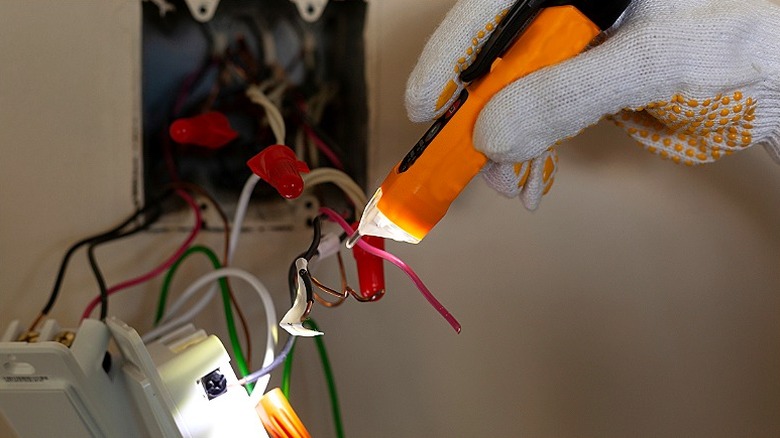
For practical purposes, here's one place where a red wire is probably already at work in your home, even if you've never noticed it. If you have a light that you can turn on from two different switches, for example one at the bottom of the steps and another at the top of the steps, this convenience comes from something called a three-way switch. On this switch the red wire is the one making it possible, which is why it's also referred to as the "traveler" wire, because it's carrying that signal between the two switches.
Let's say you need to replace the wall switch because the old one has turned yellow and has visible cracks. If you see a red wire when you remove your cover, note that this is the wire responsible for the light knowing which switch you used. And since it's still carrying a live current, it's not one to handle carelessly. So before you touch anything, first turn off your electrical panel breaker. Then, as an extra safety measure, use a voltage tester to double check that there's no current flowing through the wire before you start the electrical work.
For example, you can use an easy-to-use tester, like the Klein Tools NCVT-1 (around $17 on Amazon). It's worth keeping one of these on-hand, so you're never guessing whether a wire is live before you touch it. The truth is that you don't need to have an electrician certification to make small updates around your home. However, when doing so, having a basic understanding of electrical components and their functions, like knowing the red wire's job, will help you stay safe.