

Traditional Landscape Fabric Could Doom Your French Drain — And It Makes Sense
We may receive a commission on purchases made from links.
They say close only counts in horseshoes and cornhole, and unfortunately, when you're a DIYer, you often find out the hard way just how true this is. While it might seem like whatever extension cord you have handy is fine for running an air compressor or any screw will work for an outdoor project, the truth is that "close enough" sometimes spells disaster. For a French drain project, that's exactly what happens when you choose traditional landscape fabric instead of a non-woven geotextile that's designed to let water through while keeping soil out. With the tightly woven landscape fabric, which is made to block weeds, what you get instead of a French drain is a hydraulic plug that keeps water out altogether, rendering your drain useless.
No matter what type of soil you have, woven landscape fabric can doom your French drain because its pores are too tight to let water pass through without trapping fine dirt particles. As water tries to drain through landscape fabric, it carries tiny particles of dirt with it, and those particles get caught on the fabric wherever the water is trying to enter. The more they build up, the less water can get through, which is how you end up with a hydraulic plug. With a French drain, which is designed to handle significant amounts of underground water pressure, this effectively turns your drainage system into a barrier.
How to choose the right fabric and method for French drains
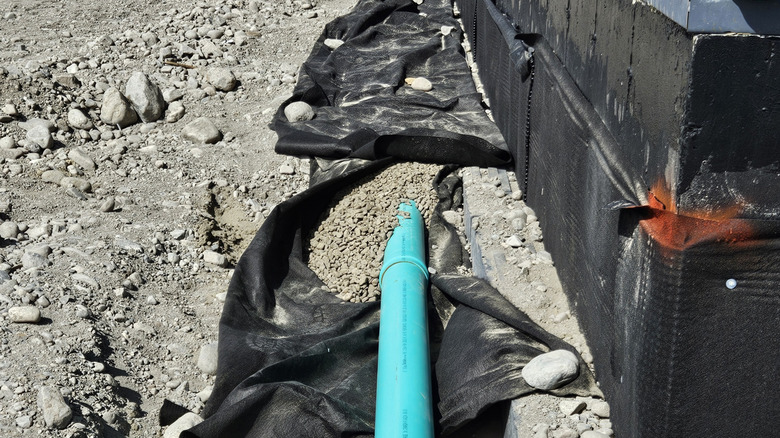
Although there's often confusion between what type of landscape fabric or geotextile materials to use — or whether an alternative solution means no fabric at all – for a French drain, the answer is clear. It's the same basic approach that many of us have seen road crews use. They build French drains with DOT-certified geotextiles made with polypropylene fibers. These types of fabric are not woven. Instead, they're needle-punched, allowing water and fine particles to move through while keeping larger soil particles in place.
This type of fabric solution is ideal for a French drain when you wrap the entire trench, including the pipe and drainage rock, like a burrito. It promotes better water flow, helping reduce sediment buildup while allowing the drain to handle heavy rain or spring snowmelt.
Geotextiles are rated by weight, with heavier fabrics offering more durability. For most residential French drains, you can use either the 4-ounce or a heavier duty 6-ounce fabric. A product like Sandbaggy's Non Woven 4 oz. Geotextile Fabric is ideal for residential use. Best of all, this fabric can do double duty, since non-woven geotextile also works beneath mulch, even though woven landscape fabric isn't suitable for drainage projects. According to the manufacturer, this 4-ounce material can handle up to 140 gallons of water per minute per square foot, providing excellent drainage for most residential applications.
More handy tips for building a French drain that lasts
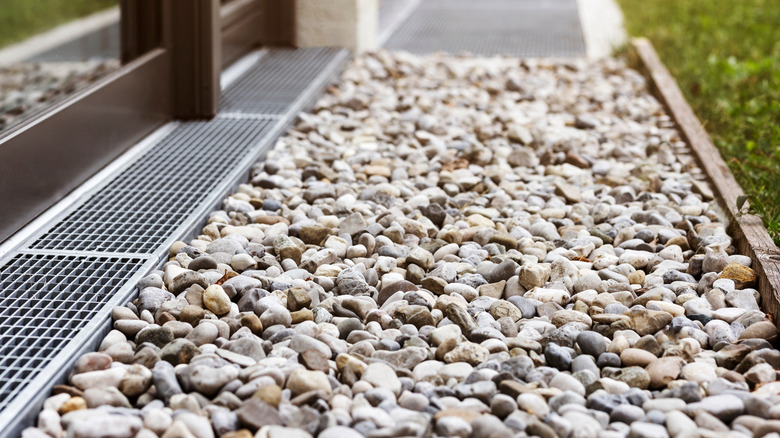
A properly installed French drain can last up to a few decades, but with the wrong materials and installation, it might fail within the first year. And although fabric is important for the reasons we discussed, it's not the only deciding factor. The materials that work well with non-woven geotextile fabric are washed round stones and a perforated collection pipe with a consistent slope so it drains. Once water flows into the pipe, it can travel faster to its termination point, whether that's a dry well, storm sewer, or rain garden.
Your soil type is another factor to consider. Clay and silt soils, which contain finer particles, generally benefit from fabrics with tighter apparent openings. Sandy soils, with their larger particles, can use more open fabrics while still providing effective filtration. No matter what, though, French drains have a lifespan and will eventually get clogged. In fine soils especially, you'll face an uphill battle since nothing can block the fine particles and still allow water to pass through. A failed French drain typically shows up as ponding water in your yard after it rains. When that happens, the fix could include digging the area up and replacing the French drain. The good news is that if you match your materials to your soil and project type, you may only have to dig this trench once.