

Don't Let This Pretty Pairing Fool You: The Companion Plant For Hostas That Can Lead To Disease

Ever set up two close friends on a blind date, fervently hoping they'll get along and like the same things, only to find they are totally incompatible? It's a little like that with some plants. You love these two picks so much that you want them to be close — after all, they look so good together — but to serve as effective companions, plants must have similar needs.
There are numerous perennial companion plants that thrive next to hostas, but among the listed options, you certainly won't find Mediterranean herbs. These herbs have very different needs from hostas, which means that rosemary (Salvia rosmarinus) is one of the plants you should keep away from your hostas in the garden.
Rosemary and hosta are incompatible in four major areas: sunlight, water, soil (including soil pH), and fertilizer, which is where the disease risk enters the picture. While they might make for a pretty pairing, planting them together will guarantee that at least one plant suffers as a result.
Hosta and rosemary have incompatible needs and should not be planted together
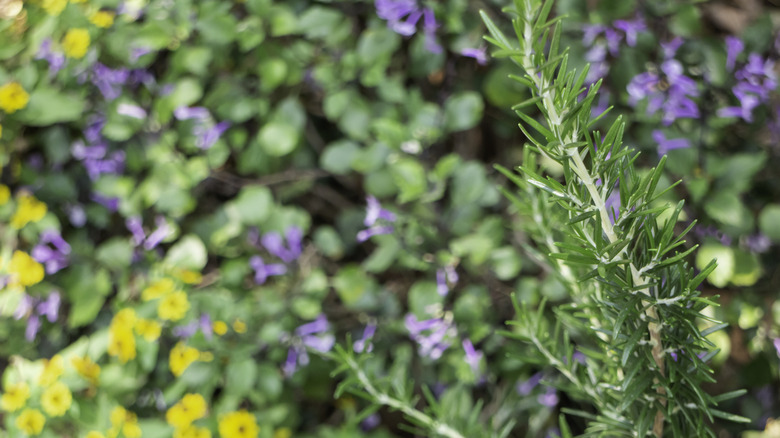
As a Mediterranean herb, rosemary craves full sun and is so intolerant of shade that it may weaken and become leggy in the absence of light. Meanwhile, hosta is a shade plant that tends to not thrive in sunny spots. Changes in foliage, such as bleached-out spots and crispy, brown leaf edges, are the warning signals that hostas are getting too much sun. Rosemary has low water requirements and should not be watered until soil is completely dry. It's also drought tolerant, while hostas should have evenly moist soil. Like most plants, both rosemary and hosta need good drainage, but it's especially critical for rosemary.
Rosemary tolerates a range of soil types, including poor soil, but hosta does well in soil rich in organic matter. Rosemary's soil should be at a neutral to alkaline pH level, while hosta prefers slightly acidic soil. There is some overlap between these two plants' ideal USDA Hardiness Zones — hostas can thrive in Zones 3 through 9, while rosemary is best in Zones 7 through 11 — but that certainly shouldn't be considered an invitation to grow them in the same bed.
Although rosemary is not a greedy consumer of fertilizer, you can use small doses on it, especially to address issues like yellowing leaves. If the rosemary were next to hostas, though, nitrogen could soften hosta leaves, causing stress that makes the plant vulnerable to leaf diseases. Thus, if you habitually fertilize rosemary — and for a myriad of other reasons — you'll want to keep it away from hostas. Add "don't plant next to rosemary" to your list of mistakes to avoid when growing garden favorite hostas, and you'll have a much greater chance of a lush, thriving garden.