

Blue Vs Green Painter's Tape: What's The Difference?
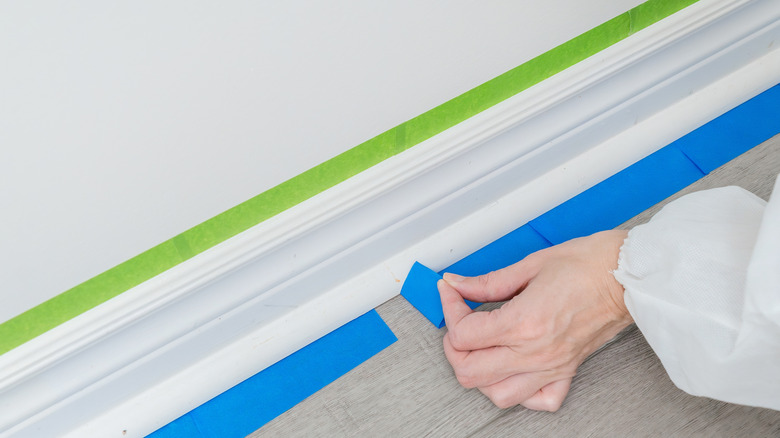
When it comes to achieving a professional-looking paint job at home, the secret isn't just in your brush technique — it's in your prep work. In fact, failing to gather the correct tape and surface-protection gear is one of the top amateur mistakes that can ruin your paint job. While blue painter's tape has long been the undisputed gold standard for everyday indoor DIYs, its green counterpart has rapidly taken over shelves for specialized projects. Knowing the difference between blue and green tape is the ultimate shortcut to avoiding paint bleed and securing flawless results.
To the untrained eye, these colorful rolls look practically identical, save for their vibrant shades. But to regard them as interchangeable utilities is a major mistake. The distinct color coding is actually a visual shorthand for entirely different chemical formulations, each engineered to handle specific project timelines, weather conditions, and wall textures. Before you start slapping adhesive onto your surfaces, it helps to understand the underlying mechanics that separate these two painting staples in order to choose the right kind of painter's tape. Simply put: blue painter's tape is your versatile option for smooth interior surfaces, while green is the high-performance specialist for rough textures, outdoor elements, or pristine accent lines.
Which painter's tape should you choose?
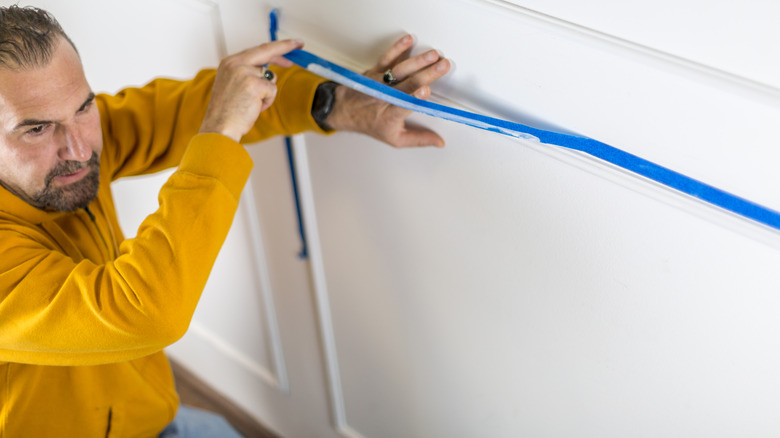
The key differences between these tapes are their adhesion strength and the surfaces where they are best applied, which then determines how well they peel off and prevent bleed to get flawless paint lines. The blue type is a more all-purpose tape with a medium adhesion level, formulated to have enough grip to stay put but still pull away effortlessly. With this version, you can generally leave it on the surface for up to two weeks, and it will still pull away cleanly without damaging the surface underneath. Blue painter's tape is highly versatile and widely available, but it doesn't handle direct sunlight or moisture well. If used for exterior projects, the sun's UV rays can rapidly bake the adhesive into the trim or siding, making it difficult to scrape off, while humidity can cause the edges to curl and lift prematurely.
Green painter's tape, on the other hand, is engineered as a heavy-duty alternative. Its applications can vary a bit more depending on the brand, but it is generally used either for heavy-duty grip on difficult materials or high-performance sharp lines on smooth walls. Green painter's tape typically has a medium-to-high adhesion level and can have either a shorter or longer clean-removal window depending on the brand — some last up to 21 days, while others last less than a week, so it's always best to read the directions before using. Green painter's tape is highly durable and excellent for stubborn or rough surfaces like brick or stucco, but because many heavy-duty versions are much stiffer than blue tape, it can be frustrating to manipulate around tight curves or sharp corners. It also tends to be slightly more expensive than blue tape, but only by about a couple dollars per 60-yard roll.