

Planting Hostas Underneath Trees Is Almost Always A Good Idea — Unless It's This One
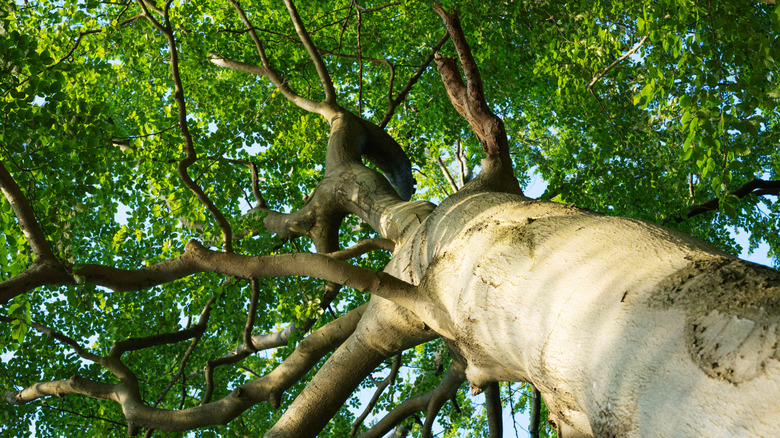
If your hosta plants are failing to grow, their companion tree may well be the problem. Given how many lush groundcover hosta varieties (Hosta spp.) exist, it's not surprising that this shade-loving plant has both a large growing range and a special place in so many gardeners' hearts. After all, hostas, which can grow in USDA Hardiness Zones 3 to 9, can mask a multitude of problem areas, including unsightly tree roots. But not every tree is happy to host the ubiquitous hosta plant — especially the beech tree, with its shallow root system.
Beech trees (Fagus spp.) are infamously inhospitable to underplanting. In fact, beech trees are among the types whose root systems are most easily disturbed by the planting process. And not only can younger beech trees suffer from root disturbance, but they become increasingly competitive with nearby plantings as they grow. Hostas grown under beech trees are likely to wither as they're increasingly deprived of nutrients and water.
Additionally, the tree canopies of mature beeches are so dense that plants are unlikely to survive beneath them, even hostas. Most hostas do best with a bit of dappled sun in the morning. Although blue-leaved hostas may do better with the full shade that a beech tree provides, it doesn't solve the issue of the beech's shallow and competitive roots. A better landscaping option is to simply mulch around the beech tree and save the hostas for other areas in your yard.
Look for other shade trees to host your lovely hostas
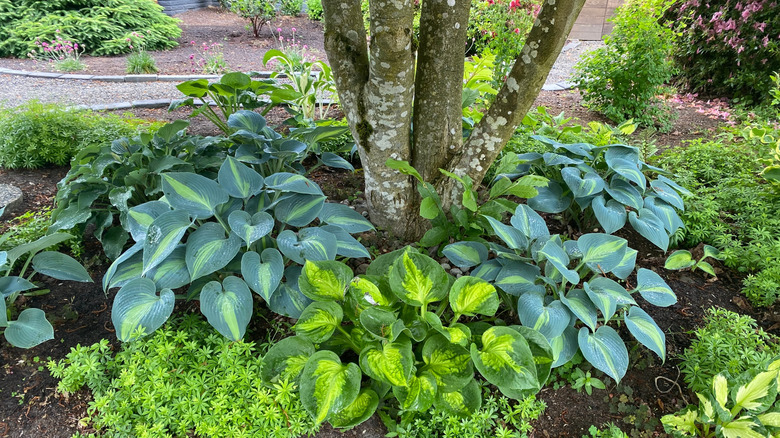
Although hostas and trees usually make a classic pair, choosing the wrong tree is one of the common mistakes to avoid when planting these garden favorites. If you're lucky enough to have a few different shade trees in your yard, one of them may well fit the bill as a nurturing hosta companion.
According to the New England Hosta Society, oak trees (Quercus spp.) are often great choices as hosta hosts. White oak (Quercus alba) and bur oak (Quercus macrocarpa), for example, are recommended for their hosta compatibility, and both have a fairly wide growing range: zones 3 to 8. Other compatible oak species include red oak (Quercus rubra), Chinese cork oak (Quercus variabilis), and konara oak (Quercus serrata). Truly, oak trees and hostas are a classic shade-loving plant combo.
Many maple tree varieties (Acer sp.) are also common shade trees that are compatible with hostas. Japanese maple (Acer palmatum) and painted maple (Acer pictum ssp. mопо) not only make good hosta friends in residential yards, but are found growing with hostas in the wild. Both are perennial in zones 5 to 8. Paperbark maple (Acer griseum), hardy in zones 4 to 8, is another good choice. But avoid Norway maple (Acer platanoides), box elder (Acer negundo), red maple (Acer rubrum), and silver maple (Acer saccharinum). All of these have invasive root systems. The New England Hosta Society also recommends Kousa dogwood trees (Cornus kousa), which are perennial in zones 5 to 8, Japanese chestnut (Castanea crenata) in zones 4 to 8, and katsura tree (Cercidiphyllum japonicum) in zones 4 to 8.