

How Ancient Egyptians Built Perfectly Level Walls (And How To DIY Their Tool In Minutes)
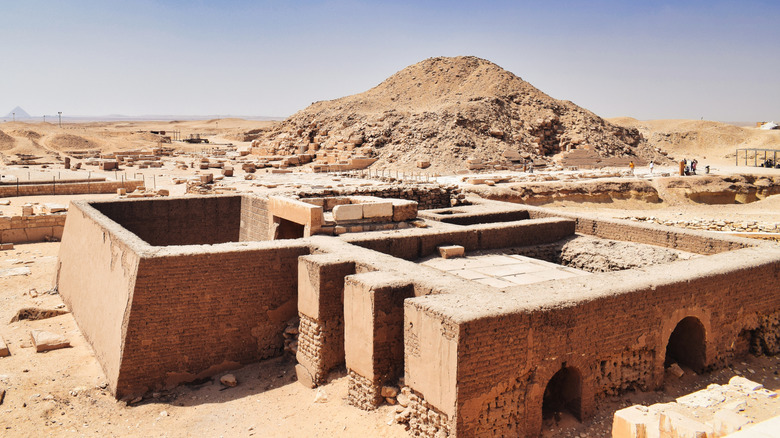
Long before the apple incident that helped Sir Isaac Newton put a name to it, ancient civilizations built enduring structures with a tool that relied on gravity. Paradoxically, this simple contraption helped the Egyptians defy gravity when they built the pyramids. The tool is a plumb bob, and you can make one in no time with string, a speed square, and a small metal object like a nut, key, or fishing sinker. The Egyptians used a sort of A-frame made of wood with a string and a bob hung from its peak. A mark at exactly the halfway point on the horizontal support showed where the string should hit on a perfectly level surface.
Making one with a speed square not only takes a few minutes, but it's also nearly as reliable and easy to use as modern levels. A spirit level is a tool every homeowner should have, but the little glass vials that hold the bubble-bearing liquid can break. If you find yourself in this situation in the middle of a project and don't have time to run to the hardware store for a replacement level, grab those three components instead. You might also simply want to try this to relive a bit of history (without having to build a wooden triangle first). Plumb bobs can even have a leg up over laser levels at times. When the sun is shining brightly on a work space, a laser line may be impossible to see. Plus, a plum bob will never run out of batteries or be damaged by moisture if it's stored in a garage.
Making a plumb bob and working with its limitations
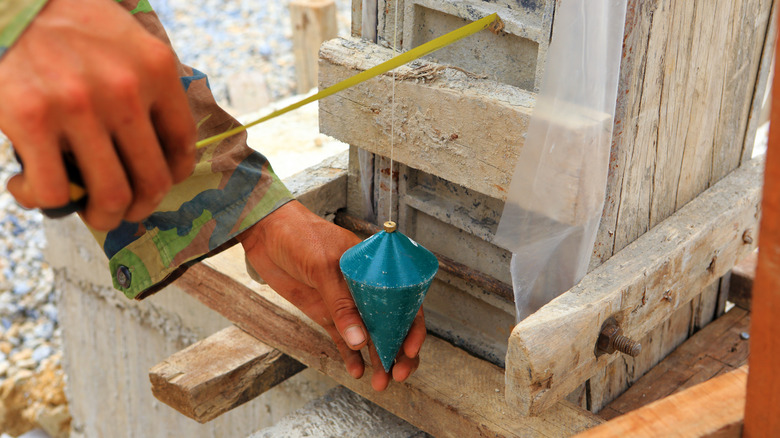
To make your plumb bob, cut a length of string that's about twice as long as the height of the speed square at its peak. Attach your weight at one end and tie the other end around the triangle's peak, adjusting the string's length so that the pendulum hangs about 2 inches below the horizontal section (the hypotenuse), running through the 45-degree mark. When you set the hypotenuse on the surface you want to level, the string should hit that 45-degree mark.
Although plumb bobs are pretty much a surefire way to gauge if something is level, there are reasons why most modern builders and DIYers have moved on to other methods. The ancient builders noticed that the bob and string tended to swing, making it hard to tell whether a surface was level or not. As an early troubleshooting option, stonemasons dangled the bob into a pail of water to slow the swing, but later on, builders discovered that a swinging bob wasn't an issue; they noticed that if the tool was on a level surface, the bob swung to even points on each side of the center mark.
One issue a 21st century plumb bob user can still run into is how certain metals perform as bobs in certain situations. Bobs made of magnetic metal can be affected by pulls from steel or electrical conduit, possibly preventing the line from hanging straight down. Avoid this by using a non-magnetic metal, and a heavy one at that. Among the household items that can be used as a DIY plumb bob, both brass keys and lead fishing sinkers work, since they're not magnetic.